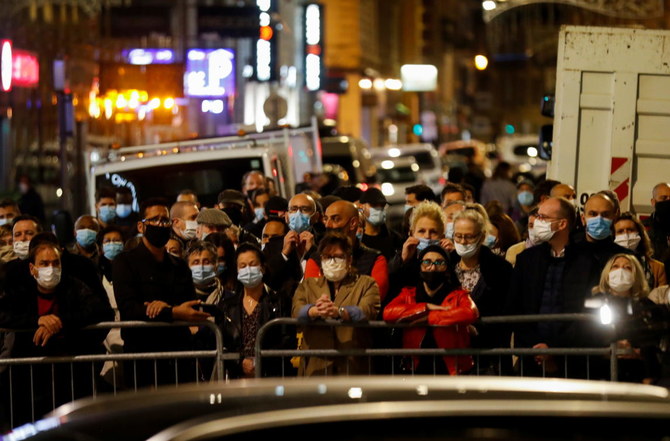
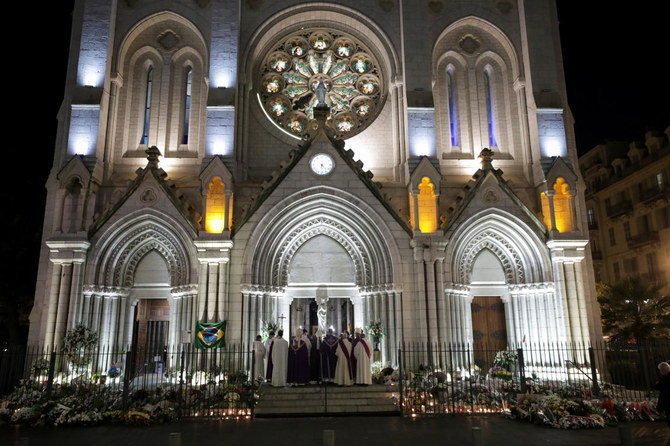
NICE: Shocked local parishioners gathered outside the Notre-Dame catholic church in the southern French city of Nice on Sunday, seeking solace at its first mass in the three days since a knifewielding attacker killed three people inside.
In France’s second deadly knife attack in two weeks with a suspected Islamist motive, an assailant shouting “Allahu Akbar” (God is Greatest) beheaded a woman and killed two other people in the basilica.
Church sexton Vincent Loques was one of the victims, along with devout mother-of-three- Simone Barreto Silva, who moved to France from Brazil as a teenager. A 60-year-old woman, named by church officials as Nadine, was beheaded.
On Sunday evening, several hundred people gathered on the other side of a security perimeter around the church to follow the mass from a distance.
“I was baptised here, took holy communion here... my parents were buried here. It was very important to come out of solidarity,” church regular Michele, 67, said before the mass got underway. “It was a shock... It was a barbaric act.”
The Nice attack followed the beheading of a Paris schoolteacher on Oct. 16 by a Chechen-born man, apparently angered that the teacher had shown cartoons of the Prophet Muhammad to teach a lesson on free speech.
Standing on the steps of the church, which was covered in wreaths and candles, the bishop of Nice, Andre Marceau, paid tribute to the three victims.
“The meaning of this celebration is to speak of... our bewilderment, our sadness, our suffering, our feeling of anger maybe, our struggle to understand,” Marceau said ahead of the mass. “And above all, to give strength to our peacemakers.”
The church is located not far from the seaside promenade, where a suspected Islamist drove a 19-ton truck into a crowd in 2016, killing more than 80 people on Bastille Day.
The people of Nice had suffered enough, said Martine Leroy, a local resident outside the church.
“We form a bloc today, and people need to see this bloc, the whole world needs to see it,” she said. “It all has to stop. We’re here to tell our leaders that we’ve had enough, we want to be able to be at ease walking around in our city.”

French church in Nice hit by deadly attack seeks solace in mass
https://arab.news/npgmf
French church in Nice hit by deadly attack seeks solace in mass
- Parishioners gathered outside the Notre-Dame catholic churchseeking solace
- The Nice attack followed the beheading of a Paris schoolteacher on Oct. 16 by a Chechen-born man
India hosts global leaders, tech moguls at AI Impact Summit
- 20 heads of state scheduled to attend event which runs until Feb. 20
- Summit expected to speed up adoption of AI in India’s governance, expert says
NEW DELHI: A global artificial intelligence summit opened in New Delhi on Monday, with representatives of more than 60 countries scheduled to discuss the use and regulation of AI with the industry’s leaders and investors.
The India AI Impact Summit 2026 is hosted by the Indian government’s IndiaAI Mission — an initiative worth in excess of $1 billion and launched by the Ministry of Electronics and Information Technology in 2024 to develop the AI ecosystem in the country.
After five days of sessions and an accompanying exhibition of 300 companies at Bharat Mandapam — the venue of the 2023 G20 summit — participating leaders are expected to sign a declaration which, according to the organizer, will outline a “shared road map for global AI governance and collaboration.”
Prime Minister Narendra Modi, who will attend the summit on Friday with French President Emmanuel Macron, said on X it was a “matter of great pride for us that people from around the world are coming to India” for the event, which is evidence that the country is “rapidly advancing in the fields of science and technology and is making a significant contribution to global development.”
Among the 20 heads of state that the Indian Ministry of External Affairs has announced as scheduled to attend are Macron, Brazilian President Luiz Inacio Lula da Silva, Spanish Prime Minister Pedro Sanchez, Finnish Prime Minister Petteri Orpo, and Sheikh Khaled bin Mohamed bin Zayed Al-Nahyan, Abu Dhabi’s crown prince.
Also expected are tech moguls such as OpenAI CEO Sam Altman and Google’s chief Sundar Pichai.
The summit will give India, the world’s most populous country, a platform to try to steer cooperation and AI regulation between the West and the Global South, and to present to the global audience its own technological development.
“India is leveraging its position as a bridge between emerging and developed economies to bring together not just country leaders and technologists, but also delegates, policy analysts, media, and others … to explore the facets of AI, multilateral collaborations, and the direction that large-scale development of AI should take,” said Anwesha Sen, assistant program manager for technology and policy at Takshashila Institution.
“India is trying to do three things through the AI Impact Summit. One, India is advocating for sovereign AI and the development of inclusive, population-scale solutions. Two, establishing international collaborations that prioritize AI diffusion in sectors like healthcare and agriculture. And three, showcasing how Indian startups and organizations are using frameworks such as that of digital public infrastructure as a model to bridge the two.”
It is the fourth such gathering dedicated to the development of AI. The first one was held in the UK in 2023, a year after the debut of ChatGPT; the 2024 meeting in South Korea; and last year’s event took place in France.
The summit is likely to help the Indian government in speeding up the adoption of AI, according to Nikhil Pahwa, digital rights activist and founder of MediaNama, a mobile and digital news portal, who likened it to the Digital India initiative launched in 2015 to provide digital government services.
“A summit like this, with this much bandwidth allocated to it by the government, even if the agenda is flat, ends up making AI a priority focus for ministries and state governments,” Pahwa told Arab News.
“It encourages diffusion of AI execution-specific thinking and ends up increasing adoption of AI in governance and by both central and state-level ministries. That reduces time for adoption of AI.
“We saw this play out with the government’s Digital India focus: it increased digitization and the adoption of digital technology. The agenda and India’s role in AI globally is less important than speeding up adoption.”