

Demand issues ‘to overshadow OPEC+ supply next year’

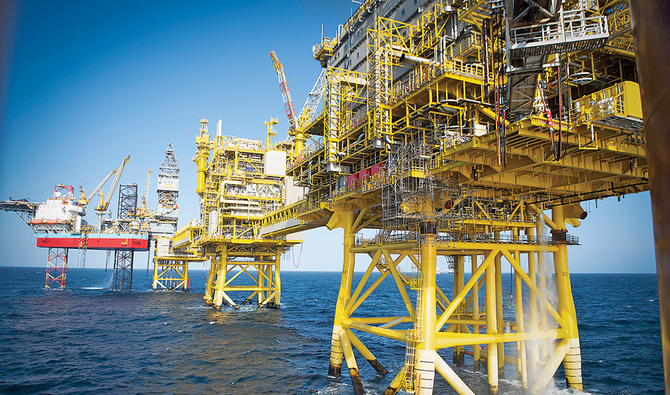
Oil prices fell over on Wednesday as surging coronavirus infections in the US and Europe fueled fears over the unsteady economic recovery. (File/AFP)
Short Url
Updated 29 October 2020
Follow

Demand issues ‘to overshadow OPEC+ supply next year’

  • Libya's rising production adding to pressure on oil markets

DUBAI: The Organization of the Petroleum Exporting Countries (OPEC) and its allies will have to contend with a “lot of demand issues” before raising supply in January 2021, given throughput cuts by oil refiners, the head of Saudi Aramco’s trading arm said.
OPEC and its allies plan to raise production by 2 million barrels per day (bpd) from January after record output cuts this year as the coronavirus pandemic hammered demand, taking overall reductions to about 5.7 million bpd. 

“We see stress in refining margins and see a lot of refineries either cutting their refining capacity to 50-60% or a lot of refineries closing,” Ibrahim Al-Buainain said an interview with Gulf Intelligence released on Wednesday.

“I don’t think the (refining) business is sustainable at these rates (refining margins).”

However, Chinese oil demand is likely to remain solid through the fourth quarter and into 2021 as its economy grows while the rest of the world is in negative territory, he added.

Among the uncertainties facing the oil market are rising Libyan output on the supply side and a second wave of global COVID-19 infections, especially in Europe, on the demand side, Al-Buainain said.

Complicating efforts by other OPEC members and allies to curb output, Libyan production is expected to rebound to 1 million bpd in the coming weeks.

Oil prices, meanwhile, fell over 4 percent on Wednesday as surging coronavirus infections in the US and Europe are leading to renewed lockdowns, fanning fears that the unsteady economic recovery will deteriorate.

“Crude oil is under pressure from the increase in COVID-19 cases, especially in Europe,” said Robert Yawger, director of energy futures at Mizuho in New York.

Brent futures fell $1.91, or 4.6 percent, to $39.29 a barrel, while US West Texas Intermediate crude fell $2.05, or 5.2 percent, to $37.52.

Earlier in the day Brent traded to its lowest since Oct. 2 and WTI its lowest since Oct. 5.

Futures pared losses somewhat after the US Energy Information Administration (EIA) said a bigger-than-expected 4.3 million barrels of crude oil was put into storage last week, but slightly less than industry data late Tuesday which showed a 4.6 million-barrel build.

However, crude production surged to its highest since July at 11.1 million barrels per day in a record weekly build of 1.2 million bpd, the data showed.

Gasoline demand has also been weak overall, down 10 percent from the four-week average a year ago. US consumption is recovering slowly, especially as millions of people restrict leisure travel with cases surging nationwide.


First EU–Saudi roundtable on critical raw materials reflects shared policy commitment

Updated 16 January 2026
Follow

First EU–Saudi roundtable on critical raw materials reflects shared policy commitment

RIYADH: The EU–Saudi Arabia Business and Investment Dialogue on Advancing Critical Raw Materials Value Chains, held in Riyadh as part of the Future Minerals Forum, brought together senior policymakers, industry leaders, and investors to advance strategic cooperation across critical raw materials value chains.

Organized under a Team Europe approach by the EU–GCC Cooperation on Green Transition Project, in coordination with the EU Delegation to Saudi Arabia, the European Chamber of Commerce in the Kingdom and in close cooperation with FMF, the dialogue provided a high-level platform to explore European actions under the EU Critical Raw Materials Act and ResourceEU alongside the Kingdom’s aspirations for minerals, industrial, and investment priorities.

This is in line with Saudi Vision 2030 and broader regional ambitions across the GCC, MENA, and Africa.

ResourceEU is the EU’s new strategic action plan, launched in late 2025, to secure a reliable supply of critical raw materials like lithium, rare earths, and cobalt, reducing dependency on single suppliers, such as China, by boosting domestic extraction, processing, recycling, stockpiling, and strategic partnerships with resource-rich nations.

The first ever EU–Saudi roundtable on critical raw materials was opened by the bloc’s Ambassador to the Kingdom, Christophe Farnaud, together with Saudi Deputy Minister for Mining Development Turki Al-Babtain, turning policy alignment into concrete cooperation.

Farnaud underlined the central role of international cooperation in the implementation of the EU’s critical raw materials policy framework.

“As the European Union advances the implementation of its Critical Raw Materials policy, international cooperation is indispensable to building secure, diversified, and sustainable value chains. Saudi Arabia is a key partner in this effort. This dialogue reflects our shared commitment to translate policy alignment into concrete business and investment cooperation that supports the green and digital transitions,” said the ambassador.

Discussions focused on strengthening resilient, diversified, and responsible CRM supply chains that are essential to the green and digital transitions.

Participants explored concrete opportunities for EU–Saudi cooperation across the full value chain, including exploration, mining, and processing and refining, as well as recycling, downstream manufacturing, and the mobilization of private investment and sustainable finance, underpinned by high environmental, social, and governance standards.

From the Saudi side, the dialogue was framed as a key contribution to the Kingdom’s industrial transformation and long-term economic diversification agenda under Vision 2030, with a strong focus on responsible resource development and global market integration.

“Developing globally competitive mineral hubs and sustainable value chains is a central pillar of Saudi Vision 2030 and the Kingdom’s industrial transformation. Our engagement with the European Union through this dialogue to strengthen upstream and downstream integration, attract high-quality investment, and advance responsible mining and processing. Enhanced cooperation with the EU, capitalizing on the demand dynamics of the EU Critical Raw Materials Act, will be key to delivering long-term value for both sides,” said Al-Babtain.

Valere Moutarlier, deputy director-general for European industry decarbonization, and directorate-general for the internal market, industry, entrepreneurship and SMEs at European Commission, said the EU Critical Raw Materials Act and ResourceEU provided a clear framework to strengthen Europe’s resilience while deepening its cooperation with international partners.

“Cooperation with Saudi Arabia is essential to advancing secure, sustainable, and diversified critical raw materials value chains. Dialogues such as this play a key role in translating policy ambitions into concrete industrial and investment cooperation,” she added.