

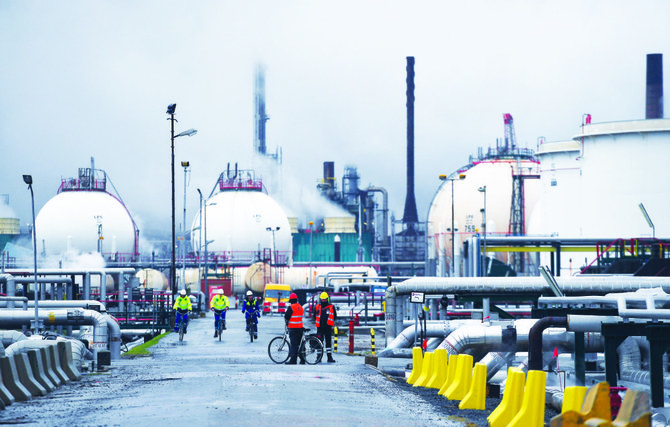
OPEC+ says it will ensure oil prices do not plunge again

The head of OPEC has said that demand for oil is recovering more slowly than expected as an increasing number of countries are reimposing curfews and lockdowns. (AFP)
Short Url
Updated 16 October 2020
Follow

OPEC+ says it will ensure oil prices do not plunge again

  • Secretary general said group would take stock of its policy at the ministerial meeting next month

LONDON: The OPEC+ alliance will ensure oil prices do not plunge steeply again when it meets to set policy at the end of November, OPEC’s secretary general said on Thursday, adding that demand has been recovering more slowly than expected.

“I want to assure you that the OPEC, non-OPEC partnership will continue to do what it knows best, by ensuring that we don’t relapse into this almost historic plunge that we saw,” Mohammad Barkindo said.

Barkindo was answering a question at the Energy Intelligence Forum on whether there was room for a planned increase in oil output from January by OPEC+, a grouping that includes OPEC states, Russia and other allies.

“We have to be realistic that this recovery is not picking up pace at the rate that we expected earlier in the year,” he said. “Demand itself is still looking anaemic.”

A technical OPEC+ committee meeting is taking place on Thursday to discuss compliance with oil cuts and market fundamentals.

The group had 102 percent compliance with its cuts in September, two OPEC+ sources told Reuters.

Countries such as Iraq, Nigeria and the UAE, which had fallen short of their commitments, have been asked to make additional cuts until the end of the year to compensate for the shortfalls.

Barkindo said the compensation scheme was working well.

OPEC+ is due to taper production cuts by 2 million barrels per day (bpd), from 7.7 million bpd currently, in January.

Barkindo said when OPEC+ holds its ministerial meetings on Nov. 30 and Dec. 1 it will take stock of the whole year to inform any decision to stay the course or amend its policy.

On Tuesday, the energy minister from the United Arab Emirates told the same event that OPEC+ will stick to their plans to taper oil production cuts from January.

It comes as some European countries are reviving curfews and lockdowns to try to contain the rise in new coronavirus cases, with Britain expected to impose tougher COVID-19 restrictions on London from midnight on Friday.

A third of France’s population has been placed under nightly curfew to tackle climbing infections.

India, the world’s third biggest oil consumer, is on track to overtake United States with the world’s most COVID-19 infections, and is bracing for a surge of cases in coming weeks as it heads into its main holiday season.

“If demand weakens noticeably, OPEC+ will have no choice but to call off its production increase if it does not want to risk a renewed oversupply and another price slide,” Commerzbank said.


Saudi Arabia’s cultural sector is a new economic engine between Riyadh and Paris, says ambassador

Updated 25 January 2026
Follow

Saudi Arabia’s cultural sector is a new economic engine between Riyadh and Paris, says ambassador

RIYADH: Culture has become a fundamental pillar in bilateral relations between France and Saudi Arabia, according to the French Ambassador to the Kingdom, Patrick Maisonnave.

Maisonnave noted its connection to the entertainment and tourism sectors, which makes it a new engine for economic cooperation between Riyadh and Paris.

He told Al-Eqtisadiah during the opening ceremony of La Fabrique in the Jax district of Diriyah that cultural cooperation with Saudi Arabia is an important element for its attractiveness in the coming decades.

La Fabrique is a space dedicated to artistic creativity and cultural exchange, launched as part of a partnership between the Riyadh Art program and the French Institute in Riyadh. 

Running from Jan. 22 until Feb 14, the initiative will provide an open workspace that allows artists to develop and work on their ideas within a collaborative framework.

Launching La Fabrique as a space dedicated to artistic creativity

The ambassador highlighted that the transformation journey in the Kingdom under Vision 2030 has contributed to the emergence of a new generation of young artists and creators, alongside a growing desire in Saudi society to connect with culture and to embrace what is happening globally. 

He affirmed that the relationship between the two countries is “profound, even cultural par excellence,” with interest from the Saudi side in French culture, matched by increasing interest from the French public and cultural institutions unfolding in the Kingdom.

Latest estimates indicate that the culture-based economy represents about 2.3 percent of France’s gross domestic product, equivalent to more than 90 billion euros ($106.4 billion) in annual revenues, according to government data. The sector directly employs more than 600,000 people, making it one of the largest job-creating sectors in the fields of creativity, publishing, cinema, and visual arts.

Saudi Arabia benefiting from French experience in the cultural field

Maisonnave explained that France possesses established cultural institutions, while Saudi Arabia is building a strong cultural sector, which opens the door for cooperation opportunities.

This comes as an extension of the signing of 10 major cultural agreements a year ago between French and Saudi institutions, aiming to enhance cooperation and transfer French expertise and knowledge to contribute to the development of the cultural system in the Kingdom.

He added that experiences like La Fabrique provide an opportunity to meet the new generation of Saudi creators, who have expressed interest in connecting with French institutions and artists in Paris and France.

La Fabrique encompasses a space for multiple contemporary artistic practices, including performance arts, digital and interactive arts, photography, music, and cinema, while providing the public with an opportunity to witness the stages of producing artistic works and interact with the creative process.