



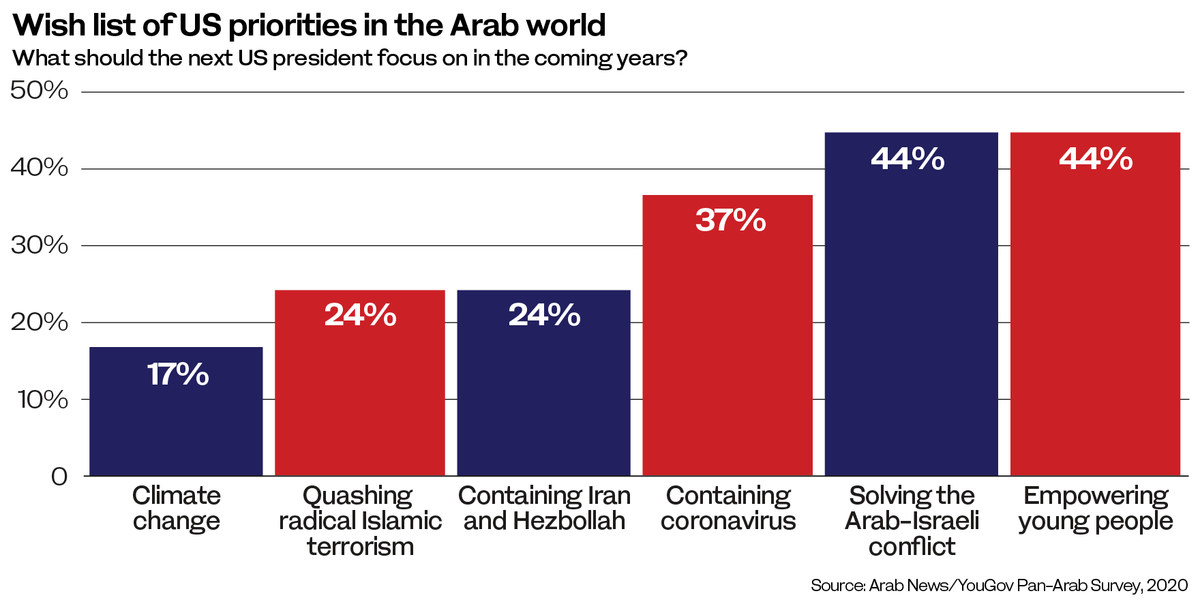
DUBAI: Youth empowerment has long been viewed as a key driver of global development. The new Arab News/YouGov pan-Arab survey shows that the issue is a priority for Arabs. Close to half (44 percent) of the respondents said they would like to see the next US president focus on “empowering young people.”
Baria Alamuddin, an award-winning journalist and political commentator, said a long-term challenge for modern Arab states is developing economies capable of absorbing their growing youth populations.
This is especially true, in her view, of those countries that have failed over the past decade to increase the number of “wealth-creating” jobs in the private sector.
“This challenge is as immediate as ever and is a primary motivator behind Saudi Arabia’s Vision 2030 and equivalent initiatives in many other Arab states,” she said.
Alamuddin believes officials in the next US administration may need convincing of the value of investing in the region’s young people.
“The challenge will be to encourage these officials to prioritize the region from a perspective of economic growth and youth empowerment, rather than just from a narrow security and terrorism approach,” she said.
That youth empowerment is so widely cited as a key Arab priority does not surprise Hussein Shobokshi, a Saudi columnist and businessman, who said it reflected the Arab world’s young demographic.
“Right now the loudest voice in the Arab world on all fronts is the youth. They are controlling the rhetoric, they are establishing the priorities on the economic front, new jobs and the direction of these new jobs, and the topics that are engaging in the media and on social media platforms,” he said.
This “rhetoric or lingua franca” is to a large extent influenced by the US through technology and entertainment, he said, but also through higher education. “We were used to the engagement of the US in the field of investment, the economy, in education,” said Shobokshi, referring to the American universities in Beirut, Cairo, Dubai and Sharjah.
However, he thought that unless the US and its Western allies engage with the Arab world’s youth in more substantial ways, the resulting vacuum could soon be filled by Russia or China — causing a potential headache for US policymakers.

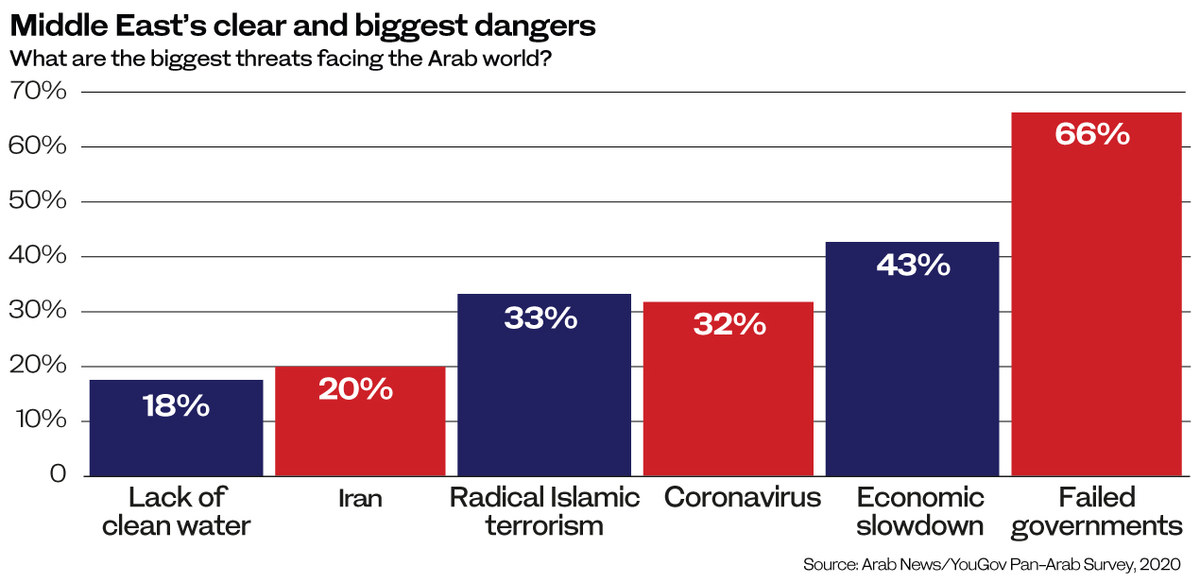
The survey also found that 44 percent of Arabs would like to see the next US president play a greater role in solving the Arab-Israeli problem, while 24 percent said containing Iran and Hezbollah ought to be a priority.
In this context, Alamuddin said a large proportion of the Arab public wants to see a just solution to the Palestinian issue alongside an improved relationship with Israel. “These are two sides of the same coin,” she said. “We are all fed up with a frozen conflict which has gone on for 70 years too long — exacerbated by a fragmented and weak Palestinian leadership, which has long since lost the initiative.”
The world must act together to reach and enforce a solution which does justice to both sides, she said.
READ: The methodology behind the Arab News/YouGov Pan-Arab Survey
“There is no solution without the US, but we are likely to see a more balanced process when Arab states, the Europeans, and even Russia and China play a role in ensuring that all sides come to the table and make the necessary concessions.”
As for Iran, Alamuddin believed the Trump administration’s “maximum pressure” strategy has certainly reined in Iranian ambitions. “Iran has already taken huge bites out of the Arab region, with its proxies in de facto control of much of Syria, Yemen, Iraq and Lebanon,” she said.
Although Democratic challenger Joe Biden appears to recognize that he cannot simply return to the more concessional Obama-era strategy on Iran, it is unclear whether a Biden administration would have the political will to quash Iranian influence in these troubled Arab states.
“The challenge for Gulf states will be to force the threat from Iran to the top of the international agenda,” Alamuddin said.
Shobokshi also acknowledged the important steps taken by the Trump administration against Iran, but said the strategy lacked the required “universality” of including the Europeans, the Russians and the Chinese.
Comparing the differing approaches of the Republican and Democratic parties with regards to the Iranian regime, he said: “One looks at Iran as a serious national threat and the other looks at it in a much tamer fashion.”
-------------
@jumana_khamis


