

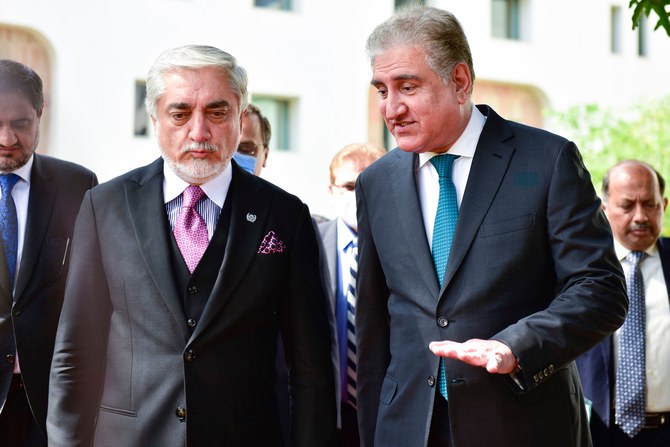

ISLAMABAD: Pakistani foreign minister Shah Mahmood Qureshi reaffirmed Islamabad’s “steadfast support” to ongoing peace talks between the Afghan Taliban and the Kabul government aimed at ending almost two decades of civil war, as chairman of Afghanistan’s High Council for National Reconciliation arrived in Islamabad on a three-day visit.
Abdullah Abdullah has described his visit as a “unique opportunity” to push forward peace talks aimed at ending almost two decades of civil war.
Afghan and Taliban negotiators have been meeting in Doha since September 12 hoping to agree on a cease-fire and a power-sharing deal. Pakistan is considered key in facilitating the talks.
“Reaffirming Pakistan’s steadfast support to the peace process, Foreign Minister Qureshi emphasized that Pakistan had always maintained there is no military solution to the Afghan conflict and encouraged all parties to reach a political solution through an Afghan-led and Afghan-owned process,” the foreign office said in a statement.
“Foreign Minister noted that it was now up to the Afghan leadership to seize this historic opportunity to bring an end to the decades long conflict and secure an inclusive, broad-based and comprehensive political settlement.”
“Foreign Minister Qureshi further underlined that there was a need to guard against the detrimental role of ‘spoilers’, both within and outside Afghanistan, who do not wish to see return of peace in the region,” the statement added.
In a tweet on Monday evening, Abdullah said:
“As always had a constructive meeting with HE @SMQureshiPTI, the Foreign Minister of I.R [Islamic Republic] of Pakistan. We discussed the #PeaceProcess, the intra-Afghan talks in Doha, & strengthening bilateral relations. I would like to thank HE @SMQureshiPTI for his warm welcome & hospitality.”
As always had a constructive meeting with HE @SMQureshiPTI, the Foreign Minister of I.R of Pakistan. We discussed the #PeaceProcess, the intra-Afghan talks in Doha, & strengthening bilateral relations. I would like to thank HE @SMQureshiPTI for his warm welcome & hospitality. pic.twitter.com/sUsChZMs9T
— Dr. Abdullah Abdullah (@DrabdullahCE) September 28, 2020
In a series of tweets on Monday morning, Abdullah had said the visit would “provide a unique opportunity for the two sides to exchange views on Afghanistan peace talks in Doha, & bilateral relations.”
“I hope this visit will open a new chapter of mutual cooperation at all levels, especially on achieving a lasting and dignified peace in AFG [Afghanistan],” he wrote.
Today I am travelling to Islamabad for three days official visit accompanied by a high-level delegation. During this visit I will meet Pakistan's Prime Minister, President, Chairman of the Senate, Speaker of the National Assembly, Foreign Minister & other dignitaries.
— Dr. Abdullah Abdullah (@DrabdullahCE) September 28, 2020
Pakistani foreign minister Shah Mahmood Qureshi welcomed Abdullah at the ministry of foreign affairs on Monday morning and said the Afghan Peace Process was of “paramount importance” for both nations.
“Its success ensures socio-economic prosperity for all,” Qureshi said in a tweet. “@DrabdullahCE’s visit further strengthens the amity & fraternity between our countries.”
It was a pleasure to have welcomed @DrabdullahCE to MoFA. The #AfghanPeaceProcess is of paramount importance for both and & its success ensures socio-economic prosperity for all. @DrabdullahCE’s visit further strengthens the amity & fraternity between our countries. pic.twitter.com/4EXhRuuV2W
— Shah Mahmood Qureshi (@SMQureshiPTI) September 28, 2020
“This is an important visit. Pakistan can do a lot in facilitation of the peace talks,” Mohammad Umer Daudzai, Afghan president Ashraf Ghani’s special envoy for Pakistan, told Arab News from Kabul on Monday. “Pakistan helped the United States in the process, and the Taliban and the US signed the agreement. There are indications that Pakistan wants to help in the peace process.”
A spokesman for Abdullah said the main goal of the trip was to “seek regional cooperation for the strengthening of the peace process, bilateral relations, regional consensus and requesting cooperation and assistance to bear fruit for peace and cease aid for terroristic groups.”
Abdullah’s schedule on Monday includes a meeting with Foreign Minister Qureshi, National Assembly Speaker Asad Qaisar and a key-note address at the Institute of Strategic Studies in Islamabad, a statement by Pakistan’s Foreign Ministry said.
The Afghan leader will also meet with Pakistan’s religious leaders to seek their support for the peace process, Abdul Rahim Qatra, Charge d’affaires of the Afghan embassy in Islamabad, told Arab News on Monday.
“It is widely believed in Afghanistan that Pakistani religious leaders could play an important role in the peace process,” Qatra said. “Dr. Abdullah will seek their support.”


