

A Middle East coronavirus web resource has global resonance

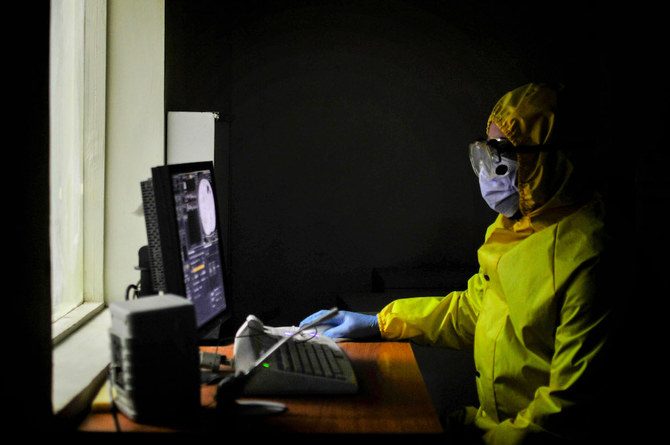
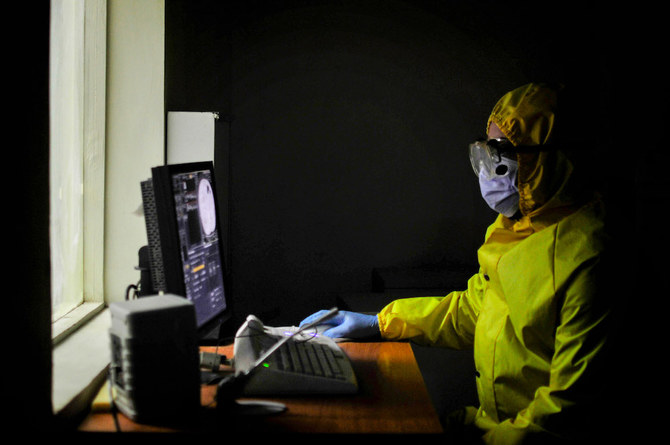
One of the most popular websites for monitoring activity relating to the SARS-CoV-2 coronavirus comes from the Middle East region. (AFP/File Photo)
Short Url
Updated 26 September 2020
Follow

A Middle East coronavirus web resource has global resonance

  • Corona Meter is a free resource that attracts tens of thousands of visitors every day from across the world
  • Building the coronameter.co website took the team of developers a few days from conception to launch

DUBAI: One of the most popular websites for monitoring activity relating to the SARS-CoV-2 coronavirus comes from this very region. Launched in March, coronameter.co is a free resource that attracts tens of thousands of visitors every day, getting traffic from as far afield as Argentina and India.

Using daily data from the renowned Johns Hopkins University in the US, the website displays a vast array of statistics presented for easy comprehension.

Data includes the total number of confirmed cases, mortality rates and infection doubling time in the preceding seven days, all broken down by country. A time-lapse graph shows how the disease initially struck China, Iran and Italy before the US, Brazil and Britain became the worst affected nations.

There is also a globe that enables users to click on any country and see its COVID-19 statistics.

“It all started when the (World Health Organization) classified the coronavirus as a pandemic because, at that point, I knew it was going to be something for the long run. We had this urge to stay on top of it,” said Paris-based entrepreneur Amr Sobhy.



Paris-based entrepreneur Amr Sobhy who founded wesbite Corona Meter. (Supplied)

The 31-year-old talked with his friend and Corona Meter co-creator Mohamed Reda Eldehiry about their approach. Building the website took the team a few days from conception to launch, although the original idea has been expanded steadily, with more data points and graphics added.

“It’s a perpetual work in progress,” Sobhy said. “We wanted to provide something reliable in Arabic. Once we had enough data, we wanted to use (it) to answer the questions we thought were important.

“I wanted to see how the pandemic was developing over time in order to understand the gravity of the situation. Once we had things up and running, I started adding interesting visualizations.”

Initially available in Arabic and English, the website is now also in Russian, Hindi, French, Italian and Spanish.

“It’s an automated data stream although we have to keep on updating the software because inevitably there are bugs due to it not being designed to run on every device,” Sobhy said.

------

READ MORE: Egypt fitness startup eyes new market in coronavirus protective gear

------

As the demands grew, another engineer, Osama Sayed, joined the team to help manage the website.

What sets this product apart from other international ones is that it is accessible in the region. “Once you get the data, the next step is to use it to give people something meaningful,” said Sobhy, who is also the founder and CEO of PushBots, which sold two software-as-a-service (SaaS) products to an Austrian company last year.

IPtrace gives applications users’ geolocation data, while CurrencyStack provides real-time exchange rates for over 150 currencies.

“There are a lot of ways to make digital products, and we from the MENA region can compete globally,” he said. “Code is a building block to solve problems. It’s not an end but a means.”



Corona Meter co-creator Mohamed Reda Eldehiry. (Supplied)

He believes the success of Corona Meter shows that the people of the Middle East can create products and services that will resonate globally.

“What I could see us do more in MENA is to use existing technologies to answer our own questions because otherwise, we’re just hoping that someone else does it for us,” Sobhy said.

“With technology comes the empowerment that we don’t have to wait. We can actually do it ourselves.”

-----------------------

This report is being published by Arab News as a partner of the Middle East Exchange, which was launched by the Mohammed bin Rashid Al Maktoum Global Initiatives to reflect the vision of the UAE prime minister and ruler of Dubai to explore the possibility of changing the status of the Arab region.


Israel to partially reopen Gaza’s Rafah crossing

Updated 01 February 2026
Follow

Israel to partially reopen Gaza’s Rafah crossing

  • Reopening comes amid ongoing violence in the Palestinian territory
  • Gaza’s civil defense agency says dozens killed in Israeli attacks on Saturday

RAFAH, Palestinian Territories: Israel is set to partially reopen the Rafah crossing between the war-devastated Gaza Strip and Egypt on Sunday, following months of urging from humanitarian organizations, though access will be limited to the movement of people.

The reopening comes amid ongoing violence in the Palestinian territory, with Gaza’s civil defense agency reporting dozens killed in Israeli attacks on Saturday, while the Israeli military said it was retaliating against ceasefire violations.

The Rafah crossing is a vital gateway for both civilians and aid, but has remained closed since Israeli forces seized control of it in May 2024 during the war with Hamas, aside from a brief and limited reopening in early 2025.

Israel had previously said it would not reopen the crossing until the remains of Ran Gvili — the last Israeli hostage held in Gaza — were returned.

His remains were recovered days ago and he was laid to rest in Israel on Wednesday.

“The Rafah Crossing will open this coming Sunday (February 1st) in both directions, for limited movement of people only,” COGAT, an Israeli defense ministry body overseeing civil affairs in the occupied Palestinian territories, said on Friday.

Entry and exit “will be permitted in coordination with Egypt, following prior security clearance of individuals by Israel, and under the supervision of the European Union mission,” it added.

However, key details remain unclear, including how many people will be allowed to cross and whether those seeking to return to Gaza will be permitted entry.

A source at the border told AFP that Sunday would be largely devoted to preparations and logistical arrangements.

The crossing is set to open on Sunday on a trial basis to allow the passage of wounded individuals, ahead of a regular reopening scheduled for Monday, three sources at the crossing said.

However, no agreement has yet been reached on the number of Palestinians permitted to enter or exit, the sources added, noting that Egypt plans to admit “all Palestinians whom Israel authorizes to leave” the territory.

“Every day that passes drains my life and worsens my condition,” said Mohammed Shamiya, 33, who suffers from kidney disease and requires dialysis treatment abroad.

“I’m waiting every moment for the opening of the Rafah land crossing.”

Anxious wait

Safa Al-Hawajri, who has received a scholarship to study overseas, is also eagerly awaiting the reopening on Sunday.

“I’m waiting in the hope of fulfilling my ambition, which is tied to the reopening of the crossing,” said Hawajri, 18.

“I hope to be able to travel as soon as it opens.”

Located on Gaza’s southern border with Egypt, Rafah is the only crossing into and out of the territory that does not pass through Israel.

The crossing lies in an area held by Israeli forces following their withdrawal behind the so-called “Yellow Line” under the terms of a US-brokered ceasefire that came into effect on October 10.

Israeli troops still control more than half of Gaza, while the rest remains under Hamas authority.

The ceasefire has now entered its second phase and calls for reopening the crossing following the release or return of all Israeli hostages held by Palestinian militants.

Hamas had called for its full reopening in both directions after the remains of Gvili were brought back to Israel.

The reopening is expected to facilitate the entry of a 15-member Palestinian technocratic body, the National Committee for the Administration of Gaza (NCAG), established to oversee the day-to-day governance of the territory’s 2.2 million residents.

The committee is to operate under the supervision of the so-called “Board of Peace” chaired by US President Donald Trump.

The NCAG, headed by former Palestinian Authority deputy minister Ali Shaath, is expected to enter the Gaza Strip once the Rafah crossing reopens.

Violence continued ahead of the crossing’s reopening.

At least 32 people, including children, were killed on Saturday in Israeli air strikes in Gaza, reported the civil defense agency, which operates as a rescue force under the Hamas authority.

Israel’s military said the strikes were retaliation for an incident on Friday in which eight Palestinian fighters exited a tunnel in the city of Rafah, which it said violated the ceasefire.