ISLAMABAD: Prime Minister Imran Khan on Friday warned the international community against the threat of Islamophobia, criticizing India’s Hindu nationalist government for sponsoring prejudice against Islam and encouraging hatred toward Muslims.
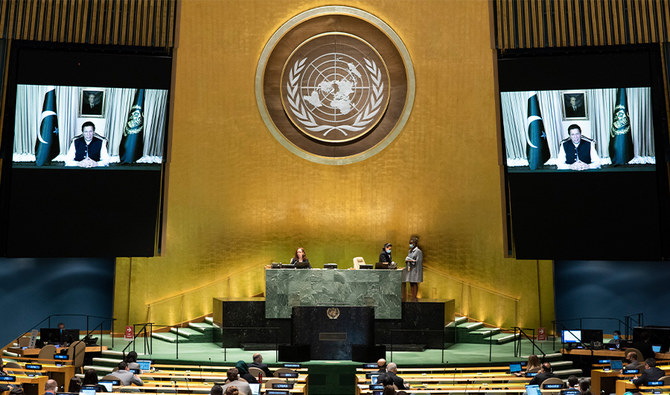
Addressing the 75th session of the United Nations General Assembly, Khan said that the coronavirus pandemic gave the world an opportunity to bring humanity together, but the contagion was used to fan nationalism, increase global tensions, and give rise to racial and religious hatred and violence against vulnerable minorities in several places.
“These trends have also accentuated Islamophobia,” he said, adding that Muslims were continued to be targeted with impunity in many countries.
Calling India “the one country in the world where state sponsors Islamophobia,” the Pakistani prime minister maintained that “willful provocations and incitement to hate and violence must be universally outlawed.”
According to Indian newspapers and television channels, New Delhi’s delegate walked out of the hall as soon as Khan’s statement was broadcast by the world body.
Meanwhile, the Pakistani leader warned India against any aggression in his virtual address, urging the Security Council to play a role to avoid a “disastrous conflict” between the two nuclear-armed neighbors.
The UNGA session this year is unique in a way that world leaders are not attending in person and instead are sending recorded video statements, which would be introduced by the respective country’s envoy, and then played in the assembly’s hall “as live.”
In his wide-ranging address, Khan noted that Pakistan’s foreign policy was aimed to have peace with the neighboring countries, including India, and settle all outstanding disputes through dialogue.
“I want to make it clear that any attempt by the fascist totalitarian RSS-led Indian government to aggress against Pakistan will be met by a nation that will fight for its freedom to the end,” he said.
The prime minister pointed out that there would be no durable peace and stability in South Asia until the Jammu and Kashmir dispute was resolved on the basis of international legitimacy. Kashmir “has been rightly described as a nuclear flash point,” he said.
Both the nuclear-armed neighbors have fought at least three full-fledged wars over the Himalayan Kashmir valley that they claim in full, though they only rule parts of it.
“In order to divert attention from its illegal actions and atrocities in Indian Occupied Jammu and Kashmir, India is playing a dangerous game of upping the military ante against Pakistan in a nuclearized environment,” the prime minister said.
“The government and people of Pakistan are committed to standing by and supporting their Kashmiri brothers and sisters in their legitimate struggle for self-determination,” he said.
Khan noted that Pakistan had exercised “maximum restraint” despite constant Indian provocations and cease-fire violations along the Line of Control and the working boundary, targeting “innocent civilians.”
“We have consistently sensitized the world community about a false flag operation and another ill-conceived misadventure by India,” he said.
Talking about the illicit financial flows from developing countries to rich countries and to offshore tax havens, the prime minister said the practice was leading to the impoverishment of the developing nations.
“Money that could be used toward human development is siphoned off by corrupt elites,” he said, adding that the quest for getting back the stolen resources was nearly impossible, given the cumbersome procedures.
“If this phenomenon is unaddressed, it will continue to accentuate the inequality between the rich and the poor nations, and eventually spark off a far bigger global crisis than the present migration issue poses,” he said.
“The rich states cannot hold forth on human rights and justice when they provide sanctuary to money launderers’ and their looted wealth,” he said while urging the assembly to build a global framework to stem the practice and ensure speedy repatriation of stolen wealth.
The prime minister said the COVID-19 pandemic had hit the developing countries hard and they would need fiscal space to recover from the crisis.
About Afghanistan, he said that Pakistan fully facilitated the process that culminated in the US-Taliban Peace Agreement on 29 February 2020.
“Pakistan is deeply gratified that it has fulfilled its part of the responsibility,” he said.
The prime minister also described Palestine as a “festering wound,” adding that Pakistan would continue to support a two-state solution with pre-1967 borders, and Al-Quds Al-Sharif as the capital of a united, contiguous and independent Palestinian state.


![]()

Indian delegate walks out as Pakistani PM accuses New Delhi of 'sponsoring' Islamophobia
Short Url
https://arab.news/mvq34
Indian delegate walks out as Pakistani PM accuses New Delhi of 'sponsoring' Islamophobia
- The Pakistani prime minister warns India against any aggression, urges Security Council to prevent ‘disastrous’ conflict
- Khan says the illicit financial flows from developing nations to rich economies detrimental to the developing world
Latest updates


© 2026 SAUDI RESEARCH & PUBLISHING COMPANY, All Rights Reserved And subject to Terms of Use Agreement.