The seductive new Ghost — a Rolls-Royce for the pandemic era

1 / 2
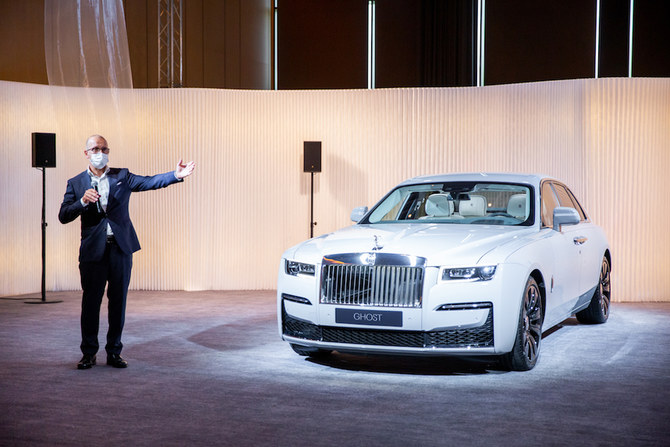
A Rolls-Royce for the COVID-19 era might be an incongruous idea, but that is what the luxury car maker has made with its new Ghost, writes Frank Kane. (Supplied)
2 / 2
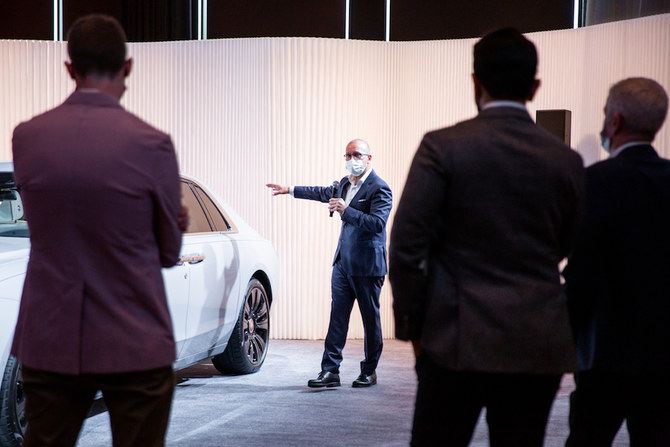
A Rolls-Royce for the COVID-19 era might be an incongruous idea, but that is what the luxury car maker has made with its new Ghost, writes Frank Kane. (Supplied)
Short Url
Updated 24 September 2020
Follow

The seductive new Ghost — a Rolls-Royce for the pandemic era

  • The revamped model was officially launched in the Middle East at a glitzy ceremony in Caesars Palace hotel in Dubai this week

DUBAI: A Rolls-Royce for the COVID-19 era might be an incongruous idea, but that is what the luxury car maker has made with its new Ghost.

Not that the elite motor marque has gone anywhere near austerity in the new car, which was officially launched in the Middle East at a glitzy ceremony in Caesars Palace hotel in Dubai this week.

All the features that have made Rolls-Royce a by-word for iconic luxury are still there, and more: Deep pile carpet made from finest British wool; enough technology — much of it from the hi-tech heartland of Rolls’ German owner BMW — to launch a Mars mission; and a price tag of around 1.8 million Emirati dirhams ($490,000) that will buy you the bare minimum of customization.

But, in the words of Rolls-Royce global CEO Torsten Muller-Otvos, this version of the Ghost is in tune with the era of “post opulence.”

******

READ MORE: Rolls-Royce Phantom VIII review: The car of kings and presidents

******

Apparently, Rolls’ owners wanted something that “didn’t shout, but rather whisper.”

The car that was unveiled at Caesars Palace did not so much whisper, as entice. “Come and drive me,” it seemed to be saying, in a seductive voice.

As ever with Rolls, the car looks a knockout, and you could spend a long time admiring its minimalist lines, but any red-blooded driver simply wants to get behind that wheel on an open road.

What a thrill that will be when the Rolls cognoscenti get their pre-ordered deliveries in the next couple of months. The 6.7-liter twin-turbo V-12 engine has so much power that drivers will appreciate the close control of four-wheel-drive and steering that comes as standard, as well as improved suspension. The “magic carpet” ride promises to be even smoother.

The whole car has been re-engineered from the previous Ghost, which was one of the best-selling cars in Rolls’ illustrious 120-year history, and it has some eye-catching refinements. Doors open from the inside at the touch of a button, and the “spirit of ecstasy” now slips back into the bonnet when you want, rather than into the radiator grill.

The “pantheon” grill itself can be backlit for those occasions when you might want to let other rear-view motorists know you are driving the best car on the road.

Cesar Habib, the head of the Rolls business in the Middle East, quoted founder Henry Rolls: “Small things make perfection, but perfection is not a small thing.”

The launch of a new Rolls-Royce is no small thing either. The huge number of enthusiasts in Saudi Arabia will get their chance to sample the new Ghost next month.


‘One in a Million’: Syrian refugee tale wows Sundance

Updated 24 January 2026
Follow

‘One in a Million’: Syrian refugee tale wows Sundance

PARK CITY: As a million Syrians fled their country's devastating civil war in 2015, directors Itab Azzam and Jack MacInnes headed to Turkey where they would meet a young girl who encapsulated the contradictions of this enormous migration.

In Ismir, they met Isra'a, a then-11-year-old girl whose family had left Aleppo as bombs rained down on the city, and who would become the subject of their documentary "One In A Million," which premiered at the Sundance Film Festival on Friday.

For the next ten years, they followed her and her family's travels through Europe, towards Germany and a new life, where the opportunities and the challenges would almost tear her family apart.

The film is by directors Itab Azzam and Jack MacInnes. (Supplied)

There was "something about Isra'a that sort of felt to us like it encapsulated everything about what was happening there," MacInnes told an audience at the Sundance Film Festival in Park City, Utah on Friday.

"The obvious vulnerability of her situation, especially as being a child going through this, but that at the same time, she was an agent.

"She wasn't sitting back, waiting for other people to save her. She was trying to fight, make her own way there."

The documentary mixes fly-on-the-wall footage with sit-down interviews that reveal Isra'a's changing relationship with Germany, with her religion, and with her father.

It is this evolution between father and daughter that provides the emotional backbone to the film, and through which tensions play out over their new-found freedoms in Europe -- something her father struggles to adjust to.

Isra'a, who by the end of the film is a married mother living in Germany, said watching her life on film in the Park City theatre was "beautiful."

And having documentarists follow her every step of the way as she grew had its upsides.

"I felt like this was something very special," she told the audience after the screening. "My friends thought I was famous; it made making friends easier and faster."