

Forgive and forget: Victims plead for Afghan peace

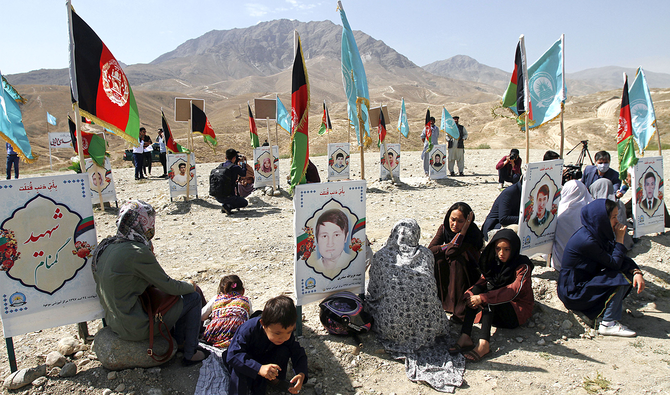
Families gather at the graves of their relatives killed in local conflicts, adorned with their pictures, on the outskirts of Kabul on Monday. (AP)
Short Url
Updated 17 September 2020
Follow

Forgive and forget: Victims plead for Afghan peace

  • ‘Civilian voices should be heard’ in Doha talks, campaigners say

DHAKA: With anguish in his voice, Baz Mohammad Timoory recalls the night when 13 of his family members, including his mother, were killed in an air raid on the outskirts of Afghanistan’s northern Kunduz province.

It has been a year and a half since the attack, but the 30-year-old laborer still does not know if the strike was conducted by the Afghan government or US-led troops stationed in the country.

“It’s not easy to see the deaths of your brother, nephews, nieces, mother and sisters,” he told Arab News from Kunduz, a lush agrarian province which lies 340 km north of Kabul. But with the government and Taliban negotiators holding talks in Doha to end decades of conflict in the war-ravaged country, Timoory said he is ready to “forgive and forget the past.”

He added: “I am not after taking revenge. I want the two sides to find a solution for bringing peace to Afghanistan.”

Timoory is not the only person who shares that sentiment.

According to a UN report released in February, 100,000 Afghans have died in the conflict since 2009.

The global body conceded that the number could be much higher if it included civilian deaths from previous conflicts.

“We want an end to the war in the country, so others live in security, harmony and no more children become orphans and mothers widows,” said Bashir Ahmad.

He is the eldest son of police officer Nasir Ahmad, who was killed in a Taliban attack three weeks ago, his family said.

The Ahmads are part of a group of victims and survivors who said they are ready to “forgive” the Taliban, provided they “choose the path of peace.”

Others have urged the “restoration of justice” and punishment for Taliban members.

“Victims of war warn that without a proper mechanism to address widespread past violations, in the best scenario, we will have a fragile peace. At worst, the conflict will resume after a brief pause,” said a statement by the group.

The statement, addressed to both sides in the Doha talks, was released in Kabul last week ahead of the negotiations which began on Saturday behind closed doors.

The talks are expected to be long and complicated as the two sides struggle to end the fighting and protect the rights of women and minorities. There are 42 negotiators from both teams, including five women on the Kabul government’s side, but there is no one representing the victims’ families.

When questioned on their exclusion from the talks, Fawzia Koofi, a female government negotiator, said: “It is not clear if the team will remain the same until the end of the talks or change. With time, there might be additions and changes.”

The long-awaited talks are based on an agreement signed between the US and the Taliban in February this year in Qatar, where the Taliban have had their political office since 2013.

Initially scheduled to take place on March 10, the intra-Afghan talks faced several rounds of delays, mainly due to a hold up in the release of about 5,000 Taliban prisoners in exchange for government hostages held by the militant group.

Afghan President Ashraf Ghani was slow to release the remaining 320 Taliban prisoners who were accused of serious crimes by several countries, including France and Australia.

Meanwhile, there are accusations that government and US-led operations against the Taliban led to civilian deaths.

Human rights campaigners have called for civilian “voices to be heard” during the Qatar dialogue and said that the ongoing talks and the February accord fail to protect victims’ rights.

Lal Gul Lal, chief of Afghanistan’s Human Rights Organization, a body funded by donors, said: “About 600,000 civilians have been killed in the past 19 years.

“Failure to address past atrocities, killings and to restore justice has been one of the main reasons for the continuation of the crisis and failure of past peace deals in Afghanistan,” he said, in reference to the former Soviet Union’s withdrawal from Afghanistan in the 1980s. Subsequent peace deals were prepared, but soon fell apart.

“If we want justice, it is for the sake of peace; both are interdependent. The voices of victims should be heard,” he told Arab News.

In the 2001 Bonn deal, signed after the Taliban was removed from power, there was a push for transitional justice, but “due to foreign and domestic pressures and interests, it was never implemented in Afghanistan,” Lal said.

Sharzad Akbar, chairperson of the government-appointed Independent Human Rights Commission, said victims should be given a platform to address their grievances, and their “suffering should be acknowledged and humanitarian needs addressed during the talks.

“We recognize all civilian victims of conflict, from violence including suicide attacks, air strikes, night raids, roadside bombs and more. This is not only the requirement of international law and good practice, but also a duty of the negotiation teams and a right of victims in Islam,” she said.


Bangladesh votes in world’s first Gen Z-inspired election

Updated 51 min 24 sec ago
Follow

Bangladesh votes in world’s first Gen Z-inspired election

  • Ousted PM Hasina’s Awami League party banned
  • BNP, Jamaat in close race with big economic, geopolitical stakes

DHAKA: For years under former Prime Minister Sheikh Hasina, Bangladesh’s opposition had little presence on the streets during elections, either boycotting polls or being sidelined by mass arrests of senior leaders. ​Now, ahead of Thursday’s vote, the roles have reversed.
Hasina’s Awami League is banned, but many young people who helped oust her government in a 2024 uprising say the upcoming vote will be the Muslim-majority nation’s first competitive election since 2009, when she began a 15-year-rule.
The Bangladesh Nationalist Party (BNP) is widely expected to win, although a coalition led by the Islamist Jamaat-e-Islami is putting up a strong challenge. A new party driven by Gen-Z activists under the age of 30 has aligned with Jamaat after failing to translate its anti-Hasina street mobilization into an electoral base.
BNP chief Tarique Rahman told Reuters his party, which is contesting 292 of the 300 parliamentary seats at stake, was confident of winning “enough to form a government.”

Bangladesh Nationalist Party (BNP) chairman Tarique Rahman speaks during an election campaign rally, ahead of the national election at Pallabi, in Dhaka, Bangladesh, on February 8, 2026. (Reuters)

Analysts say a decisive result in the February 12 vote, instead of a fractured outcome, is vital for restoring ‌stability in the nation of ‌175 million after Hasina’s ouster triggered months of unrest and disrupted major industries, including ‌the garments ⁠sector ​in the ‌world’s second-largest exporter.
The verdict will also affect the roles of rival regional heavyweights China and India in the South Asian nation.
“Opinion polls suggest the BNP has an edge, but we must remember that a significant portion of voters are still undecided,” said Parvez Karim Abbasi, executive director at Dhaka’s Center for Governance Studies.
“Several factors will shape the outcome, including how Generation Z — which makes up about a quarter of the electorate — votes, as their choices will carry considerable weight.”
Across Bangladesh, black-and-white posters and banners bearing the BNP’s “sheaf of paddy” symbol and Jamaat’s “scales” hang from poles and trees and are pasted on roadside walls, alongside those of several independent candidates. Party shacks on street corners, draped in their emblems, blare campaign songs.
It marks a sharp ⁠contrast with past elections, when the Awami League’s “boat” symbol dominated the landscape.
Opinion polls expect the once-banned Jamaat, which had opposed Bangladesh’s India-backed 1971 independence from Pakistan, to have its best electoral ‌performance even if it does not win.

China’s influence increases as India’s wanes
The election verdict ‍will also influence the roles of China and India in Bangladesh ‍in coming years, analysts have said. Beijing has increased its standing in Bangladesh since Hasina was seen as pro-India and fled to ‍New Delhi after her ouster, where she remains.
While New Delhi’s influence is on the wane, the BNP is seen by some analysts as being relatively more in tune with India than the Jamaat.
A Jamaat-led government might tilt closer to Pakistan, a fellow Muslim-majority nation and a long-standing rival of Hindu-majority India, analysts say. Also, Jamaat’s Gen-Z ally has said “New Delhi’s hegemony” in Bangladesh is one of its main concerns and its leaders met Chinese diplomats recently.
Jamaat, which calls ​for a society governed by Islamic principles, has said the party is not inclined toward any country.
BNP’s Rahman has said if his party formed the government it would have friendly relations with any nation that “offers what is suitable for ⁠my people and my country.”
Bangladesh, one of the world’s most densely populated countries with high rates of extreme poverty, has been hit by high inflation, weakening reserves and slowing investment, which has pushed it to seek large-scale external financing since 2022, including billions of dollars from the International Monetary Fund and the World Bank.

Bangladesh Nationalist Party (BNP) chairman Tarique Rahman attends an election campaign rally, ahead of the national election at Pallabi, in Dhaka 

Corruption is the biggest concern among the 128 million voters, followed by inflation, according to a survey by Dhaka-based think tanks Communication & Research Foundation and Bangladesh Election and Public Opinion Studies.
Analysts say Jamaat’s clean image is a factor in its favor, much more than its Islamic leanings.
“Voters report high intention to participate, prioritize corruption and economic concerns over religious or symbolic issues, and express clear expectations for leaders who demonstrate care, competence and accountability,” said the survey.
Nevertheless, BNP’s Rahman, son of former Prime Minister Khaleda Zia, is seen as the frontrunner to lead the next government. But if the Jamaat-led coalition emerges ahead, its chair, Shafiqur Rahman, could be in line for the top job.
Mohammad Rakib, 21, who is set to vote for the first time, said he hoped the next government would allow people to express their views and exercise their franchise freely.
“Everyone ‌was tired of (Hasina’s) Awami League. People couldn’t even vote during national elections. People had no voice,” he said. “I hope the next government, whoever comes into power, will ensure this freedom of expression.”