PARIS/NEW YORK: Students at one of France’s most prestigious universities on Friday called off protests over the Gaza war after street scuffles between pro-Palestinian and pro-Israeli groups.
Administrators at the Institute of Political Studies, or Sciences Po, university in Paris acted to douse mounting tensions at the Paris establishment as demonstrations spread across American universities over the impact of the Gaza war.
Pro-Palestinian students have staged several days of sit-ins and protests at the 150-year-old university. Some blocked entrances to the university and tents were set up at the central courtyard for a protest camp.
Hundreds of students turned out Friday and police moved in when about 50 pro-Israeli demonstrators arrived shouting and scuffles started.
With exams scheduled to start soon, the university said the pro-Palestinian students had agreed to call off their action in return for an “internal debate” about the university’s ties to Israel.
University authorities also agreed to drop all disciplinary proceedings against demonstrators, said a note sent to students and faculty by Jean Basseres, Sciences Po’s administrator.
Science Po has a joint degree program with New York’s Columbia University and several French students are taking part in protests at one of the US institutions most radicalized by protests.

Pro-Israeli counter-protesters arrive at the Sciences Po University on April 26, 2024, to confront supporters of Gaza Palestinians amid fighting between Israel and Hamas militants. (Reuters)
By Friday night, the Paris protests had eased and the street outside was calm, according to an AFP reporter on the scene.
Protest leaders, who had demanded a study of Science Po’s partnerships with universities or institutions that support the Israeli government, said they were happy with the promise of an internal debate.
France is home to the world’s largest Jewish population after Israel and the United States, as well as Europe’s biggest Muslim community.
The war in Gaza began with an attack by Palestinian militants Hamas on Israel on October 7 that resulted in the deaths of around 1,170 people, mostly civilians, according to an AFP tally of Israeli official figures.
In retaliation, Israel launched a military offensive that has killed at least 34,305 people in Gaza, mostly women and children, according to the Hamas-run territory’s health ministry.
US campus unrest
In New York, Columbia University students who inspired pro-Palestinian demonstrations across the country said that they reached an impasse with administrators and intend to continue their encampment until their demands are met.
The announcement after two days of exhaustive negotiations came as Columbia’s president faced harsh criticism from faculty and puts more pressure on university officials to find a resolution ahead of graduation ceremonies next month — a problem that campuses from California to Massachusetts are facing.
As the death toll mounts in the war in Gaza and the humanitarian crisis worsens, protesters at universities across the country are demanding that schools cut financial ties to Israel and divest from companies they say are enabling the conflict. Some Jewish students say the protests have veered into antisemitism and made them afraid to set foot on campus.
Student negotiators representing the Columbia encampment said that after meetings Thursday and Friday, the university had not met their primary demand for divestment, although there was progress on a push for more transparent financial disclosures.
“We will not rest until Columbia divests,” said Jonathan Ben-Menachem, a fourth-year doctoral student.
Columbia officials had said earlier that talks were showing progress.
“We have our demands; they have theirs,” university spokesperson Ben Chang said, adding that if the talks fail, Columbia will have to consider other options.

Columbia University students participate in an ongoing pro-Palestinian encampment on their campus following last week's arrest of more than 100 protesters on April 26, 2024 in New York City. (Getty Images/AFP)
Meanwhile, Columbia’s president, Minouche Shafik, faced a significant — but largely symbolic — rebuke from faculty Friday but retained the support of trustees, who have the power to hire or fire the president.
A report by the university senate’s executive committee, which represents faculty, found Shafik and her administration took “many actions and decisions that have harmed Columbia University.” Those included calling in police and allowing students to be arrested without consulting faculty, failing to defend the institution in the face of external pressures, misrepresenting and suspending student protest groups and hiring private investigators.
“The faculty have completely lost confidence in President Shafik’s ability to lead this organization,” said Ege Yumusak, a philosophy lecturer who is part of a faculty team protecting the encampment.
Following the report, the senate passed a resolution that included a task force to monitor how the administration would make corrective changes going forward.
In response, Chang said in the evening that “we are committed to an ongoing dialogue and appreciate the Senate’s constructive engagement in finding a pathway forward.”
Also Friday, student protester Khymani James walked back comments made in an online video in January that recently received new attention. James said in the video that “Zionists don’t deserve to live” and people should be grateful James wasn’t killing them.
“What I said was wrong,” James said in a statement. “Every member of our community deserves to feel safe without qualification.”
Protest organizers said the comments didn’t reflect their values. They declined to describe James’ level of involvement with the demonstration.
Across the country at Arizona State University, protesters pitched tents, including some that police dismantled, and at least one person was handcuffed and taken away.
Police clashed with protesters Thursday at Indiana University, Bloomington, where 34 were arrested; Ohio State University, where about 36 were arrested; and at the University of Connecticut, were one person was arrested.
California State Polytechnic University, Humboldt, has been negotiating with students who have been barricaded inside a campus building since Monday, rebuffing an attempt by the police to clear them out. The campus was shut down at least through the weekend.
On the other end of the state, the University of Southern California canceled its May 10 graduation ceremony a day after more than 90 protesters were arrested on campus. The university said it will still host dozens of commencement events, including all the traditional individual school ceremonies.
Elsewhere in New York, about a dozen protesters spent the night in tents and sleeping bags inside a building at the Fashion Institute of Technology. The institute’s museum, which is in the building where the demonstrators set up camp, was closed Friday.
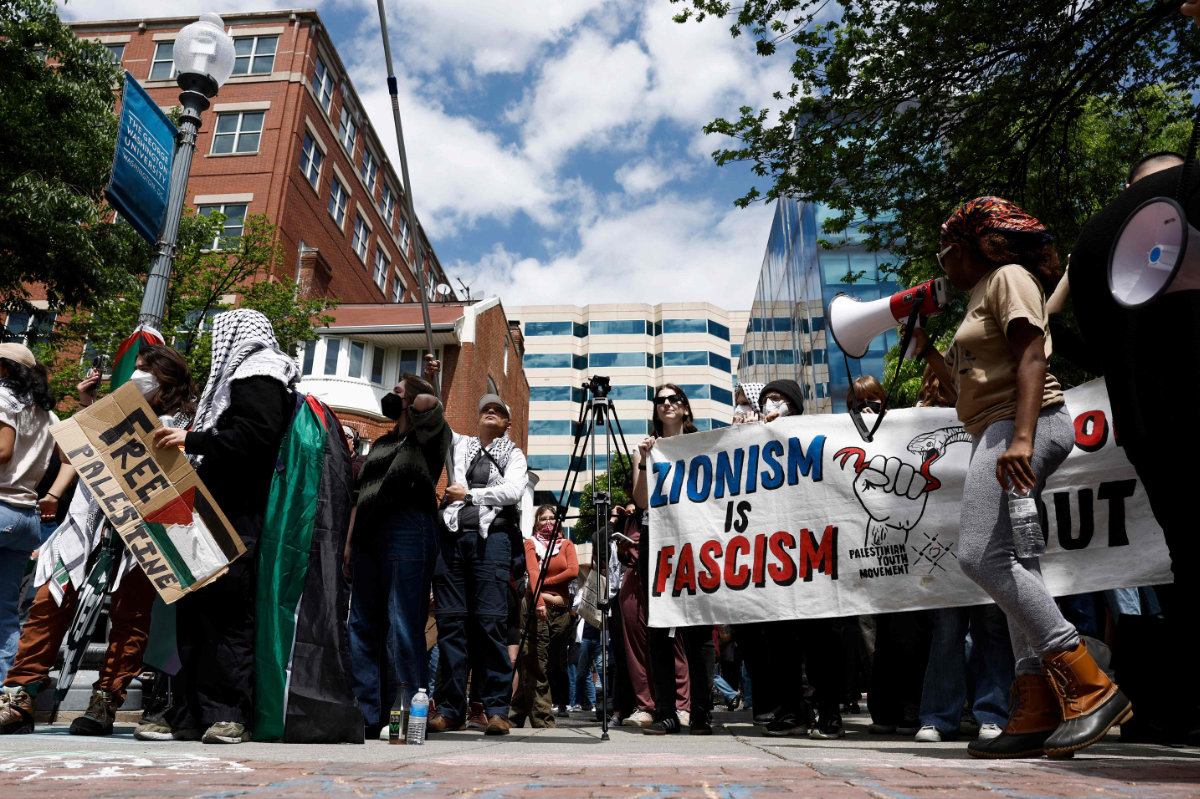
Activists and students demonstrate on the outskirts of an encampment protest at George Washington University on April 26, 2024 in Washington, DC. (Getty Images/AFP)
Protesters also stayed overnight at the encampment at George Washington University. Officials said in a statement that those who remained were trespassing on private property and disciplinary actions would be pursued against students involved in the unauthorized demonstrations.
At Emory University in Atlanta, video that circulated widely on social media showed two women who identified themselves as professors being detained, with one of them slammed to the ground by an officer as a second one pushed her chest and face onto a concrete sidewalk.
University President Gregory Fenves said via email that some videos of clashes were “shocking” and he was “horrified that members of our community had to experience and witness such interactions.”
Fenves blamed the campus unrest on “highly organized, outside protesters” who he said arrived in vans, put up tents and took over the quad. But in an earlier statement, school officials said that 20 of the 28 people arrested were members of the university community.
Since the Israel-Hamas war began, the US Education Department has launched civil rights investigations into dozens of universities and schools in response to complaints of antisemitism or Islamophobia. Among those under investigation are many colleges facing protests, including Harvard and Columbia.