Afghan peace talk negotiators to hold first direct session on Tuesday

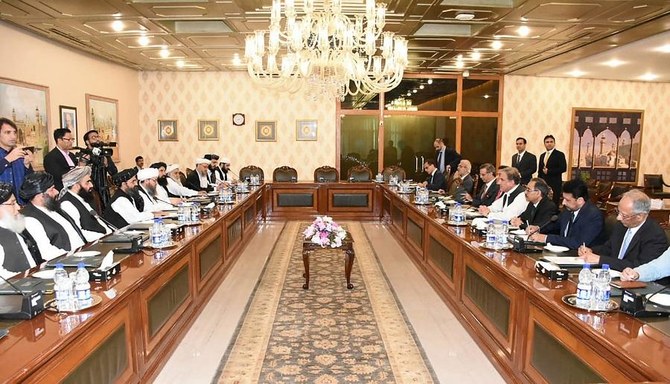
A small group of negotiators from both sides had met in previous days to try to discuss how the substantive negotiations would take place. (File/AFP)
Short Url
Updated 15 September 2020
Follow

Afghan peace talk negotiators to hold first direct session on Tuesday

  • The meeting would be “general” and there were no specific agreed issues on the agenda
  • Violence has continued in the country even after the launch of historic peace talks

KABUL: Afghanistan and Taliban peace talk negotiators will hold their first direct session on Tuesday in Doha, officials said, as the warring sides try to work out an agenda and schedule for how to negotiate a peace deal as the United States withdraws troops.
A small group of negotiators from both sides had met in previous days to try to discuss how the substantive negotiations would take place.
“The contact group from both sides’ delegations continued the discussion on rules and procedures and prepared to present it to the general meeting between the two negotiating teams (taking place on Tuesday),” senior Afghan government negotiator Nader Nadery said.
The Taliban’s political spokesman Muhammad Naeem told Reuters by phone the meeting would be “general” and there were no specific agreed issues on the agenda.
An Afghan presidential palace official said a top priority was getting the Taliban to agree on a cease-fire or significant reduction in violence.
Violence has continued in the country even after the launch of historic peace talks at an opening ceremony in Doha on Saturday.
Talks between the two sides were to begin shortly after a US-Taliban agreement in February, but started only after months of delays, caused in part by continuing Taliban offensives in the war-torn country as well as disagreement over the release of prisoners.
US President Donald Trump has made ending the war in Afghanistan a key election promise and the United States is set to withdraw all its troops by May 2021, subject to the Taliban meeting certain security guarantees.


North Korean leader Kim watches cruise missile tests with his daughter

A strategic cruise missile test launch conducted on the destroyer Choe Hyon at an undisclosed location in North Korea. (AFP)
Updated 11 March 2026
Follow

North Korean leader Kim watches cruise missile tests with his daughter

  • KCNA said the missiles hit target islands off North Korea’s west coast

SEOUL, South Korea: North Korean leader Kim Jong Un and his teenage daughter observed tests of strategic cruise missiles fired from a warship, state media reported Wednesday, as North Korea threatened responses to US-South Korean military drills.
Images sent by the Korean Central News Agency showed the two in a conference room looking at a screen showing weapons being fired from the Choe Hyon, a year-old naval destroyer.
Kim Jong Un watched the missiles launches via video on Tuesday and underscored the need to maintain “a powerful and reliable nuclear war deterrent,” KCNA reported in a dispatch that did not mention his daughter.
The girl, reportedly named Kim Ju Ae and about 13, has accompanied her father at numerous prominent events including military parades and weapons launches since late 2022. South Korea’s spy agency assessed last month Kim Jong Un was close to designating her as his heir.
KCNA said the missiles hit target islands off North Korea’s west coast. It quoted Kim Jong Un as saying the launches were meant to demonstrate the navy’s strategic offensive posture and get troops familiarized with weapons firings.
Kim Jong Un observed similar cruise missile launches from the Choe Hyon in person last week, but his daughter was not seen at that appearance.
Tuesday’s missile firings came after the start of the springtime US-South Korean military drills that North Korea views as an invasion rehearsal.
On Tuesday, Kim Jong Un’s sister and senior official, Kim Yo Jong, warned the drills reveal again the US and South Korea’s “inveterate repugnancy toward” North Korea. She said North Korea will “convince the enemies of our war deterrence.”
The 11-day Freedom Shield drill that began Monday is largely a computer-simulated command post exercise and will be accompanied by a field training program. North Korea often reacts to the two sets of training with its own weapons tests.