

At least 13 people are killed and an estimated 15,000 displaced by flooding in Kenya

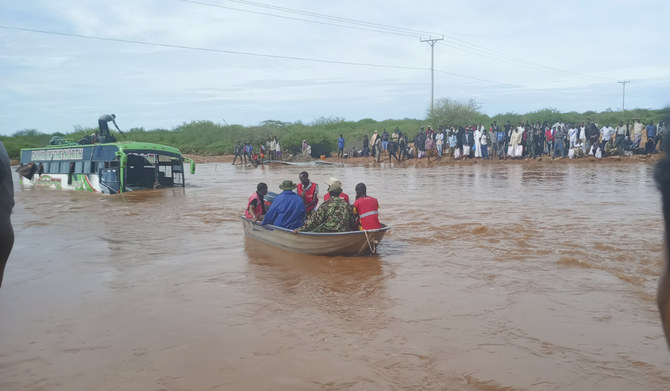
Passengers of a bus that was swept away by floodwaters are rescued by boat, near Garissa, northern Kenya, Tuesday, April 9, 2024. (AP)
Short Url
Updated 13 April 2024
Follow

At least 13 people are killed and an estimated 15,000 displaced by flooding in Kenya

  • Kenya’s disaster management agency issued a flood warning to residents of Lamu, Tana River and Garissa counties that are downstream of Tana River after flooding breached dams upstream

NAIROBI, Kenya: Heavy rains pounding different parts of Kenya have led to the deaths of at least 13 people and displaced some 15,000, the United Nations said, as forecasters warned more rains can be expected until June.
The UN Office for the Coordination of Humanitarian Affairs, citing the Kenya Red Cross Society, said Thursday that nearly 20,000 people have been affected. That includes the estimated 15,000 displaced by heavy rains and flash floods across the country since the start of the wet season in mid-March.
The East African country has seen thousands of people killed by flooding in previous rainy seasons, mostly in the lake regions and downstream of major rivers.
The Kenya Red Cross Society told The Associated Press that five major roads were cut off by the floods, including Garissa Road in northern Kenya, where a bus carrying 51 passengers was swept away on Tuesday. All passengers were rescued.
Kenya’s disaster management agency issued a flood warning to residents of Lamu, Tana River and Garissa counties that are downstream of Tana River after flooding breached dams upstream. Residents have been urged to move to higher grounds.
So far, nine out of 47 counties in the country have reported flooding incidents
Mudslides have been reported in the central regions. On Tuesday four people were killed in Narok county, in the western part of the country.
The Kenya Red Cross Society’s secretary general, Ahmed Idris, told Citizen TV that “lifesaving assistance” including shelter and clean drinking water was being offered to those displaced and are living in camps to avert outbreaks of waterborne diseases.
The rainy season is expected to reach its peak toward the end of April and subside in June, according to the meteorology department.


Treason trial of South Sudan’s suspended VP is further eroding peace deal, UN experts say

Updated 5 sec ago
Follow

Treason trial of South Sudan’s suspended VP is further eroding peace deal, UN experts say

  • The experts said forces from both sides are continuing to confront each other across much of the country
  • “Years of neglect have fragmented government and opposition forces alike,” the experts said

UNITED NATIONS: The treason trial of South Sudan’s suspended vice president is further eroding a 2018 peace agreement he signed with President Salva Kiir, UN experts warned in a new report.
As Riek Machar’s trial is taking place in the capital, Juba, the experts said forces from both sides are continuing to confront each other across much of the country and there is a threat of renewed major conflict.
UN peacekeeping chief Jean-Pierre Lacroix told the UN Security Council last month that the crisis in South Sudan is escalating, “a breaking point” has become visible, and time is running “dangerously short” to bring the peace process back on track.
There were high hopes when oil-rich South Sudan gained independence from Sudan in 2011 after a long conflict, but the country slid into a civil war in December 2013 largely based on ethnic divisions, when forces loyal to Kiir, an ethnic Dinka, battled those loyal to Machar, an ethnic Nuer.
More than 400,000 people were killed in the war, which ended with the 2018 peace agreement that brought Kiir and Machar together in a government of national unity. But implementation has been slow, and a long-delayed presidential election is now scheduled for December 2026.
The panel of UN experts stressed in a report this week that the political and security landscape in South Sudan looks very different today than it did in 2018 and that “the conflict that now threatens looks much different to those that came before.”
“Years of neglect have fragmented government and opposition forces alike,” the experts said, “resulting in a patchwork of uniformed soldiers, defectors and armed community defense groups that are increasingly preoccupied by local struggles and often unenthused by the prospect of a national confrontation. ”
With limited supplies and low morale, South Sudan’s military has relied increasingly on aerial bombings that are “relatively indiscriminate” to disrupt the opposition, the experts said.
In a major escalation of tensions in March, a Nuer militia seized an army garrison. Kiir’s government responded, charging Machar and seven other opposition figures with treason, murder, terrorism and other crimes.
The UN experts said Kiir and his allies insist that, despite having dismissed Machar, implementation of the peace agreement is unaffected, pointing to a faction of the opposition led by Stephen Par Kuol that is still engaged in the peace process.
Those who refused to join Kuol and sided with Machar’s former deputy, Natheniel Oyet, “have largely been removed from their positions, forcing many to flee the country,” the experts said in the report.
The African Union, regional countries and the Intergovernmental Authority on Development, or IGAD, have all called for Machar’s release and stressed their strong support for implementation of the 2018 agreement, the panel said.
According to the latest international assessment, 7.7 million people — 57 percent of the population — face “crisis” levels of food insecurity, with pockets of famine in some communities most affected by renewed fighting, the panel said.