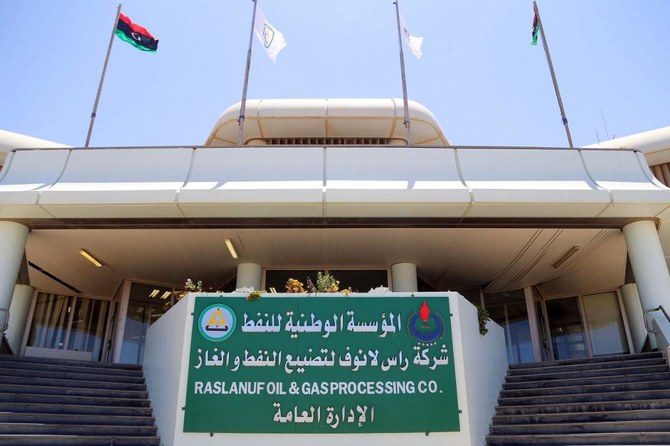
CAIRO: The US Embassy in Libya said Libyan commander Khalifa Haftar agreed to reopen key oil fields and terminals no later than Saturday, a move that could advance talks between the country’s warring sides closer to a political settlement to the yearslong conflict.
Powerful tribes in eastern Libya loyal to Haftar have kept export terminals closed and choked off major pipelines since the start of the year. That move aimed to put pressure on their rivals in the UN-supported government in the capital, Tripoli, in the country’s west.
Oil-rich Libya was plunged into disorder when a NATO-backed uprising in 2011 toppled longtime dictator Muammar Qaddafi, who was later killed. The county has since split between rival east- and west-based administrations, each backed by armed groups and foreign governments.
The US Embassy statement said Haftar’s self-styled Libyan Arab Armed Forces conveyed to the US government “the personal commitment of General Haftar to allow the full reopening of the energy sector no later than Sept. 12.”
By Saturday evening, it was not immediately clear whether the blockade had been lifted. There was no immediate comment from the LAAF, and Haftar’s spokesman did not immediately answer phone calls seeking comment.
The US Embassy said it was encouraged by “an apparent sovereign Libyan agreement” to enable Libya’s National Oil Corporation to resume its “vital and apolitical work.”
The US supports “a financial model that would constitute a credible guarantee that oil and gas revenues would be managed transparently and preserved for the benefit of the Libyan people,” the embassy said, adding: “Credible safeguards will enable all Libyans to have confidence that revenues are not misappropriated.” It did not elaborate.
Haftar in July called for oil revenues to flow into a bank account in a foreign country with a “clear mechanism” to distribute funds fairly among Libya’s regions.
The embassy said it welcomed “what appears to be a Libyan consensus that it is time to reopen the energy sector.” The statement said Libyans are suffering through an acute electricity crisis, rooted in the forced shutdown of oil and gas production.
Libya has the largest oil reserves in Africa and the ninth-biggest known reserves in the world.
The US statement came two days after delegates from Libya’s rival camps, under heavy international pressure, came to a preliminary political agreement. It aims to guide the country toward elections and demilitarize the contested city of Sirte, the gateway to Libya’s major oil fields and export terminals and which is controlled by Haftar. It also came amid protests over dire living conditions across the divided country.
Haftar’s camp has accused the Tripoli-based administration of diverting oil revenues to provide salaries and supplies for Turkish-backed mercenaries fending off Haftar’s campaign to capture the capital.
The eight-month oil blockade has deprived the Tripoli-based oil company of nearly $10 billion in revenue and put the UN-supported government under enormous financial strain.
Haftar’s forces launched an offensive in April last year to try to capture Tripoli. But the offensive quickly stalled, and in recent weeks his forces have fallen back as the Tripoli-allied militias, with Turkish support, gained the upper hand.
Fighting has mostly died down in recent weeks, but both sides were preparing for a possible battle over Sirte. Egypt, which backs Haftar, has threatened to send troops into Libya if Turkey-backed forces attacked the strategic city.


![]()

Libyan commander agrees to lift oil blockade: US embassy
Short Url
https://arab.news/nwb48
Libyan commander agrees to lift oil blockade: US embassy
- Powerful tribes in eastern Libya loyal to Haftar have kept export terminals closed and choked off major pipelines since the start of the year


Latest updates


Recommended


© 2026 SAUDI RESEARCH & PUBLISHING COMPANY, All Rights Reserved And subject to Terms of Use Agreement.