

Erdogan in new threat to Greece in Eastern Mediterranean

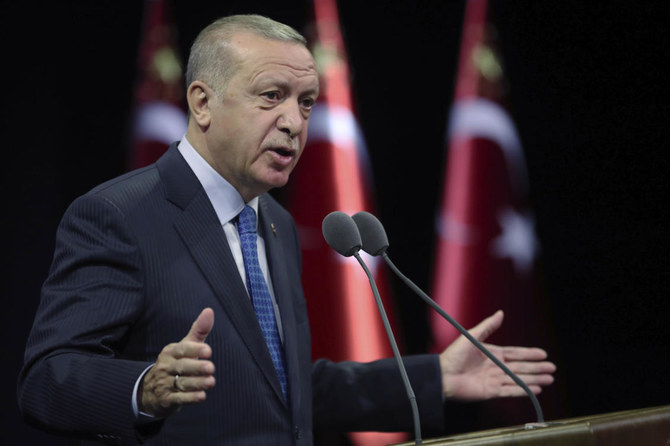
Turkish President Recep Tayyip Erdogan on Saturday warned Greece to enter talks over disputed eastern Mediterranean territorial claims or face the consequences. (AP/File Photo)
Short Url
Updated 06 September 2020
Follow

Erdogan in new threat to Greece in Eastern Mediterranean

  • "Turkish people are ready for every possibility and every consequence", he says
  • The two NATO allies have been locked for weeks in a tense standoff in the eastern Mediterranean

ANKARA: Turkish President Recep Tayyip Erdogan issued new threats to Greece on Saturday as Turkish forces prepared to conduct military exercises in the Eastern Mediterranean amid tension over oil and gas rights.

The temperature has soared in the dispute between the two countries since Turkey deployed a research vessel and an escort of warships last month to disputed waters between Cyprus and the Greek islands of Kastellorizo and Crete. Greece and Cyprus claim the area as their exclusive economic zones.

“They will understand that Turkey has the political, economic and military strength to tear up immoral maps and documents,” Erdogan said on Saturday. “They will either understand the language of politics and diplomacy, or on the field through bitter experiences. Turkey and the Turkish people are ready for every possibility and every consequence.”

Turkish military forces will begin five days of military exercises on Sunday in the breakaway republic of northern Cyprus, which is recognized only by Ankara.

NATO said last week that Greek and Turkish leaders had agreed to take part in technical discussions to avoid accidents between their navies, but Greece said later it had not agreed to the talks.

The crisis has echoes of disputes between Turkey and Greece in 1974, 1987 and 1996, experts told Arab News. “There is clearly a chance for escalation, but these two countries also have a record of limiting the level of violence between them,” said Gallia Lindenstrauss, senior research fellow at the Institute for National Security Studies in Israel.

“It seems that the Greek side is still holding to its past positions and that Turkey is using this crisis for a larger agenda than just the legal dispute.”

Paul Antonopoulos, an expert on Turkish-Greek relations, said technical talks between Greece and Turkey were unlikely to produce results because of disagreements over conditions. 

“As Turkey not only refuses to send its ships back to port, but has actually increased war and invasion rhetoric against Greece, discussions will not occur under these conditions,” he said. Antonopoulos thinks Turkey’s recent moves in the eastern Mediterranean, as well as in Syria, Iraq and Libya, have been motivated by a maximalist push for neo-Ottomanism.

“It is unsurprising that Turkey’s military interventions have all been in countries that are not only former Ottoman territories, but are energy-rich,” he said.

“When we look at Turkey’s military escalations wanting to control energy deposits and its flows to support the country’s growing population and economic progress, dialogue to resolve issues with Greece will not be fruitful.”

The Eastern Mediterranean was also a subject of talks between the UAE and Egyptian Foreign Ministers, Sheikh Abdullah bin Zayed Al-Nahyan and Sameh Shoukry.


Tanks moved toward border

Meanwhile, Turkish media reported that tanks were being moved towards the Greek border. The Cumhuriyet newspaper said 40 tanks were being transported from the Syrian border to Edirne in northwest Turkey and carried photographs of armored vehicles loaded on trucks.

A military official speaking on condition of anonymity in line with government regulations said the deployment was a regular movement of forces and unconnected to tension with Greece.

The president’s comments come after NATO said military officers from Greece and Turkey had begun technical discussions to reduce the risk of armed conflict or accidents.

The two NATO allies have been locked for weeks in a tense standoff in the eastern Mediterranean, where Turkey is prospecting the seabed for energy reserves in an area Greece claims as its own continental shelf.

Ankara says it has every right to prospect there and accuses Athens of trying to grab an unfair share of maritime resources.

Simulated dogfights between Greek and Turkish fighter pilots have multiplied over the Aegean Sea and the eastern Mediterranean. A Turkish and a Greek frigate collided last month, reportedly causing minor damage to the Turkish frigate but no injuries.

Erdogan said Turkey had repeatedly expressed its willingness to come to a just agreement.

“Our word is sincere,” he said. “The problem is those before us disregard our rights and try to situate themselves above us.”

Turkey faces a wide range of opponents in the eastern Mediterranean. France, Italy and the United Arab Emirates have all sent forces to join war games with either Greece or Cyprus in recent weeks. Egypt has signed an energy exploration deal with Athens for the Mediterranean.

The European Union, which counts Greece and Cyprus as members, has also threatened possible sanctions against Ankara over its “illegal” actions.

This week, the U.S. announced it was easing a 33-year-old arms embargo against ethnically divided Cyprus.

The island split in 1974 when Turkey invaded following a coup by supporters of union with Greece. Turkey is the only nation to recognize a Turkish Cypriot declaration of independence and it maintains more than 35,000 troops in northern Cyprus.

The recent crisis is the most serious in Turkish-Greek relations in decades. The neighbors have come to the brink of war three times since the mid-1970s, including once over maritime resources in the Aegean.

Earlier, Ankara announced joint military exercises with northern Cypriot forces from Sunday to Sept. 10. The air, land and sea drills are held every year.


(With AP)


‘Cake not hate’ campaign spreads love amid far-right rhetoric in UK

Updated 6 sec ago
Follow

‘Cake not hate’ campaign spreads love amid far-right rhetoric in UK

  • Joshua Harris, 12, who is autistic, hands out cakes at mosques
  • His father, Dan, tells Arab News they are welcomed by Muslims

LONDON: A 12-year-old boy, who is autistic and non-speaking, is visiting mosques across the country and handing out cakes to promote love and solidarity amid the rise of far-right rhetoric in the UK.

Joshua Harris, or “Joshie-Man” as he is known to his social media fans, has handed out hundreds of his baked treats to congregations in London, Leicester, Luton, Birmingham, and his home city of Peterborough.

The “Cake not hate” campaign came to life after an Islamophobic attack on a mosque in Peterborough in October this year.

The perpetrator, Alexander Hooper, 57, entered Masjid Darassalaam and abused worshipers preparing for the Fajr prayer, and physically assaulted a female police officer who arrived on the scene. Hooper later pleaded guilty to aggravated harassment and assaulting an emergency worker.

Harris’ father, Dan, is the founder of global charity Neurodiversity in Business, and told Arab News that soon after the attack, they both visited the mosque with cakes that Joshie-Man had baked and distributed them to worshipers.

“We gave them to the imam and said we want you to know that this guy (Hooper) doesn’t represent Peterborough nor the great British public,” Harris said.

“So they really warmly received that and then they gave us contact details for the other five or six mosques in Peterborough.”

Harris said he received backlash and threats from far-right individuals after posting videos of Joshie-Man handing out his cakes. And this prompted him to think of how their racism is affecting Muslims.  

“If me as a white middle-class guy in a nice part of the world could get this kind of hate from the far right, how bad must it be for a Muslim, a female Muslim, an immigrant Muslim, or a Muslim who doesn’t have English as their first language?

“They must be incredibly intimidated,” he said.

Harris said the Muslims he met told him that they do not go out at night or let their children walk home from school alone for fear of being attacked. They are scared of abuse if they wear traditional dress or speak a foreign language.

“This is not the Britain I want to bequeath to my child. I don’t want him growing up in a Britain which is really divided and I’ve always been proud of Britain being a really tolerant place which is very respectful,” he said.

Harris and his son also visited a mosque in Luton, the town where far-right activist and anti-Islam campaigner Tommy Robinson grew up.

He said it was “really profound” to meet Muslim children who said they had been attacked and shouted at by racists and Islamophobes.

Harris and his son are due to embark on a northern tour later this month to visit 12 mosques in three days. On Christmas Day, they will help cook meals for people who are lonely or need help at a Peterborough mosque, which will open its doors as a part of an outreach event.

Harris said the Muslims he met have “conducted themselves with a lot of humility and kindness. That message has been lost because the far right are now saying that Islam is something to be feared.”

He added that Joshie-Man loves baking and distributing his cakes: “You only have to look at the video to see how he’s jumping with joy when he goes into these places.”

Harris is no stranger to far-right hate and had previously received abuse after speaking out against groups painting St. George’s cross and Union Jack flags on zebra crossings and roundabouts across the UK over the summer after anti-migrant protests.

“I put a post out on social media around how the far right in the UK need to stop painting over zebra crossings.

“Because there are a number of people in our community, the visually impaired, learning disabled, non-speaking autistic or even the colorblind, who find it harder to use zebra crossings if they have the England flags painted on them.

“Joshie certainly did,” Harris said.

“The post was innocuous but the far right went a bit crazy on me and then started targeting me, calling Joshie a retard, talking about eugenics, and saying that the government is wasting money on his education.”

Harris said the comments were “quite hurtful” and he found it “absolutely abhorrent that Reform UK are targeting disabled children.”

“They are some of the most vulnerable in our society. The far right are going after them and they are whipping up a fury in people who think the disabled kids are here for the perks.

“Families that I’ve met and who live in councils controlled by Reform UK are telling me that since they’ve come to power, their interactions have been all around how do we remove your legally enshrined rights.”

Supporting children with neurodiversity is a cause close to Harris’ heart.

After seeing how using a computer with augmentative and alternative communication software transformed the way his son was able to communicate, Harris has led a campaign that raises money to provide these aids to families who cannot afford them.

He has been to several countries, including Mexico, the US, and Brazil, giving away computers to children who are autistic and non-speaking. The next stop for father and son is Dubai, where they will be giving away 100 computers in January.

“We accept the fact that this is a drop in the ocean given how many kids need them, but if we create a bit of noise and get this on the radar that that’s a big win that people can continue with locally,” he said.

“The Middle East is such an important part of our world and over the next 50 to 100 years, it’s going to be absolutely key. Some of the countries, governments, and royal families have actually got a really forward-looking and innovative outlook on this topic.

“So I felt like this is our first chance to put a footprint in the Middle East and God willing, we will achieve some success in new relationships and go to other countries later on.”