
ISLAMABAD: The International Monetary Fund (IMF) and Pakistan have reached a staff-level agreement on the South Asian nation’s loan programs, the Fund said late Friday, with the development set to unlock $1.2 billion in funding.
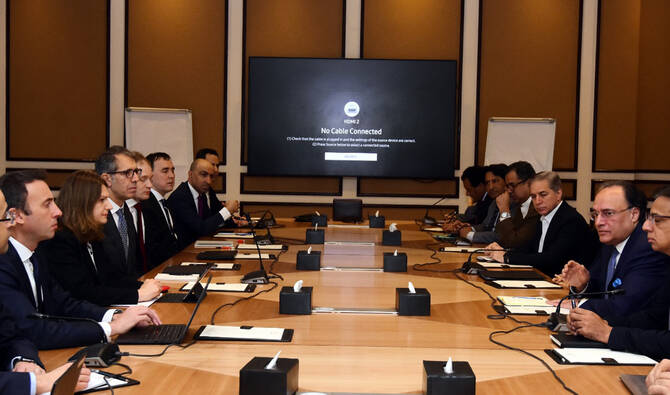
The development follows talks between both sides on the third review of a $7 billion, 37-month Extended Fund Facility (EFF) and for the second review of the $1.4 billion, 28-month Resilience and Sustainability Facility (RSF) from Feb. 25 to Mar. 11.
Both EFF, secured in Sept. 2024, and the RSF, secured in May 2025, are key programs crucial for stabilizing Pakistan’s fragile economy. The lender said the staff-level agreement with Islamabad on both facilities is subject to approval by the IMF Executive Board.
“Upon approval, Pakistan will have access to about $1.0 billion (SDR 760 million) under the EFF and about $210 million (SDR 154 million) under the RSF, bringing total disbursements under the two arrangements to about $4.5 billion,” the IMF said in a statement.
Pakistan’s policies have continued to strengthen the economy and rebuild market confidence, according to the IMF. Following the recovery in fiscal year 2024-25, economic activity gained further momentum in the first part of the current fiscal year.
“Inflation and the current account balance remained contained, and external buffers continued to strengthen,” the lender said.
“The conflict in the Middle East, however, casts a cloud over the outlook as volatile energy prices and tighter global financial conditions risk putting upward pressure on inflation and weigh on growth and the current account.”
Pakistan’s central bank kept its key policy rate unchanged at 10.5 percent this month, pausing its rate cuts as rising global energy prices and regional tensions posed new inflation risks for the import-dependent economy.
“The authorities remain committed to pursuing sound and prudent macroeconomic policies to preserve the recent gains in macro-financial stabilization, while deepening structural reforms to accelerate growth and strengthening social protection to mitigate the impact of volatile energy prices on the most vulnerable,” the IMF added.