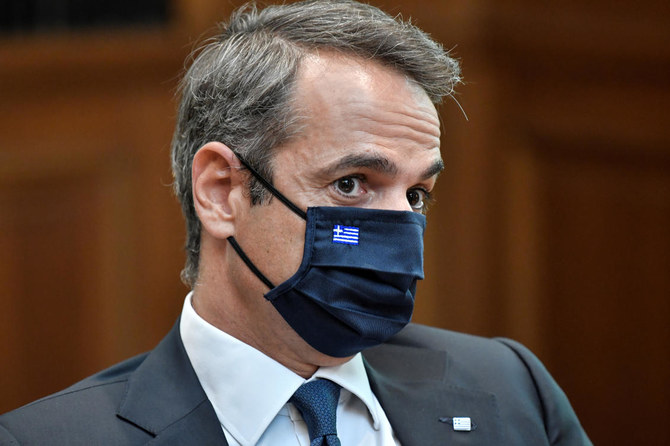
ATHENS: Greek Prime Minister Kyriakos Mitsotakis on Friday told Turkey to stop making “threats” against his country if talks on reducing tension in the eastern Mediterranean over maritime borders and gas exploration are to begin.
“Let threats go away so that the contacts can begin,” Mitsotakis said as he met a visiting senior member of the Chinese Communist party.
Tensions are running high over Turkey’s drilling activities in the eastern Mediterranean which Greece and Cyprus say violate their sovereignty.
Turkey on August 10 deployed the Oruc Reis research vessel and an escorting flotilla of warships to the disputed waters between Cyprus and the Greek islands of Kastellorizo and Crete, and has since prolonged the mission three times.
Greece responded by staging naval exercises with several EU allies and the United Arab Emirates, not far from smaller ones Turkey conducted between Cyprus and Crete last week.
Mitsotakis on Friday said that Greek Foreign Minister Nikos Dendias would later on Friday brief UN Secretary-General Antonio Guterres in New York on Turkey’s “lawless activity.”
Greece denied late Thursday that it had agreed to hold NATO-brokered talks with Turkey to de-escalate tensions over maritime borders and gas exploration rights.
“Published information claiming Greece and Turkey have agreed to hold so-called ‘technical talks’ on de-escalating tensions in the eastern Mediterranean do not correspond to reality,” Greece’s foreign ministry said.
NATO chief Jens Stoltenberg had earlier said the two NATO allies had “agreed to enter into technical talks at NATO to establish mechanisms for military de-confliction to reduce the risk of incidents and accidents in the Eastern Mediterranean.”
Greek government spokesman Stelios Petsas on Friday said Stoltenberg’s initiative “is very far from being termed an agreement to restart dialogue.”
The Greek foreign ministry stressed that “de-escalation will only take place with the immediate withdrawal of all Turkish vessels from the Greek continental shelf.”
Turkish President Recep Tayyip Erdogan has repeatedly lashed out at Greece, and also France, recently calling their respective leaders “greedy and incompetent” for challenging Turkish energy exploration in the eastern Mediterranean.
“When the time comes to fight, we will not hesitate to make sacrifices,” Erdogan told newly-commissioned officers in Ankara on Sunday.
“The question is: when they stand against us in the Mediterranean, are they ready to make the same sacrifices?
“To our enemies, we say: Bring it on!”
France’s support for Greece is brewing a serious crisis for the NATO military alliance.
The European Union has been watching the escalating row with growing concern, repeatedly urging Turkey to stop the exploration activities and threatening to slap sanctions on Ankara if it refused to solve the dispute through dialogue.
EU diplomatic chief Josep Borrell has said that unless Turkey can be engaged in talks, the bloc could develop a list of sanctions at a European Council on September 24 and 25.
Mitsotakis said Turkey was “undermining” international law and “endangering” regional security by seeking to “alter” geography.


![]()

Turkey must drop ‘threats’ for talks to begin: Greek PM
Short Url
https://arab.news/c9pds
Turkey must drop ‘threats’ for talks to begin: Greek PM
- ‘Let threats go away so that the contacts can begin’
- Greece denied late Thursday that it had agreed to hold NATO-brokered talks with Turkey to de-escalate tensions


Latest updates


© 2026 SAUDI RESEARCH & PUBLISHING COMPANY, All Rights Reserved And subject to Terms of Use Agreement.