

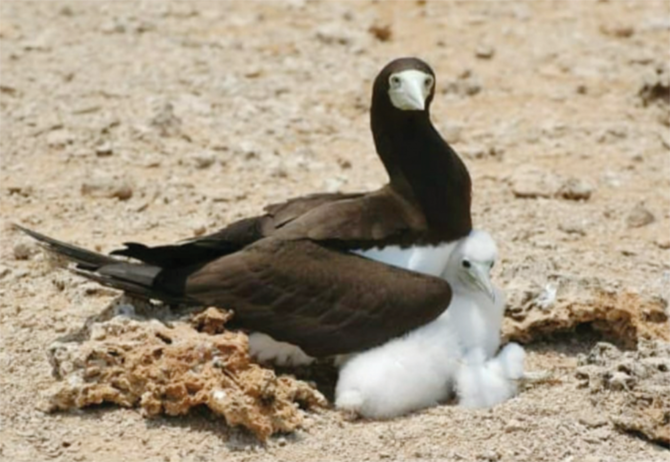
500 million birds migrate through Saudi Arabia every year

1 / 3
International efforts have been intensified to support biodiversity, especially in light of the coronavirus pandemic, in line with the methodology of the Convention on Migratory Birds and the UN Convention on Combating Desertification, according to Saudi observers. (Shutterstock/Supplied)
2 / 3
International efforts have been intensified to support biodiversity, especially in light of the coronavirus pandemic, in line with the methodology of the Convention on Migratory Birds and the UN Convention on Combating Desertification, according to Saudi observers. (Shutterstock/Supplied)
3 / 3
International efforts have been intensified to support biodiversity, especially in light of the coronavirus pandemic, in line with the methodology of the Convention on Migratory Birds and the UN Convention on Combating Desertification, according to Saudi observers. (Shutterstock/Supplied)
Short Url
Updated 04 September 2020
Follow

500 million birds migrate through Saudi Arabia every year

  • Saudi Wildlife Authority adviser: Dangerous risks facing birds include plastic pollution, dredging and illegal trade

MAKKAH: More than 500 million birds representing 500 species migrate across Saudi Arabia every year through the Red Sea, according to an expert in the Kingdom.
Dr. Mohammed Shubrak, a Saudi Wildlife Authority adviser, said that birds migrating from their habitats to other habitats reflected biodiversity, since most species were well-known and classified.
He explained that the route of migratory birds covered the yearly migration from nesting to resting and feeding grounds.
During migration, birds made many physiological adaptations such as increasing their fat percentage, reducing the size of their organs and increasing the size of their feathers. To migrate from one place to another, birds also adopted different behavior according to their size and species.
“Birds have four movements: Flailing, flying, walking and swimming,” Shubrak told Arab News.
“Flailing and flying are two types of movements of the migratory birds to the Kingdom that cannot escape potential hazards. Some birds come to the same place each year for the same foods, like the imperial eagle that has been seen in Saudi Arabia visiting the same places repeatedly.
Eagles provide a free service to humans as they feed on dead animals. According to a study conducted in a reserve in Taif, eagles get rid of 32 percent of dead animals and 3 percent of mammals (foxes and stray dogs) knowing that livestock numbers represent nine times the load capacity of
grassland in the region.”
Migratory birds are an indicator of environmental changes, he said, adding that environmental interdependence was the movement of species without obstacles ensuring the flow and continuity of natural life.

FASTFACT

• There are about 10,966 bird species in the world.

• 1,469 species are threatened with extinction — equivalent to 13 percent — and illegal hunting is one of the reasons behind their declining numbers.

• 5 billion birds migrate between Eurasia and Africa.

“Environmental interdependence also supports the movement of land, sea and air species and benefits in pollinating flowers of birds, insects, and the environmental hydrological cycle.”
Birds are one of the most common animal species as they exist in all regions of the world, from polar to desert.
According to Saudi observers, international efforts have been intensified to support biodiversity, especially in light of the coronavirus pandemic, in line with the methodology of the Convention on Migratory Birds and the UN Convention on Combating Desertification.
Shubrak said that migratory birds played a vital role as they had a major relationship with the world that people lived in, whether in terms of culture, the environment, the economy or tourism.
Some birds resorted to hopping and moving for short distances between tens to thousands of kilometers. There were also species that flew thousands of kilometers without stopping, relying on large quantities of food sources to get them through their journey.
Other birds migrated through narrow routes or straight lines, Shubrak said. “The coastal line toward the Red Sea between the mountains and coast lines — this trajectory threatens species like the Siberian crane that by disappearing, caused the disappearance of species migrating through Pakistan to spend winter in India.”
He added that the most dangerous risks facing birds were noncontrolled hunting, poisoning, plastic pollution, dredging and land filling, power lines, illegal trade and climate change.
“There are plans of action to protect migratory birds in Saudi Arabia, including hawks, in partnership with hunters. Saudi Arabia has contributed financially and scientifically to developing plans to protect hawks in partnership with hunters from Saudi Arabia.”
He added that a national plan needed to be carried out to preserve hawks in the Kingdom since the numbers of most hawks used for hunting were dwindling, such as the mountainous falcon, whose numbers have decreased by 93 percent.


How AI is expanding access for Saudi Arabia’s deaf community

Updated 24 min 24 sec ago
Follow

How AI is expanding access for Saudi Arabia’s deaf community

  • Real-time transcription, language tools and AI assistants are reshaping communication

DHAHRAN: On a recent evening in Dhahran, about 20 members of the local deaf community gathered, their hands moving swiftly through the air like conductors guiding intricate symphonies.

The event was organized by Riyadh-based awareness advocate Mohammad Alfayez, known on social media as “Prince Mohami.”

Alfayez is a Cued Speech user — a communication method that pairs mouth movements with hand signals to clarify spoken language for people who are deaf. He uses a cochlear implant, a surgically implanted device that bypasses the inner ear and sends sound signals directly to the auditory nerve. Multilingual, he is fluent in American Sign Language, Arabic Sign Language, and spoken and written English and Arabic.

After spending more than a decade in the US, Alfayez moved back to his hometown of Riyadh last Ramadan. Since then, artificial intelligence has become what he describes as a lifeline.

“ChatGPT helped me be more independent. I used to have to ask my little nieces: ‘Can you call for me,’ but I want to be independent. I’m over 18,” Alfayez said.

Image of Riyadh-based deaf-awareness advocate Mohammad Alfayez, known on social media as ‘Prince Mohami.’ (Supplied)

He believes Saudi Arabia’s rapid embrace of AI could significantly expand access to essential services for the deaf community, building on systems already common in the US.

“We need help with services — in hospitals, police stations, embassies — it is much more common in the US to go to a coffee shop and they would be able to sign with you because they learned it in school. You know, ASL is offered in high school and college in the US. Here in Saudi, we have French, English and other languages, why not include sign language? There are places that teach it but they are a few and limited.”

The demand is considerable.

According to the Kingdom’s 2022 disability census, approximately 84,000 people in Saudi Arabia have hearing impairments, accounting for 5.1 percent of people with disabilities.

Among those working to support the community is educator Abdulrahman Khalid, who also attended the gathering.

“I use AI daily because I teach deaf students here in Dammam,” Khalid told Arab News.

DID YOU KNOW?

• Saudi Arabia’s SAMAI initiative has trained over 1 million people in AI skills since its launch in 2024.

• At Saudi Aramco, a pilot program is exploring how AI can better support deaf employees in the workplace.

• Most teachers of deaf students in Saudi Arabia are not deaf themselves — and deaf educators remain rare.

“Sometimes, students cannot understand context because of the way the traditional news is written. In that case, they use programs like ChatGPT and say, ‘Explain this news to me.’ This helps them understand it better.”

Written language presents another hurdle, as many students with hearing impairment struggle with sentence structure and grammar.

“Using these programs helps them form sentences ‘properly’ in daily conversations. For example, a deaf student might write: ‘Today I go place…restaurant…coffee…’ You’ll notice the sentence has missing words. But with ChatGPT, they can write, ‘Correct this sentence so it becomes complete.’ Then they can use it in conversations, such as on WhatsApp,” he said.

Part of this linguistic gap stems from the fact that most teachers of students with hearing impairment are not deaf themselves — something that distinguishes Khalid.

“I am only one of a few deaf teachers who teaches the deaf in Saudi Arabia,” he said.

The shortage is partly due to strict qualification requirements for teaching roles, including licensing exams with written components that can be significantly more challenging for deaf candidates.

Deaf-awareness advocate Mohammad Alfayez, known on social media as ‘Prince Mohami’, has a big following on social media. (Supplied)

Another attendee, Khalid Al-Zahrani, brings both corporate and academic experience to the conversation. Fluent in ASL, he has worked at Saudi Aramco for three years within a division focused on AI-driven product innovation. He is currently involved in a pilot program exploring how artificial intelligence can better support deaf employees within the company.

Al-Zahrani earned a degree in ASL from Gallaudet University, a private institution founded in 1864 in Washington, DC, that specializes in education for deaf and hard-of-hearing students.

As AI has advanced rapidly in recent years, he has observed shifting attitudes toward the technology — though adoption within the deaf community remains inconsistent.

“Some people in the deaf community are scared of AI, to be honest, they are not fully aware of how to use AI, but we are dragging them to get involved with AI. Instead of hiring an interpreter, we can ‘hire a technology’ that can translate or give us a better understanding,” Al-Zahrani told Arab News.

While Saudi Aramco is developing internal AI tools, he hopes Arabic Sign Language will eventually be integrated into future systems as more qualified specialists enter the field. Such developments could lower costs while making communication faster and more accessible.

Another Gallaudet alumna, AlHanouf AlHenaki, who divides her time between Riyadh and Washington, DC, joined the discussion remotely.

Opinion

This section contains relevant reference points, placed in (Opinion field)

“As a deaf woman, I see AI as an empowering tool that enables me to participate, understand and make decisions confidently in predominantly hearing work environments,” she wrote to Arab News.

She also advocates for stronger deaf representation in the design and development of emerging technologies.

“I use AI-powered tools like real-time transcription apps, speech-to-text services, and translation assistants. These tools help me communicate both within the deaf community and with hearing colleagues,” she said.

She expressed particular enthusiasm for one widely used platform.

“ChatGPT is perfect the way it is!” she said.

According to the Ministry of Education, the SAMAI initiative, launched in 2024, has trained more than 1 million Saudis in AI-related skills.

As AI adoption accelerates across the Kingdom, advocates say expanding accessible technologies — including Arabic Sign Language recognition and real-time translation tools — will be critical to ensuring that the deaf community remains fully included in Saudi Arabia’s digital transformation.
