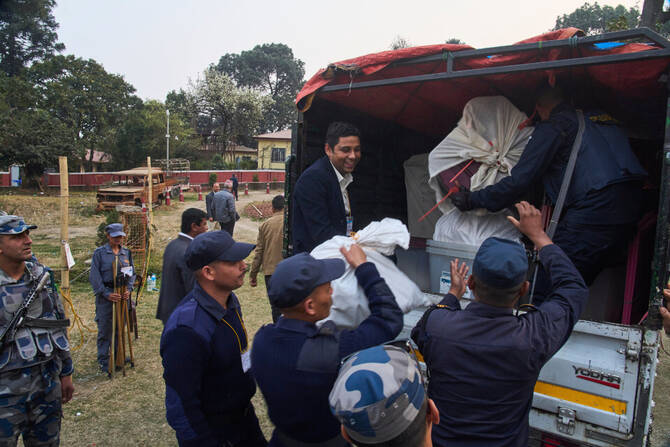
KATMANDU: Voting was peaceful in Nepal’s first nationwide election Thursday since a violent, youth-led uprising forced the government from power in September.
Turnout was about 60 percent and only a few minor incidents were reported, according to Nepal’s acting Chief Election Commissioner Ram Prasad Bhandari.
Vote counting would begin immediately after the ballot boxes are collected and transported to counting centers across the Himalayan nation, which could be as early as Thursday night. Results were expected by the weekend. Helicopters will be used to ferry the boxes from polling stations in remote mountain villages in the northern region by Friday morning, Bhandari said.
The next administration is expected to inherit daunting challenges. It must deliver on changes demanded by last year’s protests, tackle entrenched corruption and carefully manage ties with its powerful neighbors, India and China.
“I came to vote mainly because of the protest and so many people gave their lives in the hope of a change, in hope of seeing better Nepal,” said Luniva, a first-time voter. “Hopefully, I want to see my country become better by all the sacrifices that have been made.”
Others shared similar hopes that the election could usher in positive change after months of political unrest.
Voters are directly electing 165 members to the House of Representatives, the lower chamber of Parliament. The remaining 110 seats in the 275-member body will be allocated through a proportional representation system, under which political parties nominate lawmakers based on their share of the vote.
The election is widely seen as a three-way contest, shaped by voter frustration over widespread corruption and demands for greater government accountability.
The National Independent Party, founded in 2022, is considered the front-runner, posing a strong challenge to two long-dominant parties: the Nepali Congress and the Communist Party of Nepal (Unified Marxist–Leninist).
The new party’s prime ministerial candidate is rapper-turned-politician Balendra Shah, who won the 2022 Katmandu mayoral race and emerged as a leading figure in the 2025 uprising that ousted former Prime Minister Khadga Prasad Oli.
Shah, 35, has rode a wave of public anger toward traditional political parties. He highlighted health and education for poor Nepalis as a key focus of his campaign.
The protests against corruption and poor governance were triggered by a social media ban before snowballing into a popular revolt against the government. Dozens were killed and hundreds injured when protesters attacked government buildings and police opened fire on them.
While the Congress and the Communists retain loyal voter bases, Shah’s party has drawn larger crowds on the campaign trail, highlighting its growing appeal among younger voters seeking an alternative.
There are about 19 million registered voters among the country’s nearly 30 million people, according to the Election Commission of Nepal.
Millions of Nepalis living overseas are unable to take part in the vote. An estimated 3 million citizens work abroad — largely in the Middle East, Southeast Asia and neighboring India — and cannot cast ballots because the country does not yet have a system allowing voting from abroad.


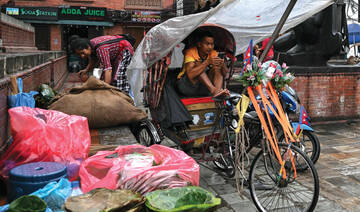
Voting passes peacefully in Nepal’s first election since September youth-led protests

https://arab.news/br4qc
Voting passes peacefully in Nepal’s first election since September youth-led protests

- Turnout was about 60 percent and only a few minor incidents were reported, says Nepal’s poll chief
- The election is widely seen as a three-way contest, shaped by voter frustration over widespread corruption


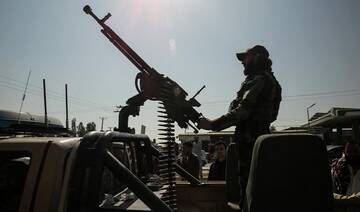
Afghan government says Pakistan strikes Kabul and border provinces
- A Pakistani security official, speaking on condition of anonymity, confirmed that Pakistan struck overnight
- Islamabad last month launched a wave of air strikes on its neighbor, an operation it says is targeting militancy
KABUL: Afghan authorities said on Friday that Pakistan had carried out new strikes on Kabul and border provinces, killing four people in the capital.
A Pakistani security official, speaking on condition of anonymity, confirmed that Pakistan struck overnight, adding their forces targeted the Pakistani Taliban militant group, known as TTP.
Islamabad last month launched a wave of air strikes on its neighbor, an operation it says is targeting militancy following growing attacks in Pakistan.
But the Taliban government has denied any involvement or the use of Afghan territory for militancy.
Khalil Zadran, the spokesman for Kabul police, said four people had been killed and 15 wounded in the bombardment that hit homes in the capital, with women and children among the victims.
Taliban government spokesman Zabihullah Mujahid posted on X that Pakistani strikes also hit the southern province of Kandahar, as well as eastern Paktia and Paktika, which border Pakistan.
In Kandahar, which is home to the administration’s supreme leader Hibatullah Akhundzada, air strikes hit a fuel depot for airline Kam Air, near the airport.
This company supplies fuel to civilian airlines and United Nations aircraft.
Pakistan insists it has not killed any civilians in the conflict. Casualty claims from both sides are difficult to verify independently.
Afghan and Pakistani forces have also clashed repeatedly at the border in recent weeks, hampering trade and forcing nearby residents to leave their homes.
‘Open war’
The United Nations’ mission in Afghanistan (UNAMA) has said that 56 civilians have been killed in Afghanistan, including 24 children, by Pakistani military operations between February 26 and March 5.
About 115,000 people were forced to leave their homes, according to the UN refugee agency.
Fighting between the two countries intensified on February 26, when Afghanistan launched an offensive along the frontier, in retaliation for earlier Pakistani air strikes targeting the TTP.
Pakistan then declared “open war” against the Taliban authorities, bombing the capital, Kabul, on February 27.
Since then, clashes have increased in border regions, including overnight Wednesday to Thursday that the Afghan authorities said killed four members of the same family in Khost province.
The Taliban government said on Thursday that four members of the same family, including two children, were killed by Pakistani artillery and mortar fire in eastern Afghanistan.
Seven people had been killed in Afghanistan since Tuesday as a result of cross-border clashes between the two sides, according to the authorities in Kabul.
Deputy government spokesman Hamdullah Fitrat said the latest deaths happened early Thursday in the village of Sadqo in Khost province, accusing Pakistan of deliberately targeting civilian homes and nomads’ tents.