‘Traumatized’ Ugandan students return home from Iran

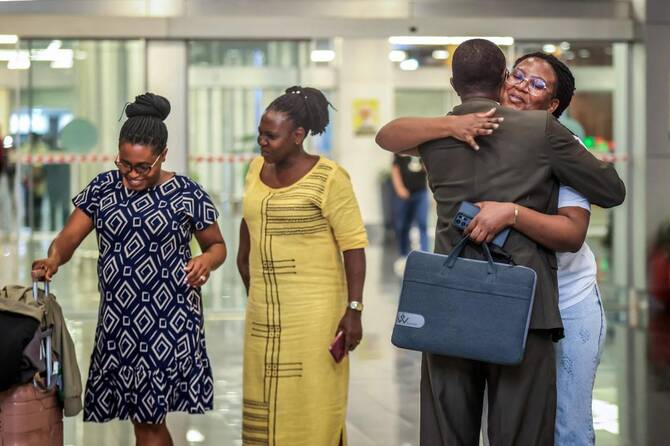
Ugandan students evacuated from Iran are welcomed by their families after arriving from Turkiye at Entebbe International Airport in Entebbe, March 5, 2026. (AFP)
Short Url
Updated 06 March 2026
Follow

‘Traumatized’ Ugandan students return home from Iran

  • Ugandan ambassador organized their escape by bus to the Turkish border
  • Despite the trauma, a student said he would return to finish his program in Iran as soon as possible

ENTEBBE: A group of 43 Ugandan students have spoken of their trauma after fleeing the US and Israeli bombing campaign in Iran and returning to Uganda on Thursday.
“I am lost for words,” said Sharon Twiine, 29, who had been studying international relations at Ahlul Bayt International University in Tehran when the war broke out.
The Ugandan ambassador organized their escape by bus to the Turkish border and then on to Istanbul where they caught a flight home.
“It was scary, traumatising and I wouldn’t wish for anyone to experience” such a thing, Twiine told reporters at Entebbe International Airport in Uganda.
Another of the students, Oscar Nyegyema, said a site near their university was hit by an air strike.
“We could hear the ground trembling, we could hear the ground shake. We were all scared, we were all feeling devastated, we really did not know whether we could make it out,” he said.
Despite the trauma, Nyegyema said he would return to finish his program in Iran as soon as possible.
Some Ugandan students chose to stay despite the offer of return from their government.
“The truth is for these students, they believe that if they return home, the two years spent in their four-year degree study may go to waste because they may not be able to afford the ticket back to the university,” said Aloisius Ssegawa, another of the students who returned on Thursday.
Twiine said she was “traumatized” by the experience.
“I love to study, I love to practice what I will learn from Iran but I think I will have to get therapy first,” she said.


UK defense minister suggests Putin’s ‘hidden hand’ behind Iran tactics

Updated 51 min 24 sec ago
Follow

UK defense minister suggests Putin’s ‘hidden hand’ behind Iran tactics

LONDON: UK Defense Minister John Healey suggested on Thursday that Russia was influencing Iran’s use of drone attacks in its war with the United States and Israel.
Healey said Russian President Vladimir Putin’s “hidden hand” may be behind some of the tactics deployed by Tehran in the Middle East conflict, which started when the United States and Israel struck Iran on February 28.
He told reporters that officials were analyzing an Iranian-made drone that hit the UK’s Akrotiri air force base in Cyprus on March 1 “for any evidence of Russian or any other foreign components and parts.”
“We will update you and appropriately publish any findings from that when we’ve got them,” he said during a visit to Britain’s military headquarters in Northwood, near London.
“But I think no one will be surprised to believe that Putin’s hidden hand is behind some of the Iranian tactics, potentially some of their capabilities as well, not least because one world leader that is benefiting from the sky high oil prices at the moment is Putin,” he added.
Russia is a close ally of Iran, with the two agreeing last year to help each other counter “common threats.”
US President Donald Trump said Saturday he had no indication Russia was supporting Iran in the war, but that if they were, it was not “helping much.”
Nick Perry, the British military’s chief of joint operations, told Healey there were “definitively” signs of a link between Russia and Iran, including Iran’s use of drones “as learned from the Russians.”
No one was injured when the drone hit a hangar at Akrotiri. British warplanes shot down a further two drones heading for the base the same day.
Guy Foden, a brigadier in the British army, briefed Healey that UK troops based at a military base housing international coalition troops in Irbil, Iraq, had helped shoot down two Iranian drones on Wednesday.