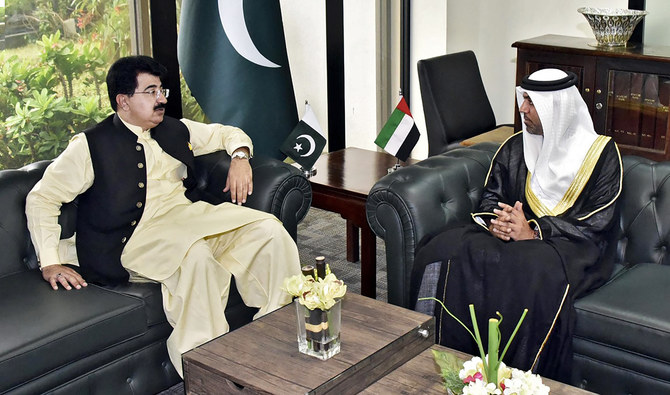
ISLAMABAD: The chairman of Pakistan’s upper house of the parliament Muhammad Sadiq Sanjrani met with UAE ambassador to Pakistan Hamad Obaid Al-Zaabi on Monday and urged him to take “advantage” of trade opportunities with Pakistan.
A statement issued by Sanjrani’s office described relations between Pakistan and the UAE as being based on common traditions, religious values and social ties and suggested increased exchange of parliamentary and high level delegations in order to enhance investment opportunities.
“UAE can take advantage of investment opportunities in trade and economic sectors in Pakistan,” Senate Chairman Sanjrani was quoted as saying in the statement.
The senate chairman thanked the UAE and its people for taking care of Pakistanis stranded in the country during the coronavirus pandemic. In return, the UAE envoy appreciated the government of Pakistan’s steps to stem the tide of the coronavirus.
The ambassador said the UAE considered bilateral relations with Pakistan very important: “Joint efforts are needed to increase trade cooperation.”
UAE is the second largest host to overseas Pakistanis in the world. Last week the government of Punjab, Pakistan’s biggest province, offered incentives for Emirati investment in its special economic zones.


Senate chairman urges UAE to take advantage of trade opportunities with Pakistan
https://arab.news/n5wv8
Senate chairman urges UAE to take advantage of trade opportunities with Pakistan

- Thanks UAE and its people for taking care of Pakistanis stranded in the country during the coronavirus pandemic
- UAE envoy says joint efforts needed to increase trade cooperation and investment between the brotherly nations

At UN, Pakistan warns India’s suspension of water-sharing treaty carries security implications
- Brokered in 1960, Indus Waters Treaty divides control of Indus basin rivers between India and Pakistan
- Pakistan urges UN to ensure prevention of unilateral suspensions, enforcement of international treaties
ISLAMABAD: Pakistan’s UN Ambassador Asim Iftikhar Ahmad warned the international community this week that any unilateral suspension of the Indus Waters Treaty (IWT) by India carries with it humanitarian, peace and security implications.
India last year announced it was holding the IWT, mediated by the World Bank in 1960, “in abeyance” amid increasing political tensions with Islamabad. The IWT divides control of the Indus basin rivers between the two nuclear-armed neighbors.
It grants Pakistan rights to the Indus basin’s western rivers — Indus, Jhelum, and Chenab — for irrigation, drinking, and non-consumptive uses like hydropower, while India controls the eastern rivers — Ravi, Beas, and Sutlej — for unrestricted use but must not significantly alter their flow. India can use the western rivers for limited purposes such as power generation and irrigation, without storing or diverting large volumes, according to the agreement.
Speaking at the “Arria Formula Meeting of the Security Council on Upholding the Sanctity of Treaties for the Maintenance of International Peace and Security” on Saturday, Ahmad noted the IWT was regarded as one of the most resilient water-sharing treaties that had stood the test of time, crises and political tensions.
“Any unilateral disruption to established water-sharing arrangements carries humanitarian, environmental, and peace-and-security implications, particularly for downstream 240 million people of Pakistan,” he said.
“When the lifelines of millions are placed under unilateral discretion, the risks are not hypothetical — they are real and immediate.”
The Pakistani envoy reiterated that the treaty was not a “bilateral concern” but a test case for the international system. He said if a treaty designed to prevent disputes or conflicts is disregarded unilaterally, “then no agreement is truly insulated from politics or all kinds of machinations.”
“Borders, demilitarized zones, trade corridors, and humanitarian arrangements all become more fragile,” Ahmad noted.
He underscored that the UN and the Security Council have a vital role to play, which includes the prevention of unilateral suspensions and enforcement of treaties.
“Compliance with treaties must therefore be regarded as a strategic imperative for conflict prevention and resolution,” he said.
Pakistan has warned India that it will not let New Delhi stop or divert the flow of its rivers. Islamabad said last year it would consider any move on India’s behalf to hinder the flow of its waters as “an act of war.”
The two countries engaged in the worst fighting between them in decades in May last year after India blamed Pakistan for being involved in a militant attack on tourists in Indian-administered Kashmir. Islamabad denied it was involved and called for a credible probe into the incident.
India and Pakistan pounded each other with missiles, drones, jets and exchanged artillery fire for four days before Washington brokered a ceasefire on May 10.


