

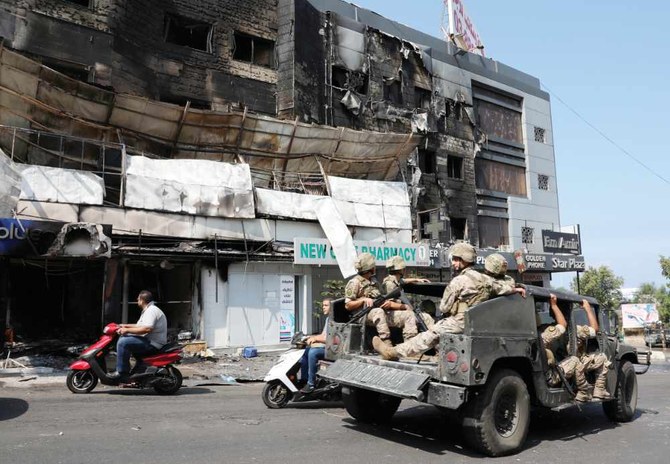

BEIRUT: A deadly battle between two major Lebanese sectarian groups has prompted warnings of more violence as the country is pushed to the breaking point by a financial meltdown and political tensions.
Two people — a 13-year-old Lebanese Sunni boy and a Syrian man — were killed in the Khaldeh area south of the capital in the shootout on Thursday night. Machine guns and rocket-propelled grenades were used in the fighting, which witnesses said lasted four hours.
A Sunni Arab tribe to which the boy belonged accused members of the Iran-backed Shiite group Hezbollah of opening fire.
The Lebanese army, which was heavily deployed in the area on Friday, said the problem spiralled out of a row over a poster put up by Shiites.
Lebanese President Michel Aoun has set Aug. 31 as a date for binding parliamentary consultations to designate a new prime minister to succeed Hassan Diab’s government.
Sources close to the former leaders told Arab News: “There is a decision not to give President Aoun political authority, and we have to wait to see who will respond to Aoun’s invitation to the consultations on Monday in light of the significant political dispute with him.”
Leader of the Progressive Socialist Party Walid Jumblatt said: “After a delay in calling for consultations and violating the Taif Agreement, it appears that some political forces are already examining a new constitution, and some are loudly calling for it.”
FASTFACT
Former Prime Ministers Tammam Salam, Saad Hariri and Najib Mikati have shown no interest in heading the new government.
Aoun objected to Parliament Speaker Nabih Berri’s proposal to nominate Hariri to head the next government, and Hezbollah objected to nominating Nawaf Salam, a judge on the International Court of Justice in The Hague, and Mohammed Baasiri, who was vice-governor of the Banque du Liban and the secretary of the Special Investigation Commission fighting money laundering.
Aoun’s office released a schedule of the consultations that will begin Monday morning and end in the afternoon. The person who gets the largest backing from parliamentary blocs and members will be asked by Aoun to form a new Cabinet.
French President Emmanuel Macron will next week meet iconic singer Fairuz and members of Lebanon’s political leadership as he returns to the country in search of serious reform in the wake of the devastating Beirut port blast.
Macron will be in Lebanon on Monday and Tuesday for his second visit in less than a month.
Fairuz, 85, is one of the rare figures in Lebanon who is admired across the multi-confessional country.
Karim Emile Bitar, a political science professor in France and Lebanon, tweeted it was an “excellent decision” by Macron to meet Fairuz, describing her as “arguably the most iconic, dignified and consensual Lebanese figure.”
An official in the French presidency said that Macron’s visit to Beirut aims “to pressure Lebanon’s political leaders to move forward in forming a government that can implement urgent reforms. The president will not give up.”


