
ISLAMABAD: Saudi Arabia’s King Salman Humanitarian Aid and Relief Center (KSrelief) has completed a shelter assistance project benefiting more than 24,000 people in Pakistan’s northwestern Khyber Pakhtunkhwa (KP) province, the aid agency said on Wednesday.
KSrelief, Saudi Arabia’s international humanitarian agency, has become one of Pakistan’s major development and relief partners, supporting projects in food security, health care, shelter, disaster recovery and polio eradication. Since 2005, the organization has implemented more than 200 projects in Pakistan worth over $184 million, according to its published project data.
In recent months, KSrelief has funded food assistance programs across Pakistan, supported immunization campaigns that reached millions of children and continued humanitarian projects targeting vulnerable communities affected by poverty, displacement and natural disasters.
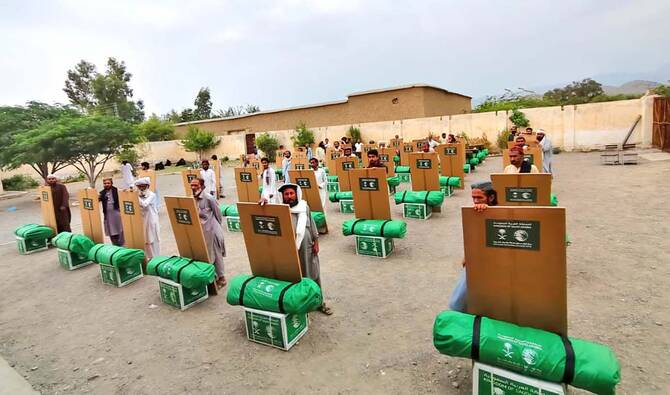
The latest project involved the distribution of 3,500 Shelter Non-Food Item (NFI) kits among vulnerable families in seven districts of northwestern Khyber Pakhtunkhwa, including several former tribal regions along Pakistan’s border with Afghanistan that have long faced militancy, displacement and natural disasters.
“Through this collective effort, the initiative successfully reached and benefited more than 24,129 individuals, reaffirming KSrelief’s unwavering commitment to supporting vulnerable communities and improving living conditions,” the agency said in a statement.
“The project also reflects the enduring humanitarian partnership and strong bonds of solidarity between the Kingdom of Saudi Arabia and Pakistan in serving communities affected by crises and disasters.”
Each shelter kit included a tent, a solar panel with an LED lighting system, two thermal blankets, plastic mats, a kitchen set, a water cooler and antibacterial soap to help families meet basic needs during emergencies, according to the statement.
The assistance was delivered in Upper Kurram, Lower Kurram, Mohmand, Orakzai, North Waziristan, Lower South Waziristan and Upper South Waziristan in coordination with Pakistan’s National Disaster Management Authority (NDMA) and local partner Hayat Foundation.
These districts, formerly part of Pakistan’s semi-autonomous Federally Administered Tribal Areas (FATA), experienced years of conflict and displacement during military operations against militant groups. Many communities remain vulnerable to economic shocks and extreme weather events, making humanitarian assistance a critical source of support.
Saudi Arabia and Pakistan maintain close political, economic and humanitarian ties, with the Kingdom regularly providing relief assistance during emergencies, including major floods, health crises and food security challenges.