

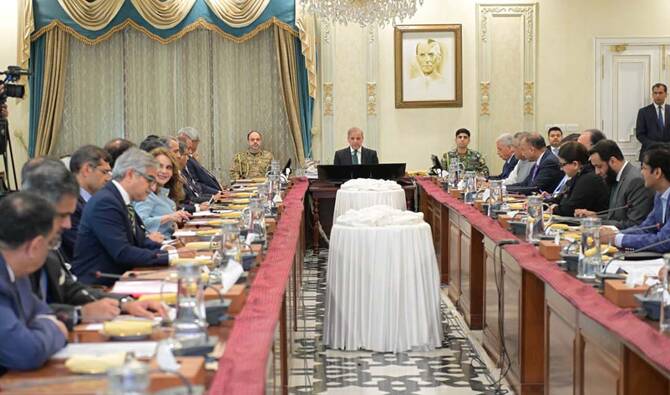

ISLAMABAD: Pakistani Prime Minister Shehbaz Sharif told leading business figures on Wednesday the government's upcoming budget would include measures aimed at providing relief to the public, as Islamabad seeks to balance economic recovery with fiscal discipline under a $7 billion International Monetary Fund (IMF) program.
The federal budget for fiscal year 2026-27, due to be presented on June 10, comes at a sensitive moment for Pakistan's economy. While inflation has eased from record highs and foreign exchange reserves have stabilized since the country secured IMF support in 2024, businesses continue to complain about high taxes, elevated energy costs and weak investment activity.
“Measures to provide relief to the public are being included in the budget,” Sharif was quoted as saying in a statement released after consultations with some of the country's most prominent industrialists and business leaders ahead of the federal budget.
The prime minister said Pakistan remained committed to an export-led growth strategy, describing it as the central pillar of the government's economic policy.
“We are moving on the path of export-led growth; this is the cornerstone of our economic policy,” Sharif said.
The government also briefed participants on a series of economic reforms, including changes aimed at speeding up the resolution of tax disputes through reforms to tax tribunals, plans for special commercial courts and efforts to bring more of the informal economy into the tax net.
According to the statement, officials said a National AI Transformation Plan is being formulated as part of broader efforts to modernize the economy, improve productivity and support future growth sectors.
The briefing also highlighted infrastructure projects intended to improve trade and logistics, including upgrades to Karachi's freight connectivity, work on the M-13 motorway linking Kharian and Rawalpindi, and plans to modernize Pakistan Railways' ML-1 and ML-2 networks to improve cargo transportation across the country.
The visiting delegation included leading industrialists and corporate executives such as Nishat Group Chairman Mian Muhammad Mansha, Arif Habib Group Chairman Arif Habib, Lucky Cement Chief Executive Muhammad Ali Tabba, Systems Limited Chief Executive Asif Peer, Pakistan Business Council Chairperson Zeelaf Munir, Interloop Chairman Musadaq Zulqarnain and Jazz Chief Executive Aamir Ibrahim.
According to the Prime Minister's Office, the business leaders presented recommendations on the upcoming budget and broader economic policy, while expressing support for efforts to strengthen the economy and improve the investment climate.
Several participants emphasized the need to convert recent macroeconomic stabilization into sustainable, export-led growth through tax reforms, investment incentives and measures to improve industrial competitiveness. Business leaders also called for a broader tax base that would bring more undocumented sectors into the formal economy while reducing the burden on compliant taxpayers and exporters.
Business leaders thanked the government for recent reductions in electricity tariffs for industry, efforts to accelerate tax refunds and measures aimed at promoting exports, according to the statement. They also welcomed the government's push for digital payments, documentation of the economy and tax reforms designed to improve the ease of doing business.
Pakistan has spent much of the past two years implementing economic reforms under IMF-supported programs, including efforts to broaden the tax base, reduce losses in the energy sector and attract investment.
The government says those measures have helped stabilize the economy, though businesses continue to press for lower taxes, cheaper energy and reduced production costs to boost competitiveness, exports and growth.


