

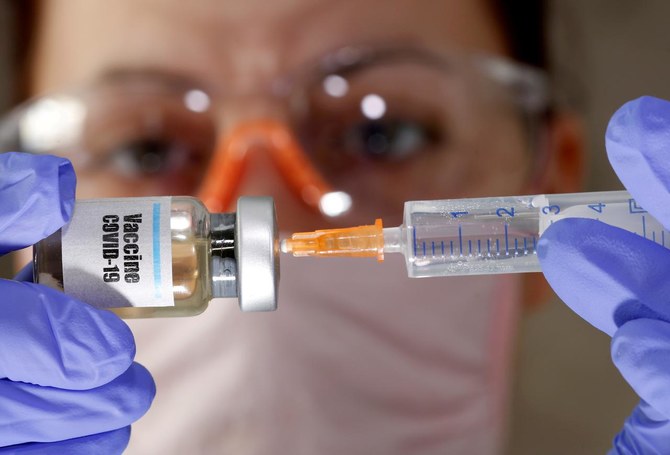
Russia to roll out COVID-19 vaccine in global tests, including Saudi Arabia

More than 40,000 tests will be rolled out in the next week in Russia, with plans to later extend the testing to Saudi Arabia, the UAE, the Philippines, and either India or Brazil. (Reuters)
Short Url
Updated 20 August 2020
Follow

Russia to roll out COVID-19 vaccine in global tests, including Saudi Arabia

  • Kirill Dmitriev, the Russian businessman who has led the development of the vaccine, said that the Kingdom would be one of the nations to trial the treatment
  • The Sputnik V vaccine has already been administered to a number of Russians, including the daughter of President Vladimir Putin

DUBAI: Russia is preparing one of the biggest-ever test programs in five countries, including Saudi Arabia, for its controversial Sputnik V vaccine against the coronavirus disease (COVID-19).

Kirill Dmitriev, the Russian businessman who has led the development of the vaccine, said that the Kingdom would be one of the nations to trial the treatment.

More than 40,000 tests would also be rolled out in the next week in Russia, with plans to later extend the testing to Saudi Arabia, the UAE, the Philippines, and either India or Brazil, he added, in “one of the largest ongoing trials in the world.”

The Saudi Ministry of Health has so far not commented on its involvement in the testing, but the Kingdom has in the past said it would be willing to cooperate in any viable plans to develop a vaccine against the virus.

The Sputnik V vaccine has already been administered to a number of Russians, including the daughter of President Vladimir Putin.

Dmitriev, who is chief executive of the Russian Direct Investment Fund which has close links with the Kingdom, told Arab News that he was in talks with the Saudi Ministry of Health and was organizing a visit by officials and scientists to the Moscow research center where the vaccine had been developed.

“We believe that Saudi will be a very strong partner for our joint work on the Sputnik V vaccine,” he said.

Sputnik V was registered in Russia two weeks ago as the first anti-COVID-19 vaccine recognized by a national government, but it met with skepticism in Europe and the US because it had not gone through the critical phase 3 stage involving large-scale testing on humans.

Some scientists also said there was insufficient data released by the Russians about the vaccine development process.

Dmitriev said that the vaccine had been reviewed by a “major scientific journal” — which he declined to name — which would shortly give it a positive verdict. He promised that more data would be released on the scientific aspects of the vaccine.

The Russian vaccine builds on previous work carried out by the country’s Gamaleya research institute in Moscow on the Ebola and MERS diseases, and relies on human adenovirus, which Russia said was tested and proven compared with Western techniques.

Dmitriev said that human adenovirus techniques had been used for other kinds of vaccines by millions of US military personnel and had been approved by the American drug authorities. “Human adenovirus is the right way to go and the safest way to go,” he added.

The question of whether Russia would facilitate the testing program financially, possibly through export guarantees, was a matter for the governments of the countries participating, he said.


Saudi hospitality boom sparks innovation beyond the plate

Chefs at Julien prepare meals to pair with Diageo drinks. (AN photo by Basmah Albasrawi)
Updated 4 sec ago
Follow

Saudi hospitality boom sparks innovation beyond the plate

RIYADH: As restaurants and hotels in Saudi Arabia refine their culinary identities, beverages are increasingly being treated as crafted experiences in their own right, shaped by technique and intention.

At the Four Seasons Riyadh, Diageo hosted a private tasting at Tonic Bar followed by a 10-course dinner at Julien, offering a snapshot of how this evolution is beginning to take shape, as international players and local venues test new approaches to pairing and presentation. 

Speaking to Arab News, Nick Rees, marketing director of Diageo MENA, pointed to the rapid growth of the nonalcoholic segment globally and in the region: “There’s a far faster growing percentage of it (the industry) is non-alcohol … There (are) trends globally … A lot of it will be pointed to wellness, mindful drinking.”

Rees said that Saudi Arabia’s fast-developing culinary and hospitality scene calls for beverages that match the level of excellence seen in kitchens across the Kingdom.

“It’s kind of the lack of choices and that’s where we want to be able to provide people the option, and people here absolutely have the same kind of talent and desire as their counterparts behind the kitchen,” he said.

“That’s where our role is to give people the kind of core ingredients for them to be able to work with … we have many more brands that we would love to introduce to the Kingdom.”

The dinner at Julien paired dishes with drinks made using Tanqueray 0.0, Captain Morgan 0.0, and Guinness 0.0, offering a glimpse into the range of styles Diageo is bringing to the market.

Flavor profiles ranged from light and refreshing combinations with cucumber and capers brine to richer, malt-forward blends, each designed to complement the accompanying dishes, from ravioli to black cod. 

Rees emphasized that pairing food with thoughtfully crafted beverages is becoming an essential part of the hospitality experience. 

“In the Kingdom, we’re looking at giving people the experience that currently is not available to them because I know for sure that the kind of quality and expertise and craftsmanship that can go into creating some of these drinks is absolutely as exciting as the work that the chefs would do with their food,” he said.

Anthony Abou Haider, head of Gulf at Diageo, said the company sees long-term potential in Saudi Arabia’s hospitality sector. 

“It’s such an opportunity to be a part of this transformation journey,” he told Arab News. “We’re not looking for a short-term gain, we’re looking at a very long-term gain here because whatever we do now is building for the future.”