

European battery makers power up for green recovery

1 / 2
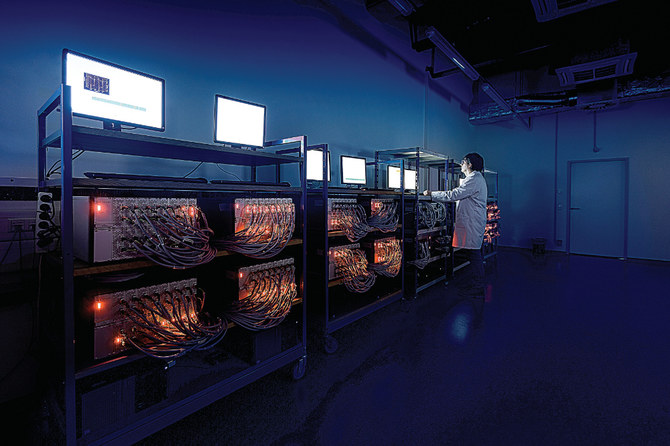
European battery technology startups are looking for ways to build a competitive advantage over larger and cheaper Chinese and South Korean rivals. (Reuters)
2 / 2
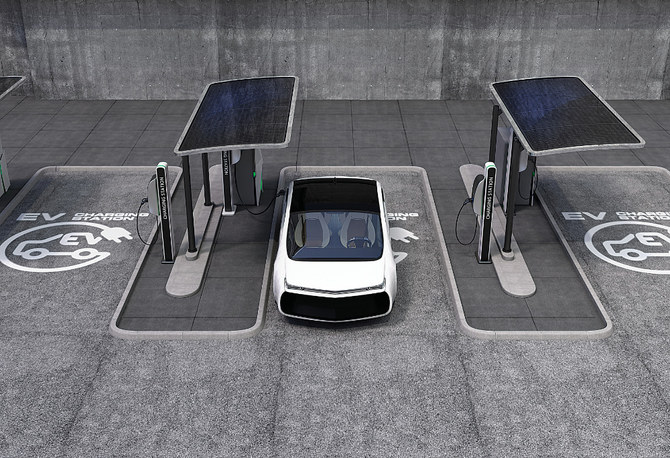
European electric vehicle production is set to increase six-fold in the next five years. (Reuters)
Short Url
Updated 13 August 2020
Follow

European battery makers power up for green recovery

  • Startups look to quality, service and EU support to carve out market niche

LONDON: European battery makers are gearing up to take advantage of massive “green” stimulus packages unveiled since the coronavirus pandemic though many acknowledge it will be tough to match the Asian giants that dominate the mainstream market.

While Sweden’s Northvolt, and more recently France’s Verkor, are making a play for large-scale production, other European companies are focusing on niche markets and new technologies rather than taking on Chinese and South Korean firms with mass production of batteries destined for electric vehicles (EVs).

From Greek battery maker Sunlight to startups like InoBat Auto in Slovakia and Switzerland’s Innolith, firms say the challenge of building economies of scale fast to compete head on means finding niches is a more likely path to success, for now.

“Having battery giants in Europe, it’s still possible,” said Sunlight CEO Lampros Bisalas. “We just need to run and catch up, and innovate faster than the others.”

Sunlight’s Greek factory is the world’s largest producer of lead-acid batteries for automated guided vehicles, forklifts and energy storage systems and it is now shifting to lithium cells.

But Bisalas isn’t going after the EV market dominated by China’s Contemporary Amperex Technology (CATL), Japan’s Panasonic and South Korea’s LG Chem, Samsung SDI and SK Innovation .

He is focusing on lithium-iron-phosphate production, a type of battery suited to forklifts, locomotives and robots that perform short tasks with breaks in between.

“These markets are billions of dollars,” said Bisalas. “We see a very big opportunity there, because we see lithium ion producers, especially from China, being focused on EVs.”

Ever since it launched the European Battery Alliance in 2017, Europe has been pushing local firms to develop an industry that should flourish in a low-carbon future and ensure the continent is not reliant on imported products — or technology.

Now, China hosts 80 percent of the world’s lithium-ion cell production – the type of battery expected to power the fast-growing EV industry – and most of the capacity coming online in Europe over the next five years belongs to Asian firms.

But the European Union has committed €550 billion ($647 billion) to climate protection and clean technologies over the next seven years, and these plans hinge on batteries to store renewable energy — and to power EVs.

Researchers have already identified 13 European battery projects that could be eligible for EU support, in countries including France, Germany, Slovakia and Poland — though some are being driven by Asian manufacturers, such as LG Chem’s plans to expand its factory in Krakow.

European EV production is expected to increase six-fold in the next five years and EU leaders expect the battery value chain — from mining to production to recycling — will be worth €250 billion by 2025.

But some European startups concede they can’t catch up with the large-scale, low-cost Asian incumbents.

InoBat Auto, for example, a Slovak startup backed by US energy technology company Wildcat Discovery Technologies and Czech utility CEZ, is instead heading into the fast lane.

CEO Marian Bocek said the European auto industry’s reliance on imported mass-produced batteries has created a “technological sovereignty crisis,” forcing manufacturers to design cars around the batteries.

So it is planning to tailor batteries for high-performance vehicles that may need something special.

It plans to bring a 100 MWh production line online next year in Slovakia near Peugeot, Kia Motors and Jaguar Land Rover’s plants — which it said could eventually become a 10 GWh facility.

There, InoBat will test battery chemistries and make prototypes tweaked to each carmaker’s needs.

“Our focus is more on a sort of niche, on-demand battery segment for high-performance vehicles that cannot go to the LG Chems or SK Innovations of the world,” Bocek said.

Analysts say the next generation of batteries must last longer, charge faster and be safer and greener than those on the market now, and that gives European companies a chance.

“That is how Europe can conceive a competitive edge over China,” said Wood Mackenzie energy storage analyst Mitalee Gupta. “It will get competitive pretty quickly.”

Swiss battery technology company Innolith, for one, is looking for an edge with new technologies.

The company, which bought US battery producer Alevo’s intellectual property after its bankruptcy in 2017, said its labs in Germany will have prototypes this year for an NMC 811 cell that will deliver up to 315 Wh/kg (watt hour per kg).

NMC 811 cells include less cobalt than most mainstream EV batteries, which means they have the potential to deliver more power and with cheaper components.

“We cannot just take the same technology which is used, for example, in China or South Korea and copy-paste,” said CEO Konstantin Solodovnikov.

In Austria, battery technology company Kreisel Electric said it has licensed its NMC 811 technology to a European-based battery producer, which it declined to name. It already licenses its technology to Vietnamese EV maker VinFast.

Kreisel said it uses an immersion liquid cooling system to solve the fire hazards associated with lithium-ion cells in large industrial applications, giving it an edge over rivals.

But while European firms look for ways into the market, Asian rivals are building more capacity on the continent.

The first European factories for SK Innovation and CATL are under construction while LG Chem already makes batteries in Poland and Samsung has a plant in Hungary.

“We can bring to Europe our advantages in cost and product quality and service,” said Susan Zeng, co-president of CATL’s European division, which plans to start production in Germany next year.

For now, Northvolt is the only European startup that looks like it will have the scale to take on the Asian giants in its backyard — and its first factory has yet to start production.

Northvolt wants 25 percent of Europe’s battery market within a decade, a goal it says will require 150 GWh of production, more than three times the continent’s current lithium-ion capacity.

It raised $1.6 billion in debt financing last month, on top of more than €1 billion from backers including the world’s biggest carmaker, Volkswagen, and Goldman Sachs.

Northvolt’s first 40 GWh plant is due to open in Sweden next year. A joint venture with Volkswagen in Germany will follow in 2024 with a potential capacity of 24 GWh.


Saudi Arabia’s Red Sea dolphins signal a thriving marine environment

Updated 8 sec ago
Follow

Saudi Arabia’s Red Sea dolphins signal a thriving marine environment

  • Long-term monitoring aims to turn observations into data for conservation

JEDDAH: The waters of the Red Sea along Saudi Arabia’s coast have become a vibrant natural stage, with pods of dolphins appearing near shorelines and along shipping lanes. These captivating sightings are emerging as a positive indicator for the health of the Red Sea’s marine ecosystem.

Saudi Arabia’s Red Sea waters are a thriving sanctuary for marine life, hosting 12 species of dolphins and small whales, according to the National Center for Wildlife.

Nearshore and reef-adjacent waters are frequently visited by the Indo-Pacific bottlenose dolphin (Tursiops aduncus) and the spinner dolphin (Stenella longirostris). Common bottlenose dolphins (Tursiops truncatus) are also present, but tend to favor deeper offshore waters.

Beyond these familiar faces, the Red Sea is home to a wider array of cetaceans that are less often documented. These include the Indo-Pacific humpback dolphin (Sousa plumbea), which inhabits shallow coastal areas, the pantropical spotted dolphin (Stenella attenuata), Risso’s dolphin (Grampus griseus), and larger relatives such as the false killer whale (Pseudorca crassidens), which may be more common than sightings suggest. Rare visitors like killer whales (Orcinus orca) and offshore species such as the rough-toothed dolphin (Steno bredanensis), striped dolphin (Stenella coeruleoalba), long-beaked common dolphin (Delphinus capensis), and short-finned pilot whale (Globicephala macrorhynchus) are known to appear sporadically but require documented evidence for confirmation.

DID YOU KNOW?

Pods of dolphins are regularly spotted near shorelines and shipping lanes along Saudi Arabia’s Red Sea coast.

Reef-enclosed lagoons and sheltered nearshore waters serve as resting and social hubs for dolphins.

Human activities, including fisheries, coastal development and vessel traffic, can disrupt dolphin behavior.

Field identification is made easier by distinct physical traits. Indo-Pacific bottlenose dolphins are smaller and more slender than their common bottlenose cousins, while spinner dolphins are streamlined with a pronounced beak. Risso’s dolphins are stockier with blunt heads, often marked with noticeable scars. Indo-Pacific humpback dolphins remain close to shallow, sometimes murky, shorelines, making them challenging to document without dedicated surveys.

Researchers at KAUST emphasized the importance of ongoing conservation to maintain the Red Sea’s ecological balance. Research scientist Jesse Cochran told Arab News: “For Saudi waters, the biggest challenge is that we still don’t have the kind of long-term, standardized monitoring needed to estimate population sizes or trends confidently. We have important observations and some targeted surveys, but the baseline is still developing.”

Another research scientist, Royale Hardenstine, highlighted the need for broader coordination: “What we need most right now is connectivity across efforts. There are good observations in specific project areas, but without a shared framework and a broader network, it’s hard to turn those observations into coast-wide inferences about residency, movements, or trends.”

Dolphins are frequently seen in reef-enclosed lagoons and sheltered nearshore waters, where they rest and socialize. These locations are often predictable, as reef structures reduce wave action and currents, creating calm conditions favorable to dolphin behavior.

Christy Judd, a Ph.D. student at KAUST, noted: “Some reef-bounded lagoons appear to be used repeatedly as resting areas. These places matter because they offer shelter and calm conditions, not because they’re automatically the highest biodiversity sites.”

While dolphins sometimes feed and socialize near coral reefs, Prof. Michael Berumen explained that their ecological range extends well beyond reef systems. Dolphin activity in the Red Sea spans a wide seascape that includes open waters, channels, continental shelf edges, and coastal zones.

He said that reefs shape resting areas and can concentrate prey. Experts, however, caution against linking dolphin presence directly to reef health.

Hardenstine elaborated: “Where dolphins and reefs overlap, it’s often because reef structures create sheltered lagoons and predictable resting areas.”

Dolphin group sizes in the Red Sea vary by species and activity. Bottlenose and spinner dolphins may form large aggregations exceeding 100 individuals during social interactions or when moving through food-rich waters.

In contrast, Indo-Pacific humpback dolphins are more often observed in small groups. Mixed-species associations also occur: Indo-Pacific humpback dolphins may interact with bottlenose dolphins, and pantropical spotted dolphins frequently accompany spinner dolphins.

From left: Dr. Michael Berumen, Christy Judd, Royale Hardenstine and Jesse Cochran. (KAUST)

Berumen described these social dynamics: “Dolphin societies are typically dynamic, with groups that form and re-form over time (often described as ‘fission-fusion’ social structure). Individuals associate for feeding, travel, resting, and social interactions, and alliances can form, particularly in some bottlenose populations.”

Judd added a field perspective: “Calves are usually integrated into the pod’s normal behavior, but groups with calves can be more cautious, especially around disturbance.”

Seasonal patterns in dolphin distribution remain unclear. Hardenstine noted: “In Saudi waters seasonal patterns, if they exist, are not yet well-resolved because sighting data are often influenced by survey effort, weather, and where people are looking.”

Dolphins respond to prey availability, water temperature, and oceanographic features such as currents and productive zones. Cochran cautioned: “We expect environment and prey to influence where dolphins are seen, but data limitations mean we should treat seasonal conclusions as provisional until long-term monitoring is in place.”

Human activities pose additional pressures. Dolphins face risks from fisheries, occasional bycatch, coastal development, tourism, vessel traffic, and underwater noise. While the Red Sea does not experience the intensive industrial fishing seen in other regions, interactions with fisheries can displace dolphins or disrupt the marine food web. Vessel traffic can disturb resting behavior and increase stress.

Berumen explained: “Vessels can affect dolphin behavior by causing avoidance of certain areas, interrupting resting behavior, altering movement patterns, and increasing stress, particularly in areas where dolphins rest in sheltered lagoons.”

Hardenstine added: “While data related to these impacts in the Red Sea are sparse, some anthropogenic pressures are increasing throughout the region. This is exactly when collaborative monitoring and scientifically informed mitigation become most valuable.”

KAUST researchers study dolphins as part of broader ecosystem and megafauna monitoring, combining reef surveys, opportunistic sightings, and targeted research. The university collaborates closely with the Saudi Arabia’s National Center for Wildlife to develop a national marine mammal stranding network, assisting with identification, sampling, and necropsies when needed. Collaborative efforts with NCW and OceanX have also supported aerial surveys documenting Red Sea megafauna.

Cochran emphasized the goal: “The most responsible next step is building long-term monitoring that is coordinated between stakeholders nationally, so that observations turn into defensible data that can identify trends and guide conservation actions or policy.”