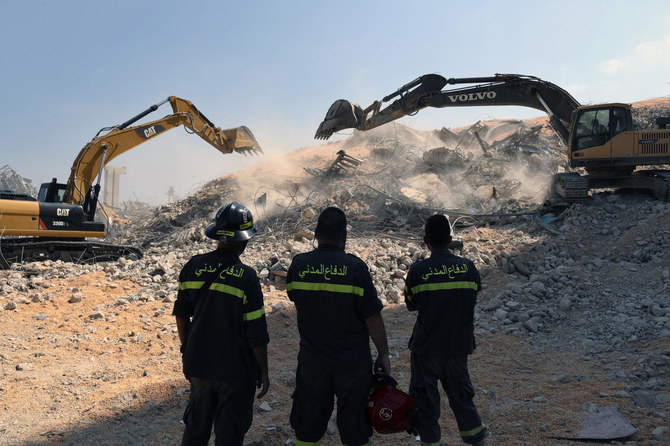
BEIRUT: Ankle-deep in corn spilling from a huge gutted silo, rescuers guide an excavator to clear access to a room where they believe Beirut port employees could still be alive.
Three days after the monster explosion that disfigured the city in a matter of seconds, the clock was already ticking down Friday on any potential survivors’ chances.
Rescuers from Lebanon, France, Germany, Russia and other countries worked shifts to try to find an entrance to a control room buried under meters (yards) of rubble.
Beirut’s “ground zero,” a term describing the point closest to a detonation that was first used for the 1945 atomic bombs on Hiroshima and Nagasaki, filled up with teams working together in a desperate push to find survivors.
“Let’s not kid ourselves, the chances are quite low,” said Lt. Andrea, a member of a 55-stong French contingent at the forefront of the rescue effort.
“But it’s been done before, three days later, four days later,” survivors have been found, he said, the charred silos behind him cutting a ghostly figure against Beirut’s ravaged skyline.
The death toll for the disaster, one of the worst of its kind in modern history, stood at 154 on Friday but dozens of people were still reported missing.
Andrea explained that the effort at the port was focused on the control room because a significant number of people would have been working there at the time of the explosion.
He said some smaller primary explosions in the port, however, might have led the staff to flee the room.
“The four bodies we uncovered in the search area... were found next to a safety exit staircase at the foot of the silos,” Andrea explained.
Thousands of tons of corn, wheat and barley scattered from the silos by the explosion carpeted the port car parks and quays.
An eerie calm filled the unrecognizable docks, usually bustling with traffic, workers and traders.
Rescuers stood silently above a gap in the ground as a sniffer dog paced around a forest of mangled containers thrown around the port like sugar cubes.
The cargo pouring out of them gave a sample of the goods that had just entered the country: French-language school books, luxury handbags, crates of imported beer.
Three Red Cross volunteers looked dazed as they walked around the site of the blast and stopped by the waterfront to stare at their devastated city.
“It looks so quiet, but bad quiet. Something in this city died and will not rise again,” said one of them, standing with his arms akimbo and his gaze lost in the destruction before him.
The only sounds were those of massive excavators smashing a path through the rubble, rotary saws cutting iron rods and jackhammers breaking blocks of concrete into smaller pieces.
Col. Tissier, leader of the French rescue team who briefed France’s President Emmanuel Macron during his visit on Thursday, has worked on many disaster sites.
“The specificity here is that the epicenter is just here, a few meters away from us, whereas usually with earthquakes it is several hundred meters below ground level,” he said.
“With quakes, things usually collapse in layers... here everything was just pulverised,” he said.
That means the growing fleet of heavy machinery converging on Beirut port Friday had to dig into solid mounds of rubble before reaching whatever is buried under it.
“When it comes to the actual center of the impact, it is quite reminiscent of September 11 ‘ground zero’,” Andrea said of the 2001 US attacks on the Twin Towers in New York.
“The extent of the destruction will also remind some members of our team of the earthquake in Haiti in 2010,” he said.
“The difference here is that it’s not an earthquake. Humans did this.”


![]()
![]()
![]()

At Beirut’s ‘ground zero’, race to find survivors


Short Url
https://arab.news/bnce8
At Beirut’s ‘ground zero’, race to find survivors
- Rescuers worked shifts to try to find an entrance to a control room buried under meters (yards) of rubble
- The death toll for the disaster stood at 154 on Friday but dozens of people were still reported missing


Latest updates



© 2026 SAUDI RESEARCH & PUBLISHING COMPANY, All Rights Reserved And subject to Terms of Use Agreement.