

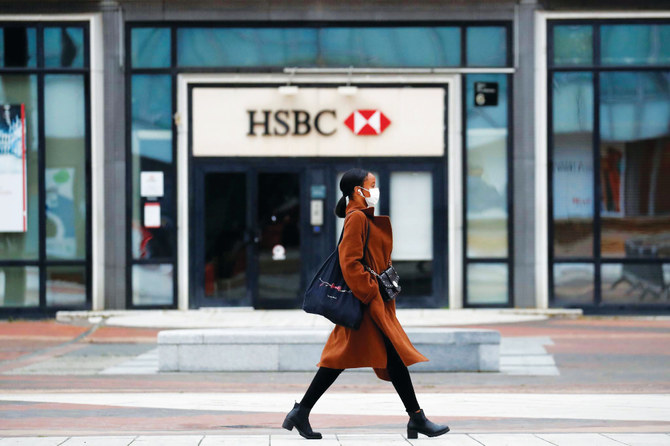

LONDON: HSBC on Monday reported a 69-percent slump in net profit, joining a number of major banks whose earnings have been slammed by the coronavirus fallout.
HSBC announced earnings of $3.1 billion compared with almost $10 billion in the first 6 months of 2019, as spiraling China-US tensions also hurt the British-based but Asia-focused lender.
Alongside HSBC results, top French bank Societe Generale on Monday announced a second quarter loss of more than €1 billion as the pandemic forced it to set aside more provisions against bad loans. UK banks Barclays, Lloyds and NatWest all last week reported huge financial hits linked to the pandemic’s fallout.
But there have been some bright spots, with French bank BNP Paribas weathering the coronavirus storm in the second quarter with only a small dip in net profits thanks to a surge in investment banking.
Credit Suisse meanwhile saw net profit jump almost a quarter in the April-June period, also on investment banking gains.
HIGHLIGHT
$1 BILLION - Alongside HSBC results, top French bank Societe Generale on Monday announced a second-quarter loss of more than €1 billion as the pandemic forced it to set aside more provisions against bad loans.
“HSBC has done little to lift investors’ spirits as it brings the curtain down on what has been a costly half-year reporting season for banks in general,” noted Richard Hunter, head of markets at Interactive Investor.
Even though banks “are much better prepared for this economic onslaught than during the financial crisis of over a decade ago ... the immediate outlook is bleak,” he added.
HSBC said that its pre-tax profit slid 64 percent to $4.3 billion in the first half while revenue was down 9 percent at $26.7 billion.
The figures missed analyst forecasts and the bank also raised its estimate for 2020 loan losses to $13 billion from $8 billion.
CEO Noel Quinn described the first 6 months of the year as “some of the most challenging in living memory.” He added: “Our first-half performance was impacted by the COVID-19 pandemic, falling interest rates, increased geopolitical risk and heightened levels of market volatility.”
Even by the standards of the current economic maelstrom engulfing global banks, HSBC has had a torrid time.
Before the coronavirus crisis it was beset by disappointing profit growth, ground down by US-China trade war uncertainties and Britain’s departure from the European Union.
The London-headquartered bank embarked on a huge cost-cutting initiative at the start of the year, including plans to slash about 35,000 jobs as well as trimming fat from less profitable divisions, primarily in the United States and Europe.
The coronavirus upended some of that cost-cutting drive with banks hammered by market volatility and the economic slowdown caused by the pandemic.
But HSBC has a further headache — geopolitical tensions via its status as a major business conduit between China and the West.
HSBC makes 90 percent of its profit in Asia, with China and Hong Kong being the major drivers of growth.
As a result it has found itself more vulnerable than most to the crossfire caused by the increasingly bellicose relationship between Beijing and Washington.
The bank has tried to stay in Beijing’s good graces. It vocally backed a draconian national security law that Beijing imposed on Hong Kong in June to end a year of unrest and pro-democracy protests. The move sparked criticism in Washington and London but analysts saw it as an attempt to protect its access to China, which has a track record of punishing businesses that do not toe Beijing’s line.
But that has not shielded it from Beijing’s wrath. Quinn referenced the bank’s growing political vulnerability in Monday’s results statement.
“Current tensions between China and the US inevitably create challenging situations for an organization with HSBC’s footprint,” he said.
“However, the need for a bank capable of bridging the economies of East and West is acute, and we are well placed to fulfil this role,” he added.




