HONG KONG: HSBC said Monday profits for the first half of 2020 plunged by 69 percent on year as the banking giant was hammered by the coronavirus pandemic and spiraling China-US tensions.
The lender reported post-tax profit of $3.1 billion while pre-tax profit was $4.3 billion, a 64 percent drop on the same period last year. Reported revenue was down nine percent at $26.7 billion.
The figures missed analyst forecasts and the bank also raised its estimate for 2020 loan losses from $8 billion to $13 billion.
Chief executive Noel Quinn described the first six months of the year as “some of the most challenging in living memory.”
“Our first-half performance was impacted by the COVID-19 pandemic, falling interest rates, increased geopolitical risk and heightened levels of market volatility,” he said in a statement to the Hong Kong stock exchange.
Even by the standards of the current economic maelstrom engulfing global banks, HSBC has had a torrid time.
Before the coronavirus crisis it was beset by disappointing profit growth, ground down by US-China trade war uncertainties and Britain’s departure from the European Union.
The Asia-focused lender embarked on a huge cost-cutting initiative at the start of the year, including plans to slash about 35,000 jobs as well as trimming fat from less profitable divisions, primarily in the United States and Europe.
The coronavirus upended some of that cost-cutting drive with banks hammered by market volatility and the economic slowdown caused by the pandemic.
But HSBC has a further headache — geopolitical tensions via its status as a major business conduit between China and the West.
HSBC makes 90 percent of its profit in Asia, with China and Hong Kong being the major drivers of growth.
As a result, it has found itself more vulnerable than most to the crossfire caused by the increasingly bellicose relationship between Beijing and Washington.
The bank has tried to stay in Beijing’s good graces.
It vocally backed a draconian national security law that Beijing imposed on Hong Kong in June to end a year of unrest and pro-democracy protests.
The move sparked criticism in Washington and London but analysts saw it as an attempt to protect its access to China, which has a track record of punishing businesses that do not toe Beijing’s line.
But that has not shielded it from Beijing’s wrath.
Last month the bank was a subject of multiple reports in China’s state-run media claiming that it had helped to provide the evidence that led to the arrest in Canada of Huawei executive Meng Wanzhou on a US arrest warrant.
HSBC released a statement on its Chinese Weibo accounts saying it had not “framed” telecom giant Huawei or “fabricated evidence” that led to the arrest of Meng.
China’s Internet censors blocked access to HSBC’s statement within hours of publication, without offering an explanation.
Quinn referenced the bank’s growing political vulnerability in Monday’s statement.
“Current tensions between China and the US inevitably create challenging situations for an organization with HSBC’s footprint,” he said.
“However, the need for a bank capable of bridging the economies of East and West is acute, and we are well placed to fulfil this role,” he added.
The bank’s Asia operations continued to show “good resilience,” Quinn said, with profit before tax of $7.4 billion.
Earlier this year Quinn put some of the job cuts on hold as the pandemic struck.
But in Monday’s statement he vowed to press ahead with the cost-cutting.
“As we seek to accelerate our transformation in the second half of the year, I am mindful of the impact it will have for some of our people, particularly those leaving us,” he said.

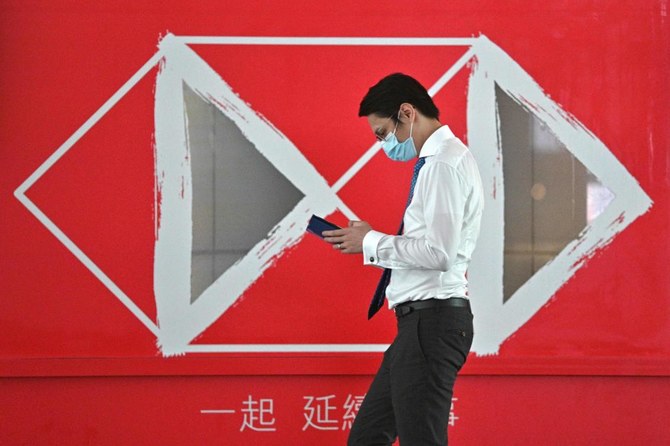
HSBC profits hammered by pandemic and soaring US-China tensions
https://arab.news/5arsh
HSBC profits hammered by pandemic and soaring US-China tensions
- Bank reports post-tax profit of $3.1 billion while pre-tax profit was $4.3 billion
- Asia-focused lender embarked on a huge cost-cutting initiative at the start of the year
Future Minerals Forum launches global index to track critical mineral supply chains
RIYADH: The Future Minerals Forum on Jan. 12 launched the “Future Minerals Index Report,” a first-of-its-kind global tool designed to measure and track progress in developing critical mineral value chains across producing, exporting, and consuming countries.
The initiative aims to support the creation of more resilient and responsible supply chains and promote sustainable development worldwide.
Khalid Al-Mudaifer, vice minister of industry and mineral resources for mining affairs, stated: “The Future Minerals Index Report is an unprecedented and essential document; it is an intellectual tool that highlights key trends in the mining and minerals sector, particularly in terms of insights and directions from sector stakeholders, including government leaders, global mining executives, experts, and interested parties.”
He pointed out that the report is distinguished by its tracking of developments in mineral supplies and its provision of actionable recommendations to ensure the sustainable development of critical mineral value chains.
Al-Mudaifer described the report as a new international benchmark that establishes a comprehensive baseline to measure the progress of governments, companies, and investors in enhancing more resilient and responsible mineral supply chains.
He said it provides a clear picture of how global critical mineral markets are shaped by capital, risk, and trust dynamics. “It shows where investment is growing or shrinking and identifies the widening gap between resource availability and capital allocation. Based on this baseline, the report will monitor changes in risk perceptions, investment flows, and progress toward more resilient mineral value chains.”
Ali Al-Mutairi, general supervisor of the Future Minerals Forum, emphasized the report’s importance and the attention it received at the forum due to its role in highlighting global trends in the mining sector.
He explained that the report was prepared in partnership with McKinsey & Co. and in collaboration with other sector experts, including S&P Global Market Intelligence, Global AI, and GlobeScan.
“It integrates stakeholder trends, data, market insights, and intelligence into a single reference that supports global mining and mineral sector decision-making,” he said.
Jeffrey Lorsch, partner at McKinsey & Co., commented: “The Future Minerals Index Report, by integrating market data, stakeholder perspectives, and value chain standards, provides a strategic roadmap to help companies navigate volatility and unlock long-term growth opportunities.”
The report is based on the “Future Minerals Framework,” developed with contributions from 47 experts across multilateral organizations, non-profits, and private companies. It was first introduced at the 2025 International Ministerial Meeting.
The framework outlines key enablers for end-to-end value chains, including supportive policies and regulations, innovative financing solutions to secure and manage investments, multimodal infrastructure such as roads, railways, and ports to reduce costs and increase viability, and sustainability through strong environmental and social governance frameworks.
It also includes talent development through education, training, R&D, technological modernization via updated geological data systems and global expertise partnerships, and geology through reliable, accessible geological data in producing, exporting, and consuming countries as a critical factor in attracting investment.
The report highlighted the world’s urgent need to sustain mineral supplies, featuring contributions from leading industry figures.
Robert Friedland, founder of Ivanhoe Mines, Ivanhoe Electric, and I-Pulse, stated that the electrification of energy systems, digitalization of the economy, and the rapid growth of artificial intelligence are converging toward a future that increasingly depends on minerals.
He stressed: “You can’t reduce emissions, build computing systems, or transport energy without mining.”
Bob Wilt, CEO of Ma’aden, said in the report: “We are not fully prepared to deliver the minerals the world needs. Our biggest challenges are not equipment, capital, or technology — but people.”
Duncan Wanblad, CEO of Anglo American, noted that global copper demand is expected to grow by 75 percent to reach 56 million tonnes annually by 2050. To meet this demand and offset declines from aging mines, the sector will need to open approximately 60 new mines the size of Quellaveco within the next decade alone.
Gustavo Pimenta, CEO of Vale, said in his contribution: “I can’t imagine a future without mining — at least not a sustainable one that balances economic development with environmental protection and social responsibility. Mining has become essential to everything.”
The release of the Future Minerals Index Report coincides with the upcoming fifth edition of the Future Minerals Forum, being held from Jan. 13 to 15, 2026, in Riyadh under the patronage of the Custodian of the Two Holy Mosques, King Salman bin Abdulaziz Al Saud. The event is held under the theme “Minerals: Facing the Challenges of a New Era of Development.”
The forum will host a wide range of ministers and CEOs from leading global mining companies, reflecting its stature as a global platform in the mining sector and a key event showcasing Saudi Arabia’s leadership in shaping the future of minerals regionally and internationally.


