


GOLAN HEIGHTS: From biblical plague to modern-day protein, one Israeli firm wants to make locusts a sustainable food choice in the Holy Land and beyond.
As for whether or not the insects are kosher, the answer is not so simple.
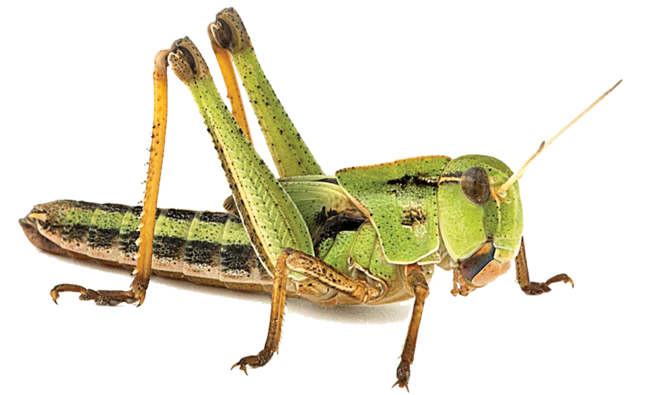
At Hargol Foodtech’s farm in the Israeli-occupied Golan Heights, a rectangular enclosure that once served as a chicken coop is filled with thousands of locusts, a grasshopper species that has a highly destructive swarming phase.
Contained in a series of meticulously stacked, climate-controlled mesh cages, the insects are served wheatgrass through their three-month life-cycle, before being cooled, killed and baked.
Hargol’s chief executive Dror Tamir said that he grew up hearing stories of how locusts destroyed the fields of his kibbutz in the 1950s.
Yet the Yemenite Jews in the area did not view locusts as crop-ruining pests, but as an edible source of nutrients, Tamir recalled.
As an adult, Tamir became a food and nutrition entrepreneur increasingly concerned about the environmental cost of providing the world’s growing population with enough animal protein.
Tamir said he founded Hargol — Hebrew for grasshopper — 6.5 years ago after realizing the insects were the solution.
The company’s goal is to be “the first in the world to grow grasshoppers on a commercial scale, and provide the world with a healthier and more sustainable source of protein.”
Ram Reifen, a professor of human nutrition at Hebrew University, agreed that the planet is facing growing food supply challenges.
With Earth’s population expected to hit 10 billion by 2050, raising livestock to feed the planet will become increasingly unsustainable, given the massive water and land resources required.
“The fear is there will be a scarcity of protein,” Reifen said. Tamir said that unprocessed locusts consist of more than 70 percent protein and contain all amino acids, along with other nutrients.
HIGHLIGHT
At Hargol Foodtech’s farm in the Israeli-occupied Golan Heights, a rectangular enclosure that once served as a chicken coop is filled with thousands of locusts, a grasshopper species that has a highly destructive swarming phase.
“What they do lack is saturated fat and cholesterol,” he said. “They have the good stuff. They don’t have the bad stuff.”
According to his own estimate, around 2.5 billion people — mainly in developing nations — consume insects as part of their regular diet.
And, the “most widely eaten insects in the world are grasshoppers,” Tamir said.
But, he added, “when trying to target North American and European customers, it’s really hard to overcome the ‘yuck’ factor.”
To make their product more palatable to Westerners, Hargol turns locusts into powder, which can be mixed into various foods.
Tamir said they were about to launch sales of locust-enhanced pancake mix and smoothie powders worldwide.
Some goods produced in the Golan Heights face export restrictions, including strict labeling requirements, because most of the international community does not recognize Israeli sovereignty in the area.


