

World praises UAE on successful launch of Mars Hope probe

1 / 2
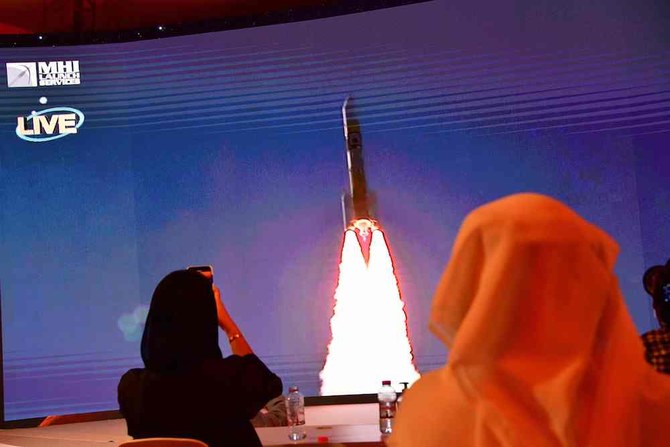
A picture taken on July 19, 2020, shows a screen broadcasting the launch of the “Hope” Mars probe at the Mohammed Bin Rashid Space Center in Dubai. The probe is one of three racing to the Red Planet, with Chinese and US rockets also taking advantage of the Earth and Mars being unusually close: a mere hop of 55 million kilometers. (AFP)
2 / 2
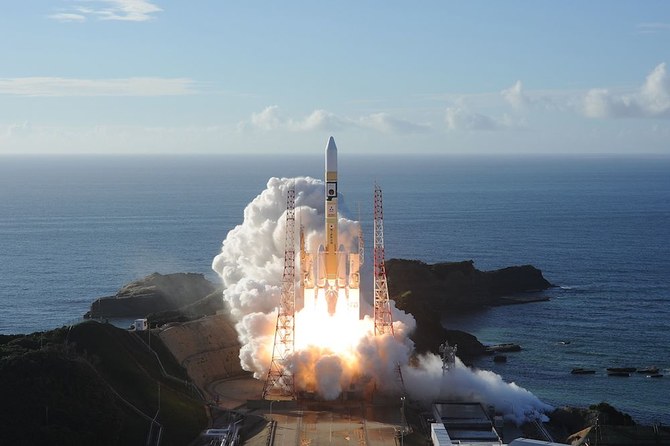
An H-2A rocket carrying the Hope Probe known as "Al-Amal" in Arabic, developed by the Mohammed Bin Rashid Space Centre (MBRSC) in the UAE to explore Mars, blasts off from Tanegashima Space Centre in southwestern Japan. (AFP/Mitsubishi Heavy Industries)
Short Url
Updated 09 February 2021
Follow

World praises UAE on successful launch of Mars Hope probe

  • Emirates Mars Mission ‘constitutes a national and Arab achievement’
  • UAE will be the ninth country to explore the Red Planet

DUBAI: The UAE has received global praise for the “historic” launch of its Mars space probe.
The Hope probe blasted off early Monday from the Tanegashima Space Center in Japan, making the Emirates the first Arab and Islamic country to attempt planetary exploration.
President Sheikh Khalifa bin Zayed led the celebrations, saying the Emirates Mars Mission “constitutes a national and Arab achievement and an advanced Emirati push in the process of building global knowledge in space.”


The probe is one of three racing to the Red Planet, with Chinese and US rockets also taking advantage of the Earth and Mars being unusually close: a mere hop of 55 million kilometers. (AFP)

He said the Hope probe idea was developed within the UAE’s “national and research institutions and was designed and manufactured with the effective participation of a young national elite of bright minds — highly qualified and trained and sincere young Emiratis.”
The mission is a joint project between the Mohammed bin Rashid Space Center and the UAE Space Agency, with the help of contributors and experts from leading universities.
The UAE will be the ninth country to explore the Red Planet, joining an exclusive club of nations.

Prior to the launch, the United Nations said the UAE’s mission is a “contribution to the entire world” and the Emirates is becoming “a main player in the space arena.”
“The UAE is always looking forward to the future; it is our wonderful partner,” said Simonetta Di Pippo, Director of the United Nations Office for Outer Space Affairs (UNOOSA).
The Arab League secretary-general said the launch is a “unique event and a milestone in UAE and Arab achievements as it embodies a message of hope, ambition and motivation for all the peoples of the region to overcome challenges.”
“This achievement is an Emirati-Arab contribution to shaping and making a promising future for humanity, and a message to future generations that nothing is impossible.” Ahmed Aboul Gheit said.
NASA congratulated the UAE on the successful launch, describing the mission as a “culmination of tremendous hard work and dedication.”
“This mission is aptly named since it’s a symbol of inspiration for the UAE, the region, and the world,” NASA Administrator Jim Bridenstine said.

“We are in awe of the speed and commitment the UAE, through both the Mohammed bin Rashid Space Center and the UAE Space Agency, has demonstrated in developing its first interplanetary spacecraft.”
The UAE plans to share all its data with the world, not just academics and scientists and the research findings will be updated regularly and made publicly available.
GCC Secretary General Nayef Al-Hajjraf also praised the UAE’s scientific achievements, expressing his pleasure at witnessing such a “unique event.”
He said “the Hope Probe comes to fulfill the hopes of millions of future generations.”
The probe will travel almost 500 million kilometers and is set to reach the orbit of Mars in February 2021, which would coincide with the 50th anniversary of the UAE’s establishment.

The data from the mission will be publicly available.
The mission is also the first of three international missions to Mars this year, including NASA’s Mars Perseverance Rover, China’s Tianwen-1, which will launch next month, and ExoMars, a collaboration between the European Space Agency and the Russian space agency Roscosmos.


Lebanon PM publishes long-awaited banking law draft

Updated 4 sec ago
Follow

Lebanon PM publishes long-awaited banking law draft

  • The law stipulates that each of the state, the central bank, commercial banks and depositors will share the losses accrued as a result of the financial crisis.
  • Depositors with a limit of $100,000, over the course of four years

BEIRUT: Lebanese Prime Minister Nawaf Salam published on Friday a long-awaited banking draft bill, which distributes losses from the 2019 economic crisis between banks and the state.
The draft law is a key demand from the international community, which has conditioned economic aid to Lebanon on financial reforms.
In a televised speech, Salam said “this draft law constitutes a roadmap to getting out of the crisis” that still grips Lebanon.
The draft will be discussed by the Lebanese cabinet on Monday before being sent to parliament, where it could be blocked.
The law stipulates that each of the state, the central bank, commercial banks and depositors will share the losses accrued as a result of the financial crisis.
Depositors, who lost access to their funds after the crisis, will be able to retrieve their money, with a limit of $100,000, over the course of four years.
Salam said that 85 percent of depositors had less than $100,000 in their accounts.
The wealthiest depositors will see the remainder of their money compensated by asset-backed securities.
“I know that many of you are listening today with hearts full of anger, anger at a state that abandoned you,” Salam said.
“This bill may not be perfect... but it is a realistic and fair step toward restoring rights, halting the collapse.”

- ‘Banks are angry’ -

The International Monetary Fund, which closely monitored the drafting of the bill, had previously insisted on the need to “restore the viability of the banking sector consistent with international standards” and protect small depositors.
The Associations of Banks in Lebanon criticized the draft law on Monday, saying in a statement that it contains “serious shortcomings” and harms commercial banks.
“Banks are angry because the law opens the door to them sharing any part of the losses,” said Sami Zougheib, researcher at The Policy Initiative, a Beirut-based think tank.
He told AFP that banks would have preferred that the state bear full responsibility.
The text provides for the recapitalization of failing banks, while the government’s debt to the Central Bank will be converted into bonds.
Salam said that the bill aims to “revive the banking sector” which had collapsed, giving free rein to a parallel economy based on cash transactions, which facilitate money laundering and illicit trade.
According to government estimates, the losses resulting from the financial crisis amounted to about $70 billion, a figure that is expected to have increased over the six years that the crisis was left unaddressed.
Since assuming power, Salam and President Joseph Aoun have pledged to implement the necessary reforms and legislation.
In April, Lebanon’s parliament adopted a bank restructuring law, as the previous legislation was believed to have allowed a flight of capital at the outbreak of the 2019 crisis.
The new bill stipulates that politically exposed persons and major shareholders who transferred significant capital outside the country from 2019 onwards — while ordinary depositors were deprived of their savings — must return them within three months or face fines.
The draft law could still be blocked by parliament even if the cabinet approves it.
“Many lawmakers are directly exposed as large depositors or bank shareholders, politically allied with bank owners, and unwilling to pass a law that either angers banks or angers depositors,” Zougheib said.
Politicians and banking officials have repeatedly obstructed the reforms required by the international community for Lebanon to receive financial support.