

Over 120 Pakistanis stranded in Sharjah to fly home on charter flight today

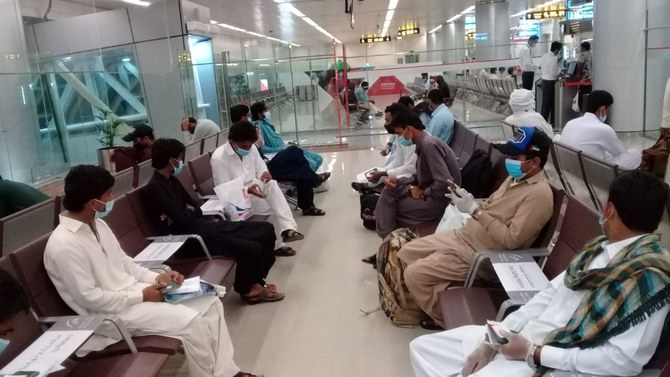
A group of Pakistanis who were stranded in the UAE by the coronavirus outbreak are waiting at Sharjah International Airport to board a flight to Karachi on July 15, 2020. (Photo courtesy: Taimoor H.)
Short Url
Updated 16 July 2020
Follow

Over 120 Pakistanis stranded in Sharjah to fly home on charter flight today

  • Most of these individuals could not afford their air tickets and were helped by Pakistan’s diaspora community and diplomatic mission
  • Many of these individuals had lost their jobs due to the economic downturn caused by the COVID-19 pandemic

DUBAI: A senior Pakistani diplomat in the United Arab Emirates confirmed on Wednesday that more than 120 Pakistani nationals would fly back to their country in a chartered plane on July 16, adding that most of these individuals could not afford their air tickets and were helped by the country’s diaspora community and the consulate general that booked a Serene Air flight to help them.
“At least 125 people will fly out of Sharjah to Karachi on a special chartered flight that will depart tomorrow morning,” Pakistan’s Consul General in Dubai Ahmed Amjad Ali told Arab News. “We are also planning another special flight for Islamabad soon.”
Ali said that some of the people traveling back to their country had lost their jobs due to the economic downturn caused by the COVID-19 pandemic while others were illegally living in the Emirates for the past few years.
The consulate also provided assistance to many of these individuals who were not in possession of their passports, issuing them “out passes” and regularizing their documents.
Last month, the consulate announced that it had completed the “biggest ever” repatriation from the Gulf countries by sending 30,229 Pakistanis back from Dubai and Northern Emirates through 138 flights.
“We had given 567 free tickets at that time, but we have given 500 more since then,” Ali said.
He added that this group of people had not registered with the country’s diplomatic mission back then since they were not aware of the repatriation procedures.
“Majority of these people have been in dire straits for the past four months,” Taimoor H., who arranged the repatriation in coordination with the consulate, told Arab News on Wednesday.


A group of Pakistanis who were stranded in the UAE by the coronavirus outbreak board a bus to reach the Sharjah airport on July 15, 2020 from where they will take a flight to Karachi. (Photo courtesy: Taimoor H.)

This is the fourth batch of stranded Pakistani workers to be sent back over the past 15 days. Nearly 400 workers had been repatriated earlier this month in a similar way, he said.
A 40-year-old Pakistani national who has been in Dubai for the past eight years, Taimoor said he had been volunteering and aiding the community since the beginning of the coronavirus outbreak.
“I discovered the plight of these individuals through social media platforms and decided to help them out,” he continued.
Initially, about 22 people sought his help, but their number grew to 85 within a few days.
“The consulate helped arrange their accommodation, transportation and repatriation, and the group was finally sent back on July 3,” said Taimoor.
The rest of the Pakistani community also rallied behind the initiative, and a sum of AED125,000 was raised to buy tickets for those traveling on the flight tomorrow.
“Tickets have been expensive, so we decided to take the shortest flight possible to Pakistan which departs from Sharjah to Karachi,” he added.
32-year-old Fareed Baksh, who worked as a foreman at a construction company, told Arab News that he was happy to be traveling back to his country.
“I have no work for the past many months and people have been helping me with food and accommodation,” he said. “Someone told me that the consulate was going to arrange my ticket, so I came over here. Now I can finally return to Pakistan.”


In Pakistan’s Bannu, people start their day with a sugar rush

Updated 5 sec ago
Follow

In Pakistan’s Bannu, people start their day with a sugar rush

  • While much of Pakistan favors savory breakfasts, residents of Bannu prefer a sweet, caramelized halwa
  • People line up before sunrise at the decades-old Speen Sar restaurant to cherish its signature dish

BANNU, Pakistan: Before sunrise, the narrow lane outside Speen Sar, a modest restaurant, fills with customers waiting for halwa, a dense sweet made from wheat starch, sugar and clarified butter, that serves as breakfast for many people in this northwestern city.

Inside the restaurant’s kitchen, the morning air is thick with the scent of caramelized sugar and heated ghee. A chef leans over a large metal vat, dissolving sugar into the hot fat before adding a slurry of flour and water. With rhythmic, heavy strokes, he stirs the mixture until it thickens into a glossy halwa.

He pours the sweet onto a tray and rushes toward the counter, where a crowd of patrons has already gathered. Three cooks work in quick succession to keep pace with demand, turning out batch after batch during the breakfast rush in Bannu, a city in Pakistan’s Khyber Pakhtunkhwa province.

While halwa is widely eaten as a dessert or festival sweet across South and Central Asia and the Middle East, Bannu stands apart for turning it into a morning staple. Across most of Pakistan, breakfast tends to be savory, typically consisting of omelets, parathas or puris, and in some places nihari, a slow-cooked meat stew. Here, however, halwa is not a side dish but the meal itself, eaten plain or with bread before the workday begins.

“We open the shop at the time of morning prayer, and after prayer, we start preparing,” says Zahid Khan, whose grandfather Akbar Ghulam opened the restaurant over six decades ago.

The shop’s name, Speen Sar — Pashto for “white-haired man” — dates back to its earliest days. Khan said the business began as a small stall run by his grandfather. As he grew older and his hair turned white, customers began directing others to the “speen sar” shop, the place where the white-haired man sold halwa. The nickname endured, eventually becoming the shop’s official identity.

Speen Sar relies on a labor-intensive process of extracting starch from wheat flour.

“In our halwa, we use ghee, sugar, flour and other ingredients. From the flour, the starch that comes out is what we use to make the halwa,” Khan explained before examining the cooking process in his kitchen.

Bannu sits at the crossroads between Pakistan’s former tribal areas and the settled plains of the northwest, and the halwa shop serves as a rare social equalizer, drawing laborers, traders, students and travelers to the same counter each morning. For many passing through the city, stopping for halwa is not optional.

“Whenever I come from Waziristan ... the first thing I do is start with halwa,” says Irafullah Mehsud, an expatriate worker. “I eat the halwa first, and only then move on to other things.”

The popularity of the dish is partly due to its shelf life and to what the owners call good quality. At Rs500 ($1.80) per kilogram, it is an affordable luxury as well.

“Our halwa is widely consumed with breakfast, and it does not spoil quickly. If you want, that you will eat it tomorrow, you can even set some aside for the next day,” Khan said, pointing to a tray of nishasta halwa, a variety made by extracting wheat starch before cooking.

While the region offers variations including sohan halwa, milk-based recipes, and carrot-infused batches, this halwa offered by Speen Sar remains the undisputed king of the breakfast table in this city.

“This is a tradition of the people of Bannu. Early in the morning, everyone eats it and comes here,” says Razaullah Khan, a student at a local college. “Eating halwa is a common practice here ... but this one is the most popular. People eat it for breakfast.”

For the elders of the city, the habit is as much about routine as it is about flavor.

“This tradition has been going on for the past forty to fifty years ever since I can remember,” says Sakhi Marjan, a local elder in his late sixties. “We first come to the Azad Mandi market and then come here to eat halwa. We really enjoy this halwa. It is delicious.”

As the sun rises over Bannu, this ‘sweet’ trade shows no sign of slowing. For those like Gul Sher, a regular from Jani Khel, a town in a neighboring tribal district, a day without the local sweet is a day started wrong.

“As soon as I step into Bannu, I start my day with halwa. After that, the rest of the day goes well,” Sher said before finishing his plate of halwa.

“It is a sweet dish, and it makes the day better. It is a good thing.”