

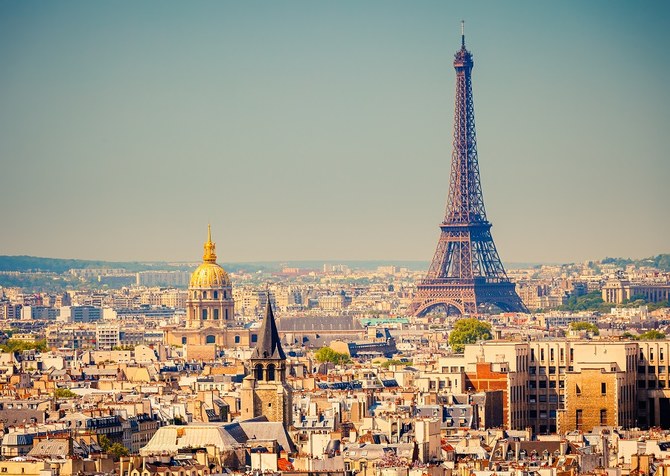

RIYADH: For decades, France has been a hotspot for Saudi tourists who are drawn to its rich history, decadent dishes, luxury shops and stunning landscapes.
It comes as no surprise that close to 200,000 Saudi citizens visit France each year, with 96 percent of Saudis applying for French travel visas getting approved.
Dania Halawani, a 28-year-old accountant who traveled to France for the first time during her honeymoon in 2017, told Arab News it was an experience that she will treasure and hopes to repeat it in the near future after the pandemic is over.
“Besides being breathtakingly beautiful and rich with culture in every corner you take, it’s an absolutely romantic country,” said Halawani, who lives in Jeddah.
She stayed in France a week, taking in the sites of Paris, Versailles and Marseilles. “Versailles was absolutely stunning,” she said, of her trip’s highlight. “We walked through the palace and it felt like we were reliving and breathing its history.”
Perhaps one of the downsides of her experience was communication, or the lack of it. “The French people are proud and take pride in their language, which forced me to pick up a few words to be able to communicate with them.”
While France might be rich in history and culture, it is also the hallmark of fashion worldwide. Noura Mufti, a luxury brand retail manager in Jeddah, takes inspiration from the impeccably dressed people. “What will really catch your eye is the fashion trends you see each year,” she said.
South of France is all about luxury, relaxation and dressing up, Mufti said with a smile, reminiscing fondly about her time on the French Riviera, with its white sands, delicious dishes and luxurious yachts.
“Women dress up beautifully in the mornings and evenings. During the day, you will notice wonderful summer dresses and bikinis worn; everyone is tanned and looking fabulous. During the night, people dress up to a cocktail-event standard. They really go all out, and it is not surprising to notice women walking around with fine jewelry or attractive crocodile bags,” Mufti said.
There is no lack of fine dining, with France being one of the top countries around the world for Michelin-starred establishments — there are 632 of them.
It was France’s food culture that led Al-Batoul Al-Maddah, 22, to pursue her passion, baking, in Paris. “I would travel to Paris for every vacation and would discover new pastries and try new flavors, since pastries are like fashion, all about new trends,” said Al-Maddah, who lives in Jeddah.
While many people study in schools in London and Italy to pursue their culinary careers, she chose Paris for two reasons. “First, it is very rich in terms of its food culture and the fact that it transforms all cuisines creatively. Second, my student life in Paris was remarkable, and I had the chance to learn more about what I truly enjoy, and currently I am a certified chef in Saudi.”
During her time in Paris, she met many Michelin-starred chefs. “I had the opportunity to talk to them and learn from their expertise and profession,” she said.
Hadeel Al-Nufaiey, a 32-year-old graduate of Paris Descartes University, also known as Paris V, lived for five years in Paris. “It was such a rich experience, and I definitely learnt in various areas, such as culturally, educationally, and socially.”
Al-Nufaiey moved to Paris less than a week after the terrorist attacks of Nov. 13, 2015. “The events that took place were bombings that occurred in the French stadium. There were shootings in cafe Bonne Biere. I was very scared before I arrived, but thankfully when I arrived, I saw the situation and how there were police everywhere, so the condition was safe and stable. I became calmer and started going out normally.”
Not much was known about Saudi Arabia other than what was portrayed in the media, and she considered herself an unofficial ambassador for her country. “My relationships were really good in university, and I met various nationalities, and they were all great.”
She had many discussions about Saudi stereotypes, explaining the diversity of the country and how peaceful Islam is. “I was very happy to see how the perception of my country really changed them and they were all shocked that I am Saudi. Most of them never saw and interacted with Saudis, and only knew them from the media. I tried to (create) change as much as possible, and I hope I represented Saudi Arabia in the best way.”
Returning just a few months ago to Riyadh with her degree in export policy management in hand, and her two young children speaking fluent French, she said: “It was a remarkable experience for me, a journey of almost five years. I hope I left the country with a good imprint as well as the image portrayed toward Arabs, specifically toward Saudis.”


