

OPEC+ close to deal on next phase of oil cuts

1 / 2
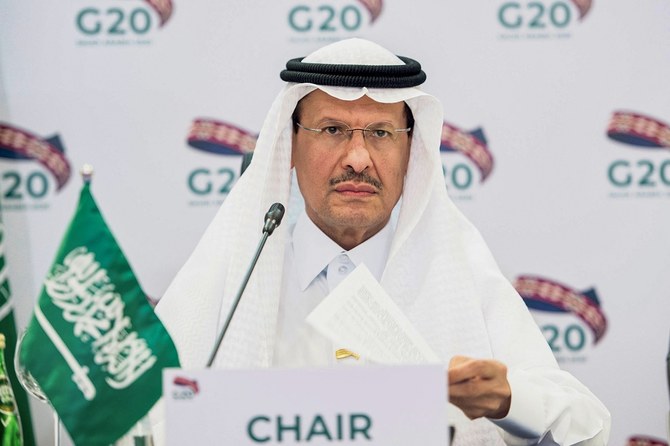
Prince Abdul Aziz bin Salman, the Saudi energy minister, held phone discussions with his counterpart in Iraq. (File/AFP)
2 / 2
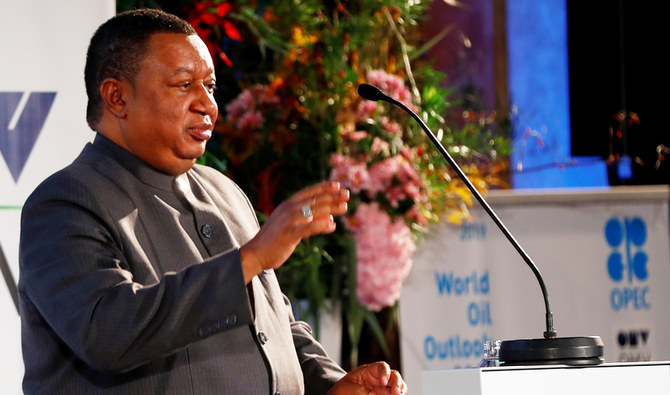
OPEC Secretary General Mohammad Barkindo delivers his speech during the presentation of the World Oil Outlook in Vienna, Austria November 5, 2019. (REUTERS)
Short Url
Updated 14 July 2020
Follow

OPEC+ close to deal on next phase of oil cuts

  • Saudi energy minister stresses importance of alliance members meeting production targets as experts point to markets rebalancing

DUBAI: OPEC+, the oil alliance led by Saudi Arabia and Russia, is close to a deal that will take it to the next stage of the historic agreement signed in April to limit global crude production.

Ministers from the 23 countries of the alliance will meet via webinar on Wednesday to seal the deal, but behind the scenes officials from the Organization of the Petroleum Exporting Countries (OPEC) have been in talks to finalize details of the agreement to add roughly 2 million barrels per day (bpd) of oil to current levels.

Prince Abdul Aziz bin Salman, the Saudi energy minister, held phone discussions with his counterpart in Iraq, Ihsan Ismail, where they affirmed their support for the new phase of the OPEC+ deal, which they agreed would “enhance oil market stability and help accelerate the rebalancing of global oil markets.”

In a call with Timipre Sylva, the Nigerian minister for petroleum resources, Prince Abdul Aziz emphasized the importance for all OPEC+ participants to meet production targets.

Russia has already signaled its desire to implement phase two of the OPEC+ agreement.

Experts believe that global oil markets had made big progress toward rebalancing since the mayhem of March and April, when oil prices collapsed.

Demand has increased as economies around the world come out of lockdown.

FASTFACT

Russia has already signaled its desire to implement phase two of the OPEC+ agreement.

OPEC+ efforts to reduce supply have been effective, and members have been meeting ambitious targets for compliance with the output levels.

The vast majority of producers have hit targets of 100 percent compliance. Some — including Saudi Arabia as the leading OPEC producer — have exceeded their targets.

The next OPEC+ schedule, which will start on Aug. 1, will see cuts in production tapered to 7.7 million bpd from the current level of 9.6 million bpd agreed in April.

OPEC+ policymakers have been encouraged by pledges from some of the countries that had missed earlier targets — such as Nigeria and Iraq — that they would make up those shortfalls by compensatory cuts in production in the summer months. Nigeria has promised 100 percent compliance.

Oil producers in the Middle East traditionally use more fuel oil domestically during the hot summer months, and that will be accentuated this year as people who would have travelled for vacation, stay at home because of the coronavirus disease (COVID-19) pandemic-related travel restrictions.

The OPEC+ agreement, as well as natural declines in other oil-producing countries because of falling demand and crude prices, is credited with rebalancing the global market.

OPEC Secretary-General Mohammed Barkindo said: “If we had not acted in such a decisive way, the market would have been in danger of a near-total collapse.”

Oil prices have more than doubled since the lows of April. Brent crude traded at $43.25 per barrel yesterday.


Mawani, Qatar Ports ink cooperation deal to boost regional maritime trade 

Updated 18 February 2026
Follow

Mawani, Qatar Ports ink cooperation deal to boost regional maritime trade 

RIYADH: The Saudi Ports Authority, or Mawani, and Qatar Ports Management Co. signed a memorandum of understanding aimed at boosting maritime and logistics cooperation, contributing to the development of the ports sector, raising operational efficiency, and supporting regional and international trade flows. 

The MoU was signed by Mawani President Suliman Al-Mazroua and Qatar Ports Management Co. CEO Abdullah Mohammed Al-Khanji, in the presence of Qatari Ambassador to Saudi Arabia Bandar bin Mohammed Al-Attiyah. 

The step reflects both sides’ commitment to building effective partnerships, exchanging expertise, establishing an organized framework for cooperation management, and developing joint investment opportunities in line with Saudi Vision 2030 and Qatar National Vision 2030. 

The MoU outlines eight key areas of cooperation, including the exchange of best practices in port management and operations, and studying opportunities for direct maritime and land connectivity between the two countries’ ports to enhance trade efficiency. 

It also includes collaboration in logistics services, exploring the establishment of joint maritime corridors serving bilateral and regional trade, and assessing the feasibility of creating shared regional distribution centers. 

Both parties agreed to enhance cooperation in digital transformation and artificial intelligence, focusing on smart systems, data governance, and a unified maritime window to improve operational efficiency and remain at the forefront of technological progress in the maritime sector. 

The MoU emphasizes maritime safety and environmental protection, including the exchange of expertise on marine pollution control and emergency response, the development of joint maritime emergency plans, and the establishment of a bilateral emergency communication line.  

It also promotes collaboration to ensure compliance with international conventions, conduct joint exercises, and implement risk-monitoring systems. 

Cooperation further extends to human capital development through joint training programs and on-the-ground expertise exchanges, as well as academic and research partnerships in maritime transport and logistics. 

Regarding joint investment, both parties will explore local and international opportunities in ports and related services, coordinating with the private sector to support these initiatives. 

The MoU also includes cooperation in cruise tourism through enhanced maritime connectivity and joint promotion of Gulf cruise routes, as well as coordination of positions in international maritime organizations and support for joint initiatives, notably “Green Ports” and “Safe Sea Corridors.” 

This memorandum reflects the commitment of Mawani and Qatar Ports Management Co. to advancing the ports sector and boosting its role as a key driver of trade and economic growth, contributing to Gulf integration, and enhancing regional competitiveness in maritime services.