LONDON: Hollywood actor Johnny Depp strenuously denied being violent to his ex-wife Amber Heard, as he launched a libel claim in a London court on Tuesday against a British tabloid newspaper that called him a “wife-beater.”
The “Pirates of the Caribbean” star, 57, is suing the publishers of The Sun and the author of the article for the claims, which were made in April 2018.
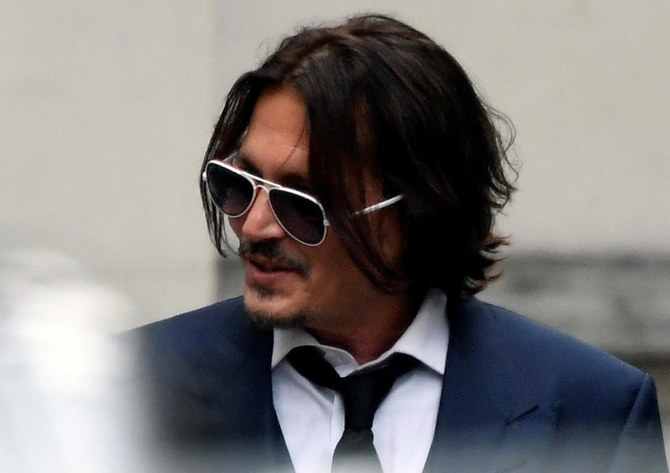
Depp, wearing a dark suit, white shirt and facemask, was met by a throng of cameras as he arrived at court while Heard, a 34-year-old actress, used a separate entrance.
The high-profile case has laid bare the couple’s turbulent relationship, which ended in divorce in 2017, just two years after they married.
But Depp said in a witness statement submitted to the court: “For the avoidance of any doubt, I have never abused Ms Heard, or, indeed any other woman, in my life.”
He said it was a “strong and central part” of his moral code that he would never hit a woman, having witnessed domestic violence growing up and vowed never to do so.
“I find it simply inconceivable and it would never happen,” he added.
“She (Heard) is a calculating, diagnosed borderline personality; she is sociopathic; she is a narcissist; and she is completely emotionally dishonest,” he went on.
“I am now convinced that she came into my life to take from me anything worth taking, and then destroy what remained of it.
The couple first met on the set of the 2011 film “The Rum Diary” and married in 2015.
News Group Newspapers (NGN) is contesting the case, and is relying for its defense on 14 separate claims of domestic violence said to have occurred between early 2013 and May 2016.
It argues Depp was “controlling and verbally and physically abusive toward Ms Heard, particularly when he was under the influence of alcohol and/or drugs” — and has evidence to prove it.
But Depp said it was the other way round, accusing Heard of violence against him during their “unhappy” time together.
In one alleged incident, he said she repeatedly punched him in the face, and in another severed his finger with a flying vodka bottle and stubbed out a cigarette on his cheek.
Heard has claimed she was physically assaulted over three days in Australia in early 2015 but Depp called the allegations “sick... and completely untrue.”
He rejected claims of being overbearing and instead said Heard had an “obsessive need” to control him, encouraging him to drink and take drugs, despite his well-known addiction issues.
Depp’s lawyers, in a written outline of his case to the court, also argued that although the couple’s relationship was at times “physical,” it was at Heard’s instigation.
Lawyer David Sherborne said his client on occasions had to defend himself from Heard’s violence, calling her allegations “complete lies.”
“He is not a wife-beater and never has been,” he said.
Heard was a “complex individual,” whose behavior was “extremely unpredictable,” with violent rages and prone to extreme mood swings, he added.
She sought attention, was provocative, had affairs, and was on a “wide range” of prescribed medication and other drugs.
Depp loved her but found her behavior “often bewildering” and “very difficult” to understand or deal with, he added.
Depp was the first witness called in the case and under cross-examination admitted using drugs and alcohol from a young age to “numb the pain” of a difficult childhood.
But he rejected suggestions from NGN lawyer Sasha Wass he had a “nasty side,” that saw him turn into a “monster” who would lose control, smash up hotel rooms and assault photographers.
“It wasn’t Dr. Jekyll and Mr.Hyde,” he insisted.
The Sun story — “Gone Potty: How can JK Rowling be ‘genuinely happy’ casting wife beater Johnny Depp in the new Fantastic Beast film?” — came after he had already publicly denied domestic violence.
Depp said he had suffered “significant reputational damage” as a result, both in terms of his career and personally.
The High Court trial is due to last three weeks.


Johnny Depp denies ‘wife-beater’ claim in London libel trial

https://arab.news/8upsu
Johnny Depp denies ‘wife-beater’ claim in London libel trial

- The high-profile case has laid bare Johnny Depp and Amber Heard’s turbulent relationship, which ended in divorce in 2017
- The couple first met on the set of the 2011 film ‘The Rum Diary’ and married in 2015


Sale of Saudi artist Safeya Binzagr’s work sets record at Sotheby’s auction in Riyadh
RIYADH: A painting by Saudi artist Safeya Binzagr sold for $2.1 million at Sotheby’s “Origins II” auction in Riyadh on Saturday, emerging as the top lot of the evening and setting a new auction record for a Saudi artist.
The work, “Coffee Shop in Madina Road” (1968), sold for $1.65 million before the buyer’s premium, the additional fee paid by the purchaser to the auction house on top of the hammer price.
The result nearly doubled the previous auction record for a Saudi artist and became the most valuable artwork ever sold at auction in the Kingdom. It also ranks as the third-highest price achieved for an Arab artist at auction.
It was presented as part of “Origins II,” Sotheby’s second auction staged in Saudi Arabia, comprising 62 modern and contemporary lots and bringing together Saudi artists alongside regional and international names.
Collectors from more than 40 countries participated in the auction, with around one-third of the lots sold to buyers within Saudi Arabia.
The sale totaled $19.6 million, exceeding its pre-sale estimate and bringing the combined value of works offered across “Origins” and “Origins II” to over $32 million.
Saudi artists were central to the evening’s results. All nine Saudi works offered found buyers, achieving a combined total of $4.3 million, well above pre‑sale expectations.
Ashkan Baghestani, Sotheby’s head of contemporary art for the Middle East, told Arab News at the auction that “Safeya made more than any other artist tonight, which is incredible.”
He said the results demonstrated Sotheby’s broader objective in the Kingdom.
“The results tonight show exactly what we’re trying to do here. Bring international collectors to Saudi Arabia and give them exposure to Saudi artists, especially the pioneers.”
All nine works by Saudi artists offered in the sale found buyers, generating a combined $4.3 million. Additional auction records were set for Egyptian artist Ahmed Morsi and Sudanese artist Abdel Badie Abdel Hay.
An untitled work from 1989 by Mohammed Al-Saleem sold for a triple estimate of $756,000, while a second work by the artist, “Flow” from 1987, achieved $630,000.
The sale opened with the auction debut of Mohamed Siam, whose “Untitled (Camel Race)” sold for $94,500. Also making his first auction appearance, Dia Aziz Dia’s prize-winning “La Palma (The Palma)” achieved $226,800.
The sale coincided with the opening week of the Contemporary Art Biennale in Riyadh, reinforcing the city’s growing role as a focal point for both cultural institutions and the art market.
Baghestani added that Saudi modern artists are now receiving long‑overdue recognition in the market.
“There’s so much interest and so much demand, and the price is where it should be,” he said.
International highlights included works by Pablo Picasso, Roy Lichtenstein, Andy Warhol and Anish Kapoor, underscoring Saudi Arabia’s growing role as a destination for major global art events and collectors.
Picasso’s “Paysage,” painted during the final decade of the artist’s life, sold for $1,600,000, becoming the second most valuable artwork sold at auction in Saudi Arabia.
Seven works by Lichtenstein from the personal collection of the artist and his wife, including collages, prints, works on paper and sculptures, all found buyers. Warhol was represented in the sale with two works: “Disquieting Muses (After de Chirico),” which sold for $1,033,200, and a complete set of four screenprints of “Muhammad Ali,” which achieved $352,000.
Baghestani said the strength of the results was closely tied to the material’s freshness. “These were not works from the trade. Some of them had not been seen since the 1970s,” he said.


