

Tech-savvy Indonesians go off-grid to help to remote villages fight virus

1 / 4
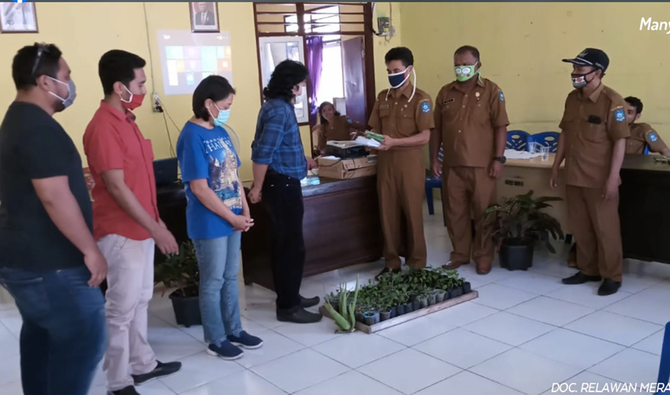
Relawan Merahb Putih handed over their assistance to officials in the Duma village of North Maluku regency during a campaign to spread awareness of the pandemic. (Photo credit: Relawan Merah Putih/Komunitas Manyawa)
2 / 4
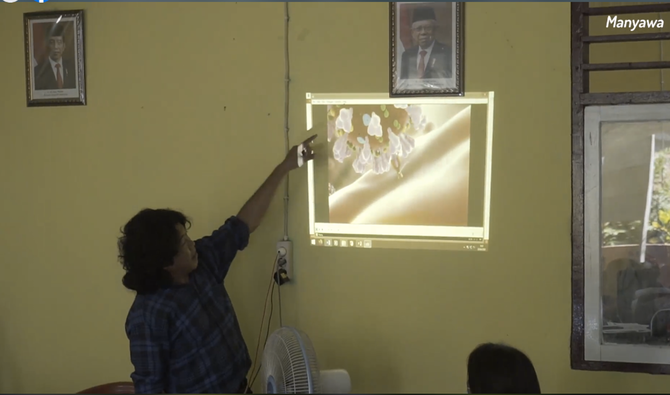
Microbiologist and volunteer adviser Jubhar Mangimbulude explains about the coronavirus to villagers during the awareness campaign. (Photo credit: Relawan Merah Putih/Komunitas Manyawa)
3 / 4
Microbiologist and volunteer adviser Jubhar Mangimbulude explains about the coronavirus to villagers during the awareness campaign. (Photo credit: Relawan Merah Putih/Komunitas Manyawa)
4 / 4
Microbiologist and volunteer adviser Jubhar Mangimbulude explains about the coronavirus to villagers during the awareness campaign. (Photo credit: Relawan Merah Putih/Komunitas Manyawa)
Short Url
Updated 04 July 2020
Follow

Tech-savvy Indonesians go off-grid to help to remote villages fight virus

  • Young volunteers tackle tough terrain, pandemic myths in isolated northern region

JAKARTA: A group of tech-savvy young locals in Indonesia’s northern North Halmahera regency is spreading awareness about the dangers of COVID-19 in remote corners of the archipelago at a time when bureaucracy has impeded a rapid response to the pandemic.

The Relawan Merah Putih, or Red and White Volunteers, includes a multimedia expert, university students, lecturers, civil servants and a web developer in Tobelo, the main city of North Halmahera in North Maluku province, about 2,500 km from the capital Jakarta.

The city is located on Halmahera island, part of the Maluku Islands, Indonesia’s fabled Spice Islands on the northeastern part of the sprawling archipelago.

Stevie Recaldo Karimang, a 28-year-old freelance photographer and videographer, told Arab News that he set up the group after social restrictions introduced to counter the pandemic put him out of business. 

He quickly developed a website on the pandemic and created online flyers and audiovisual materials that he and 31 other volunteers distributed on social media platforms and messaging apps to educate the public about the pandemic soon after the first cases in Indonesia were confirmed in Jakarta in early March.

“We translated the information we took from the national COVID-19 task force into the market language spoken here, which is a mixture of Indonesian and the local dialect, to make it more understandable for the locals,” Karimang said.

The group also used a drone to issue public warnings against mass gatherings.

“The drone helped to remind people not to form a crowd when social restrictions were enforced. We attached a flashlight to the device to catch the crowd’s attention, and we were able to dismiss such gatherings.”

But the volunteers shifted their efforts to rural areas after the first coronavirus case in North Maluku province was confirmed on March 23.

Jubhar Mangimbulude, a microbiology expert at Halmahera University and the group’s adviser, said the team had visited 30 isolated villages out of 196 townships in the regency, which is home to 161 million people.

“We reached one village after hours of driving over rough terrain. We have to use four-wheel-drive vehicles because along the way we may have to cross a river where the bridge is damaged,” he told Arab News.

Mangimbulude said that many villagers were unaware of the pandemic and only knew from TV that a dangerous virus was spreading quickly and infecting people. He was glad to find that no COVID-19 cases had been detected among the villagers.

But he acknowledged that misinformation was rife and said that he had to debunk myths about “how alcohol could be used to prevent the disease.”

“The villagers heard that the virus can be killed with heat in one’s body, and since drinking alcohol can warm the body, they encouraged their children and elders to drink a local alcoholic beverage made of fermented sugar palm fruit,” Mangimbulude said.

Fellow volunteer Oscar Berthomene, a local civil servant, said that the group was able to move faster than the regency administration whose bureaucracy slowed down the response to the pandemic.

“I have support from my supervisor, and we were able to help their activities with cars to allow them to move around,” he told Arab News.

The regency has about 18 percent of the 953 cases in the province, which make up about 1.5 percent of the national total of 62,142 as of Saturday.


8 in 10 British Muslims face ‘financial faith penalty’ when seeking home finance, survey finds

Updated 04 February 2026
Follow

8 in 10 British Muslims face ‘financial faith penalty’ when seeking home finance, survey finds

  • Restricted choices plague potential buyers

LONDON: Eight in 10 British Muslims say their home finance choices are restricted because of their faith, according to a new national survey that highlighted what researchers describe as a growing “financial faith penalty” in the UK housing market.

The report, published by Islamic home finance fintech firm Offa, found that 80 percent of Muslim respondents believe their religious beliefs limit their access to suitable home finance, while those who do use Islamic products often face slower decisions, heavier paperwork and poorer customer experiences than in the conventional mortgage market.

Based on surveys of 1,000 British Muslims conducted by Muslim Census, and 2,000 non-Muslims carried out by OnePoll, the research calls on providers, brokers and policymakers to modernize Islamic home finance and improve access to Sharia-compliant products.

Among the 24.3 percent of British Muslims who have used Islamic home finance, just 5 percent said they had received a same-day decision.

Some 62 percent waited up to two weeks, while 33 percent waited more than 15 days, including 16 percent who waited over a month.

Long decision times were cited as the biggest challenge by 28 percent of respondents, followed by excessive paperwork (22.6 percent) and poor customer service (18.9 percent).

Islamic home finance differs from conventional mortgages by avoiding interest and steering investment away from sectors considered harmful to society, including gambling, alcohol, tobacco, arms trading and animal testing.

Sagheer Malik, chief commercial officer and managing director of home finance at Offa, said the findings showed British Muslims were being underserved by outdated systems.

Malik said: “Property is the asset class of choice for many of the UK’s 3.87 million Muslims, both as a route to generational wealth and as a long-term financial foundation, yet our insightful research report reveals that British Muslims are being underserved and deterred by slow, outdated and opaque Islamic home finance provision.

“This is not a niche concern. It goes to the heart of financial fairness and inclusion in modern Britain.”

He added that Muslims deserved Sharia-compliant products that matched mainstream standards on “price, speed and simplicity.”

Despite strong demand, uptake remains low.

Only 12.8 percent of British Muslims surveyed said they currently use Islamic home finance, with a further 11.5 percent having done so in the past. More than three quarters (75.7 percent) have never used it.

Faith plays a central role in financial decisions, with 94.2 percent saying it is important that their financial products align with their ethical or religious beliefs. Yet more than half of those using conventional mortgages said they felt unhappy or uneasy about doing so because of their faith.

The study also found that British Muslims share similar home ownership aspirations to the wider population, with 79.1 percent citing the desire to provide a stable home for their family, while 18.6 percent said building generational wealth was their main motivation. Only 2.2 percent said they did not want to own a home.

The report suggests Islamic finance could appeal beyond Muslim communities. While 64 percent of non-Muslim respondents had never heard of Islamic home finance, 63 percent said they favored its ethical principles once explained.

Younger generations were the most receptive, with 43 percent of Generation Z and 37 percent of millennials saying they would consider using Islamic home finance, compared with just 7 percent of baby boomers. More than three quarters of Gen Z and 72 percent of millennials also said it was important that their finance provider avoided investing in ethically harmful sectors.

Offa said the findings pointed to an opportunity to expand ethical finance in the UK, provided the industry can deliver faster, simpler and more transparent services.