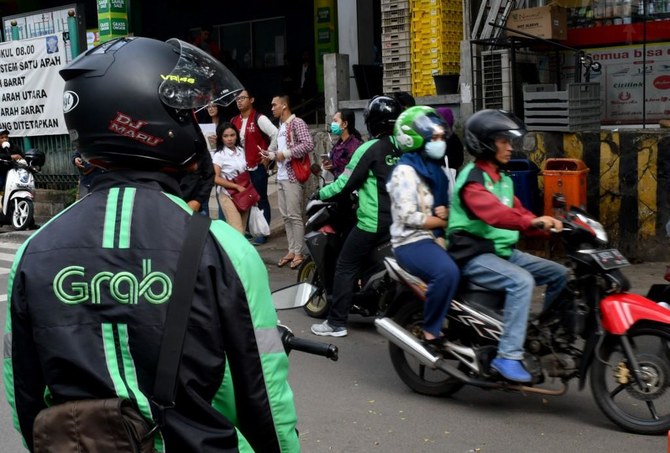
JAKARTA: Indonesia’s anti-trust watchdog announced fines totaling more than $3 million for Grab and its business partner after finding it guilty of breaking anti-monopoly laws, a verdict the ride-hailing firm vowed to appeal.
The Business Competition Supervisory Commission (KPPU) said it had found Grab had discriminated against its drivers, prioritizing those provided by partner PT Teknologi Pengangkutan Indonesia (TPI) to the Softbank-backed firm.
In a statement, Dinni Melanie, the chair of the watchdog judicial panel, said it had found Grab infringed the anti-monopoly laws after evaluating the case on Thursday evening.
The agency imposed a fine of $2.1 million on Grab and a penalty of $1.03 million rupiah on TPI.
A spokesman for Grab, which is Southeast Asia’s most valuable startup with a valuation of $14 billion, said the firm would appeal the verdict.
“Grab’s view is that it has not violated any regulation, engaged in any anti-competitive business practices, or injured any third parties,” he said, characterizing the watchdog’s findings as “unsubstantiated allegations.”
Reuters could not immediately reach TPI to seek comment.

Indonesia’s anti-trust watchdog levies $3 million in fines on Grab and partner
https://arab.news/wv8up
Indonesia’s anti-trust watchdog levies $3 million in fines on Grab and partner
- Grab infringed the anti-monopoly laws after evaluating the case
- Grab is Southeast Asia’s most valuable startup with a valuation of $14 billion

Saudi tourism employment surpasses 1m as hospitality sector expands
RIYADH: Saudi Arabia’s tourism workforce surpassed 1 million in the third quarter of 2025, underscoring the sector’s rapid expansion as the Kingdom continues to develop its hospitality infrastructure and visitor economy.
According to the latest Tourism Establishments Statistics report released by the General Authority for Statistics, the total number of employees in tourism activities reached approximately 1,009,691 in the third quarter of 2025, marking a 6.4 percent increase compared to the same period in 2024, when employment stood at 948,629.
The growth in employment comes alongside a significant rise in the number of licensed tourism hospitality facilities, which increased by 40.6 percent year on year to reach 5,622 in the third quarter. Of these, serviced apartments and other hospitality facilities accounted for 52.6 percent, while hotels represented 47.4 percent.
The robust growth reflected in the latest tourism statistics aligns directly with the goals of Vision 2030, as the Kingdom aims to double tourism’s gross domestic product contribution to 10 percent. The sector is also seeking to create 1.6 million jobs, and attract 150 million visitors annually by 2030.
The report showed that non-Saudi employees made up the majority of the tourism workforce, numbering 764,520 and accounting for 75.7 percent of the total. Saudi nationals employed in the sector reached 245,171, representing 24.3 percent of all tourism workers.
In terms of gender distribution, male employees dominated the sector with 875,658 workers, while female employees totaled 134,033, making up just 13.3 percent of the workforce.
Hotel performance showed positive momentum, with the average room occupancy rate rising to 49.1 percent during the quarter, an increase of 2.9 percentage points from 46.1 percent in the same period a year earlier.
In contrast, serviced apartments and other hospitality facilities experienced a slight dip in occupancy, recording 57.4 percent compared to 58 percent in the same quarter of 2024.
The average daily room rate in hotels decreased by 3.6 percent to SR341 ($90.9), down from SR354 in the third quarter of 2024. Meanwhile, serviced apartments and similar facilities saw their average daily rate rise by 4.1 percent to SR208, up from SR200 a year earlier.
The average length of stay in hotels was 4.1 nights, down 1 percent from 4.2 nights in the third quarter of 2024. For serviced apartments and other hospitality facilities, the average stay was 2.1 nights, reflecting a marginal decrease of 0.2 percent year-on-year.
The statistics draw on administrative records, surveys and secondary data to capture activity across the Kingdom’s tourism sector, GASTAT said.


