



ISLAMABAD: Pakistan’s health ministry spokesman, Sajid Shah, told Arab News on Saturday the number of people willing to get tested for COVID-19 in the country had decreased, even though the government had not reduced daily testing capacity amid optimistic rates of recovery.
After reporting its first case on February 26, Pakistan has so far officially registered nearly 213,000 infections of COVID-19 and 4,619 deaths. Of those infected, 125,000-- more than 50 percent-- have recovered.
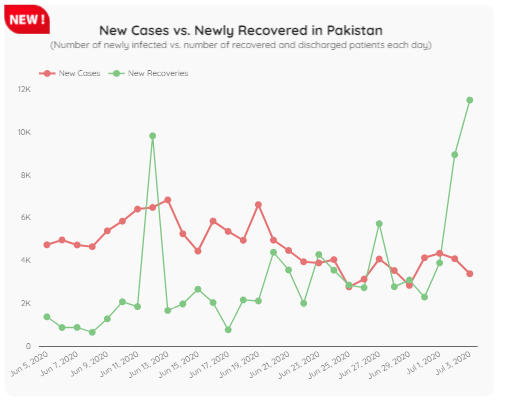
“The masses consulting the NHS (National Health Services) to treat symptoms and our doctors advising patients over the phone have helped a great deal with recoveries... but at the same time the number of people willing to test for COVID-19 has dropped,” he said, and added it was still unclear whether the country had already reached the peak of the outbreak.
The optimistic recovery rate, he said, may well be a temporary phase.
But statistics look encouraging as more than half of Pakistanis who contracted COVID-19 have recovered with the country’s infection curve going down.
Health officials say a number of factors contributed to the high recovery rate.
“Hospitals have ramped up their facilities and are providing better care. District administrations have helped keep people indoors,” Pakistan Institute of Medical Sciences (PIMS) executive director, Dr. Minhaj us Siraj told Arab News. He praised the government’s efforts to enforce smart lockdowns in virus hotspots, as well as people’s compliance with social distancing measures.
#WATCH: “If patients are not coming for #COVID19 testing, then the surveillance and record will be affected” says Dr. Akhter as virus recoveries cross 50% bending the curve of active cases in #Pakistan
-
Read special by @sibkaifeehttps://t.co/5u1mZty9w6 pic.twitter.com/34RZrjGp9X— Arab News Pakistan (@arabnewspk) July 4, 2020
According to Siraj, nationwide awareness programs and recommendations of the National Command and Operation Center had also paid off with more people now conscious of the disease.
However he declined to comment on why the country’s coronavirus screening had dropped to 22,050 tests.
Last month, the government said it would increase its rate of testing to 50,000 tests a day from July. On June 19, Pakistan conducted 31,681 COVID-19 tests — the highest officially recorded.
Dr. Naeem Akhter, an infectious disease consultant and focal person for COVID-19 at PIMS, said people were “not very convinced for testing” because most knew they could recover on their own in the absence of a cure or vaccine.
“If the patients are not coming for testing, then the surveillance and record will be affected and you won’t be able to know how many people are basically affected,” she said.


