

Chinese mining firm gets 15-year lease for copper, gold exploration in Saindak

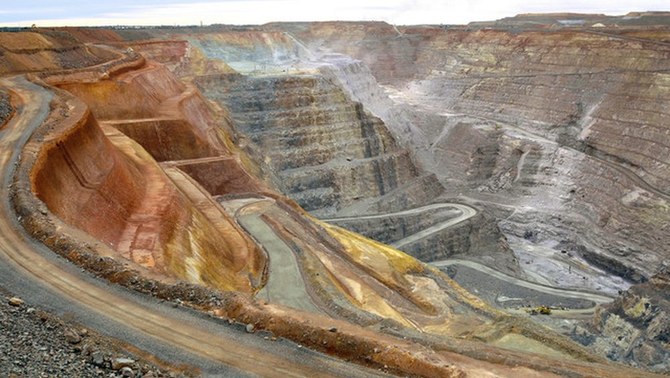
Chinese mining firm gets 15-year lease for copper, gold exploration in Saindak. (Phot courtesy: Social Media)
Short Url
Updated 02 July 2020
Follow

Chinese mining firm gets 15-year lease for copper, gold exploration in Saindak

  • The East Ore Body area contains about 278 million tons of copper and gold deposits
  • China’s MRDL will invest $45 million on the purchase of machinery and development of mines

KARACHI: Pakistan has allowed China’s MCC Resources Development Company (MRDL) to explore and develop eastern mines under the Saindak Copper-Gold Project for another 15 years, officials told Arab News on Wednesday.

A small town in Balochistan’s Chaghi district, Saindak has huge mineral resources. The Chinese company will invest $45 million to explore copper and gold in the East Ore Body (EOB) area of the town where 278 million tons of deposits are estimated.

“The money will be used to purchase machinery and develop the mines after the government of Balochistan has given its consent to extend our lease for the next 15 years,” Humayun Mehmoodi, MRDL vice president, told Arab News. “The current machinery needs to be replaced as it has been in use since 2002.”

Last Friday, Balochistan’s provincial administration informed the federal government that it had extended the stay of Metrological Construction Company of China (MCC) that has an agreement with the federally-owned Saindak Metals Limited (SML), making it possible for the foreign firm to continue the exploration and development work in the area.

Locally registered as MRDL, the MCC has been operating in Balochistan’s remote town since 2002, extracting significant amount of mineral resources from the region.

“The deposits in South and North Ore Body have almost depleted and soon there will be nothing to explore, so we approached the government to get the lease and agreement extended for the development of Eastern Ore Body,” Mehmoodi informed.

“The EOB has 278 million tons of reservoirs. It is the third and the largest reservoir with major content of copper. The mining life of the EOB is around 19 years,” he added.

The company’s contract agreement was scheduled to expire on October 31, 2022. In a letter written to the Federal Ministry of Energy, the Balochistan administration noted that an extension in the lease would “ensure investment of $45 million by MCC/SML at their own risk for exploration and development of East Ore Body in Saindak area.”

According to analysts, Chinese companies are playing an active role in the development of Pakistan’s southwestern province, since they are bringing in investments and technical support.

“The provincial government’s decision to extend the lease shows that it wants to continue the development of the local mining sector. The Chinese investment is also creating job opportunities in Balochistan,” Shaukat Populzai, president of Balochistan Economic Forum, told Arab News.

He added that the development of Gwadar would “change the economic geography of the area.”

MRDL officials say the company is providing employment to 1,890 Pakistanis and 85 percent of them are locals. The company also maintains that it is providing free electricity, water and schooling to the residents of about 60 villages surrounding the area.

T20 World Cup: ICC deputy chief in Lahore for talks after Pakistan boycotts India match

Updated 08 February 2026
Follow

T20 World Cup: ICC deputy chief in Lahore for talks after Pakistan boycotts India match

  • Islamabad’s boycott over Bangladesh’s exclusion has threatened the tournament’s most lucrative game
  • Bangladesh Cricket Board chief has also arrived in Pakistan and is expected to participate in meetings

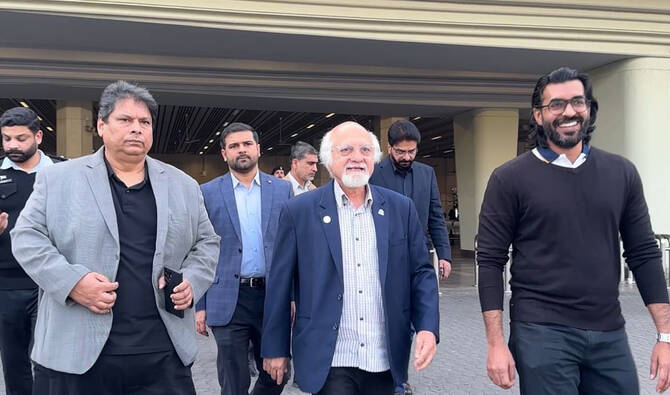
ISLAMABAD: International Cricket Council (ICC) Deputy Chairman Imran Khwaja arrived in Lahore on Sunday for talks with Pakistan Cricket Board (PCB) officials, the PCB said, as the sport’s governing body strives to save a high-stakes T20 World Cup clash between arch-rivals Pakistan and India.

The development follows Islamabad’s decision to boycott the Feb. 15 Pakistan-India match in Colombo, a move to protest the ICC’s exclusion of Bangladesh from the ongoing T20 World Cup.

The controversy over Pakistan’s participation erupted after the ICC replaced Bangladesh with Scotland, following Bangladesh’s decision to not play matches in India owing to security fears.

The ICC has since requested the Pakistan Cricket Board to reconsider the decision to boycott their match against India in Colombo or they will have to forfeit the marquee game of the tournament.

“ICC Deputy Chairman Imran Khwaja arrived in Lahore,” the PCB said on Sunday, adding that he was received at the airport by the PCB chairman’s adviser, Aamir Mir.

Prior to Khwaja’s arrival in Lahore, where the PCB is headquartered, Pakistan welcomed Bangladesh Cricket Board (BCB) President Aminul Islam, who was received by PCB CEO Salman Naseer.

The two visiting officials are scheduled to meet PCB Chairman Mohsin Naqvi.

“Bangladesh Cricket Board President Aminul Islam will also take part in other meetings,” the PCB said in a statement, hinting that he will be part of the meeting with ICC’s Khwaja.

The dispute stems from the ICC’s decision to replace Bangladesh with Scotland last month after Bangladesh refused to play tournament matches in India. Dhaka’s decision followed the removal of Mustafizur Rahman from the Indian Premier League (IPL). He was bought for $1 million by the IPL’s Kolkata Knight Riders, but on Jan. 3 the Board of Control for Cricket in India (BCCI) ordered Kolkata to release Mustafizur without a public explanation but amid regional tensions.

Pakistan have boycotted the 27th match of the tournament against India, due to take place at R. Premadasa Stadium in Colombo. An India-Pakistan fixture is the sport’s most lucrative asset, generating a massive share of global broadcasting and sponsorship revenue.

The PCB has remained defiant amid reports of potential sanctions. On Saturday, the board rejected claims by Indian media that it had initiated a dialogue with the ICC to find a way out of the standoff.

“I categorically reject the claim by Indian sports journalist Vikrant Gupta that PCB approached the ICC,” PCB’s Mir said in a statement. “As usual, sections of Indian media are busy circulating fiction. A little patience and time will clearly show who actually went knocking and who didn’t.”

The standoff highlights the growing friction within the sport’s governance.

Pakistan has accused India’s cricket board of influencing the ICC’s decisions.

Defense Minister Khawaja Asif this week called for the formation of a new cricket governing body, saying the ICC, currently chaired by Jay Shah, son of India’s Home Minister Amit Shah, was being held “hostage” to “Indian political interests.”

India generates the largest share of cricket’s commercial revenue and hence enjoys considerable influence over the sport. Critics argue that this financial contribution translates into decisive leverage within the ICC.

A large part of that revenue comes from the Indian Premier League (IPL), the sport’s most lucrative T20 cricket competition, which is run by the Board of Control for Cricket in India (BCCI). Between 2024 and 2027, the IPL is projected to earn $1.15 billion, nearly 39 percent of the ICC’s total annual revenue, according to international media reports.

While the Pakistani government cleared the team to participate in the rest of the tournament, Prime Minister Shehbaz Sharif maintained that the boycott of the India game was necessary to protest the “unjust” treatment of Bangladesh.