What We Are Buying Today: Tidy Kids

Short Url
Updated 26 June 2020
Follow

What We Are Buying Today: Tidy Kids

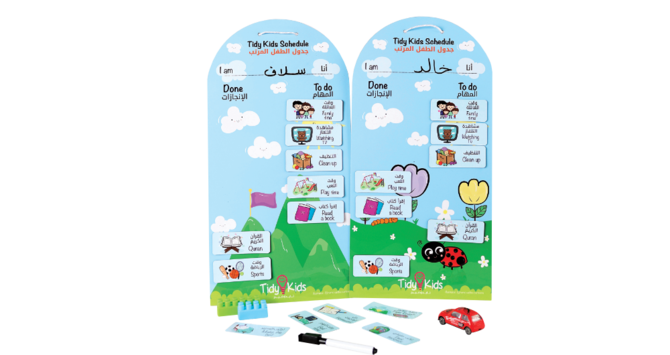
Tidy Kids is a project created in Saudi Arabia that aims to provide a fun, educational way to help children become more organized. It is designed for children aged 3 to 9. Tidy Kids offers two products — “Reward Chart” and “Tidy Kids Schedule.”
Founder Sumiah Al-Farhan said she wanted to create a product that helps teach kids how to be well-behaved and successful.
Reward Chart allows parents to record tasks that a child has to carry out and match each task with a reward for the child once it is completed. It is billed as a “helpful aid in encouraging good behavior as a visual reminder of how a child’s actions will be perceived as either positive or negative.”
Tidy Kids Schedule is split into “To Do” and “Done” lists of specific tasks for a child to accomplish each day. The company promotes it as a tool to enable children to “learn how to prioritize their tasks” and “learn how to motivate themselves in order to finish tasks and be rewarded.”
The aim of the project, the promotional material says, is to help parents raise their children in a better way and teach them that anything is possible with good planning.
“Tidy Kids serves as an effective way to monitor your child’s progress and celebrate their small successes and achievements,” it claims.
Tidy Kids’ products are available in Arabic and English on various online platforms for just under $24 per product.


Riyadh summit to highlight next-gen governance and strategic innovation

Updated 4 sec ago
Follow

Riyadh summit to highlight next-gen governance and strategic innovation

RIYADH: The fourth annual Governance, Performance, Risk, and Compliance Summit, themed “Integration for Strategic Performance,” will begin on Monday in Riyadh, aiming to transform regulatory systems from oversight tools into drivers of innovation and growth.

Inge Vasshus, chair of the organizing committee, said: “The summit seeks to foster a corporate culture where risk management and compliance are seamlessly embedded into strategic operations.”

Day 1 will open with a keynote titled “Risk Is Our Business,” focusing on shifting from documentation-based approaches to strategic risk integration.

The agenda includes panel discussions with representatives from the Center for Governance, the Royal Commission for AlUla, and the GCC Board Directors Institute, examining the integration of governance, risk, and compliance into Saudi companies’ strategies.

Speakers will also present case studies from Saudi institutions and PIF-backed companies, highlighting the impact of governance practices, the role of artificial intelligence in sustainability, and the link between sustainability and competitive governance.

Day 2 focuses on practical applications, starting with a session on managing supplier and third-party risks in complex organizations. This will be followed by a discussion on future governance frameworks and their alignment with international standards and Saudi Vision 2030.

The program will include a session on its impact on the risk management function, as well as a dedicated session on establishing AI governance frameworks.

It will further explore the evolution of the Gulf’s compliance function from a regulatory obligation into a driver of operational efficiency.

In addition, workshops will address applying “zero-trust” principles to AI agent security, the shift from reactive to proactive risk management, and the impact of individual dominance on board effectiveness.