

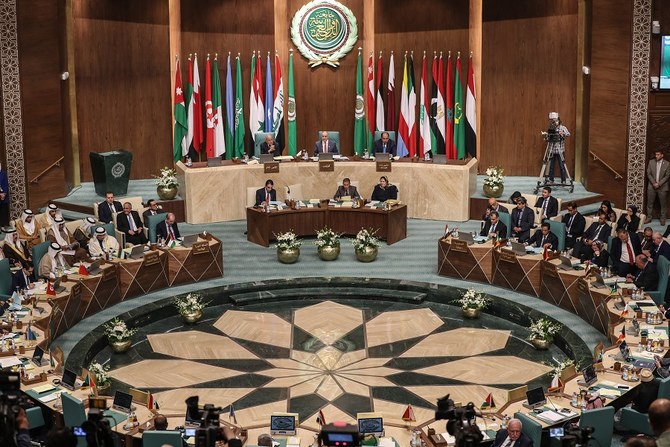

CAIRO: Arab foreign ministers have agreed to stick to a political solution for the Libyan crisis in accordance with the outcome of the Berlin Conference and the Cairo Declaration.
In a video meeting held on Tuesday, the ministers underlined the importance of a cease-fire and also discussed the reservations of the Government of National Accord (GNA) and Qatar on the declaration.
The meeting was chaired by Oman’s minister responsible for foreign affairs Yusuf bin Alawi upon Cairo’s invitation.
The foreign ministers reiterated that they upheld the sovereignty of the state of Libya, the wholeness of its territories and its national unity “every step of the way.” They also stressed their rejection of any local or foreign schemes to divide the country into “power regions,” thus causing a permanent rift in Libyan social coherence.
The ministers condemned all forms of foreign military interference in Libya “in accordance with the clear and firm resolutions of the Arab League Council in this regard, especially broader regional interference in the internal affairs of Arab states.” They rejected any military solution, which, they said, would not make any party victorious or achieve peace on Libyan soil.
They said that the solution should be achieved through a comprehensive political process addressing all the security, political, and economic paths under the original sponsorship of the United Nations, as affirmed by the Arab League resolutions.
The meeting called for a cease-fire, military de-escalation and an immediate truce, especially around the Libyan city of Sirte. The participants also called for the Libyan parties to re-engage in the negotiations of the Joint Military Committee (5+5) sponsored by the UN mission, to reach a permanent agreement.
The participants considered that any arrangements for a cease-fire will only succeed if there are clear commitments to expel foreign mercenaries from the country. They underscored the importance of disbanding armed militias operating outside of the state’s authority.
The meeting’s participants also called for the resumption of a serious political dialogue between the Libyans themselves under the sponsorship of the United Nations. They pointed to the constructive and detailed proposals in the Cairo Declaration which had broad Arab, regional, and international backing.
The Cairo Declaration, initiated by Egyptian President Abdel Fattah El-Sisi, mandates a Libyan-Libyan agreement for resolving the country’s conflict under resolutions by the UN and past efforts in Paris, Rome, Abu Dhabi, and most recently in Berlin.
The participants also discussed the “long path” of the Arab League as part of the Quartet grouping, alongside the United Nations, the European Union and the African Union. The Arab League is co-chairing the International Follow-Up Committee on Libya (IFCL), which is tasked with securing the commitments of the Berlin Conference, uniting international efforts to achieve peace in Libya.
At the meeting, Arab League Secretary-General Ahmed Abul Gheit spoke of the gravity of the current situation in Libya and warned that it was expected to escalate.
Egyptian Foreign Minister Sameh Shoukry said that Egypt was involved in all the international initiatives aiming to reach a political settlement in Libya. He added that Egypt had hosted the inter-Libyan political initiative launched by the Libyan parliament speaker and the Libyan commander-in-chief of the armed forces under the auspices of President El-Sisi on June 6.
The Egyptian foreign minister warned against the repercussions of continued foreign interference on Libyan territory, including the transport of foreign terrorists and mercenaries from Syria to Libya, which he said destabilizes Libya’s internal security and represents a huge threat to Arab national security.


