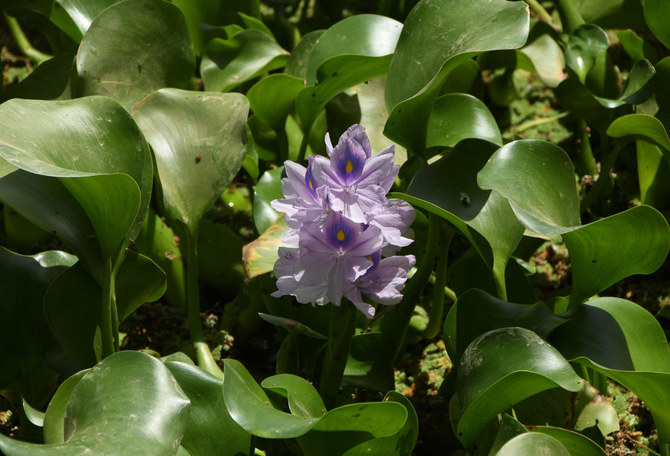
AL-BADAA: The broad leaves and delicate purple flowers floating on the Euphrates look breathtaking — but they are suffocating the waterways of Iraq, celebrated as the “land of the two rivers.”
The water hyacinth, nicknamed the “Nile flower” in Iraq, is an invasive plant native to South America’s Amazon basin that has ravaged ecosystems across the world, from Sri Lanka to Nigeria.
The fast-spreading pest poses a special risk in Iraq, one of the world’s hottest countries that is already suffering from regular droughts and shrinking water resources due to overuse, pollution and upstream river dams.
The exotic flower was introduced to Iraq just two decades ago as a decorative plant, but now the mighty Tigris and Euphrates rivers are being choked by its rapid spread.
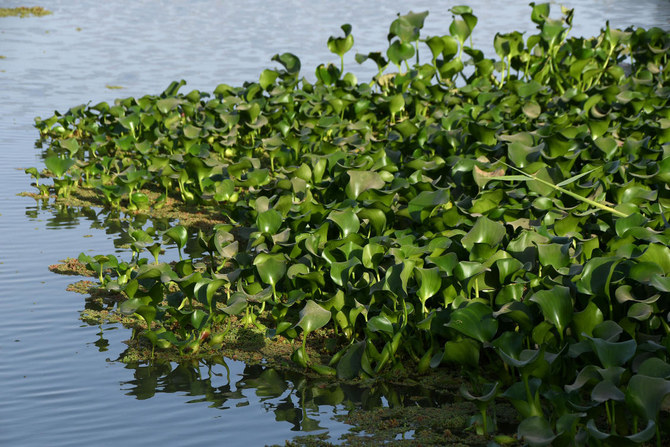
Its glossy leaves form a thick cover, absorbing up to five liters (1.3 gallons) of water per plant a day and blocking sunlight and oxygen vital to the aquatic life below.
That has made the hyacinth a formidable floral foe for Iraq’s fishermen, who sell hauls of river carp in local markets to those cooking “masgouf,” a national delicacy.
Because of the infestation, carp are dying and fishing nets get caught in the tangle of flat leaves, roots and flowers that also hampers boat travel.
“Our livelihoods are gone, all because of this Nile flower,” said Jallab Al-Sharifi, a fisherman in the southern province of Dhi Qar who makes his living on the Euphrates.
Another fisherman east of Baghdad who works the Tigris said his haul had dropped by as much as half.
The hyacinths have also impacted Iraqi farmers who already struggle with low water levels due to a series of dams built further upstream in Turkey and Iran.
The thick floating vegetation draws down water levels and clogs irrigation channels leading to agricultural fields.
“During this harvest, our vegetable sales in the local market were down by a third,” said Ahmed Yasser, a farmer in a village near Kut, east of Baghdad.
The hyacinth causes another type of pressure — a 100 square meter (1,000 square feet) patch can weigh up to five tons, putting major strain on dilapidated riverside infrastructure, Iraqi officials warn.
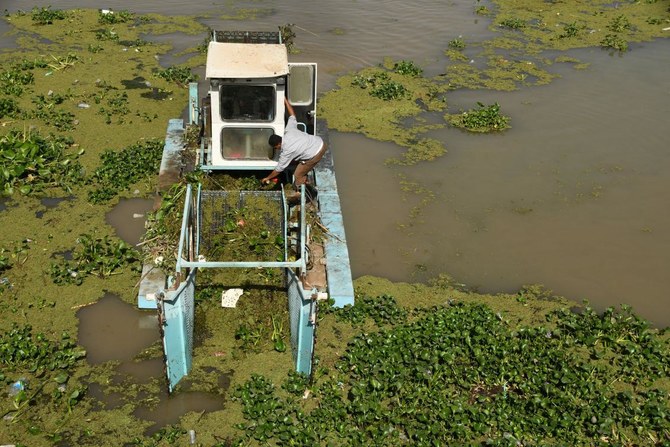
In the village of Al-Badaa, the thick columns of a brick bridge that once spanned a wide stretch of the Euphrates are now covered by hyacinths.
A dam further upstream encloses a swamp-like patch of land also covered by the plant.
If the flowers are not removed, “the bridge and dam of Al-Badaa will collapse,” said Jalil Al-Abboudi, the village sheikh.
“And if they collapse, the whole water supply system will collapse.”
That would deprive vast regions — all the way to Iraq’s southernmost province of Basra — of the fragile water resources their ecosystems and economies rely on.
Iraq’s oil-dependent economy is already projected to shrink by nearly 10 percent this year, according to the World Bank.
And a health crisis sparked by a shortage of safe drinking water in the south hospitalized some 100,000 people in 2018.
Locals blame authorities for what they say have been years of neglect and insufficient maintenance.
“The lack of action by the ministry of water resources, and the fact that there have been no renovations of infrastructure, caused an invasion that reached potable water reserves,” said Abboudi.
But Saleh Hadi, head of research at Dhi Qar’s agriculture directorate, insisted the ministry was well aware of the dangers and working hard to mitigate them.
“The ministry of water resources is working to combat this plant mechanically by uprooting it from irrigation channels,” he told AFP.
The perennial predicament has been made even worse this year because of the coronavirus pandemic.
Under normal conditions, Iraqi villagers along the banks of the Euphrates pluck out the plants by hand instead of using a chemical agent that would destroy the delicate ecosystem.
But this year, a countrywide lockdown imposed to stem COVID-19 infections has allowed the hyacinth to spread mostly unhampered.
Some vigilantes, however, are defying the curfew to fight the parasitic flower which they see as a bigger threat to their livelihoods than the pandemic.
While villagers are sneaking out to uproot the plants by hand, Mohammed Kuwaysh, an environmental activist and member of a farming cooperative, is thinking even bigger.
His collective raised about $800 from local farmers to equip small speedboats to clear waterways by cutting hyacinths en masse.
“The government isn’t listening, which allowed this flower to spread like wildfire,” Kuwaysh said.


![]()
![]()
![]()

Water hyacinth pest chokes Iraq’s vital waterways
Short Url
https://arab.news/vsfcs
Water hyacinth pest chokes Iraq’s vital waterways
- The water hyacinth was introduced to Iraq just two decades ago as a decorative plant
- Now the mighty Tigris and Euphrates rivers are being choked by its rapid spread

Latest updates



Recommended


© 2026 SAUDI RESEARCH & PUBLISHING COMPANY, All Rights Reserved And subject to Terms of Use Agreement.