

Ancient Petra a ghost town as pandemic hits Jordan tourism

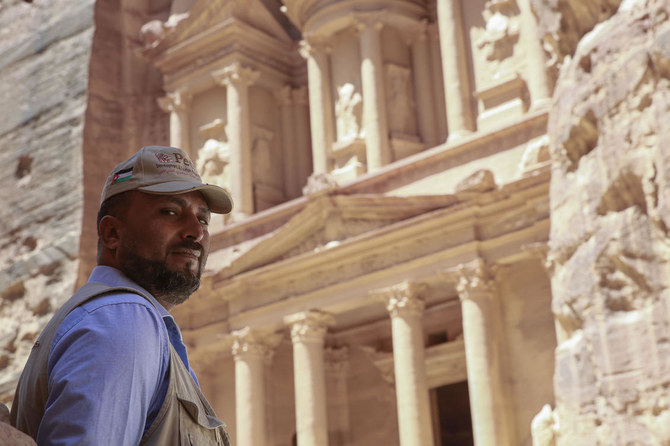
Nayef Hilalat, 42, guards Jordan's ancient city of Petra, which remains empty of tourists amid the COVID-19 pandemic crisis. (AFP)
Short Url
Updated 14 June 2020
Follow

Ancient Petra a ghost town as pandemic hits Jordan tourism

  • Petra, a beacon for tourism in the country, is now empty of visitors
  • Around 200 tour guides, along with 1,500 horse and donkey owners, are out of work

PETRA: For over two millennia the ancient city of Petra has towered majestically over the Jordanian desert. Today its famed rose-red temples hewn into the rockface lie empty and silent.
As the novel coronavirus spread around the world, Jordanian authorities imposed a lockdown, and the last tourists left on March 16, a day before the Hashemite kingdom closed its borders.

“It’s the first time I’ve seen this place so empty. Usually there are thousands of tourists,” said Nayef Hilalat, 42, who has worked as a guardian at the ancient archaeological site for a decade.
“Every year at this time the place would be buzzing with people,” he lamented, wearing a khaki cap bearing the Jordanian flag. “Today all we can hear is the birds singing.”
One of the seven wonders of the world, and classified as a UNESCO world heritage site in 1985, Petra was once the capital of the nomadic Nabataean Arab peoples and dates back to at least 200 years BC.
With the passage of time, it has become a beacon for tourism in the country and the region.
Its spectacular Al-Khazneh, or Treasury, with its stunning sandstone facade, is one of Petra’s most famous attractions, and was a location for Steven Spielberg’s 1989 movie “Indiana Jones and the Last Crusade.”


Jordan's ancient city of Petra empty of tourists amid the COVID-19 pandemic. (AFP)

But now, the steep winding Siq path — a gorge over a kilometer long that leads into Al-Khazneh — is deserted. Gone are the tourists normally thronging the pathway on foot, or riding on donkeys or in horse-drawn carriages.
Life is in limbo. Tables at the site’s cafes forlornly gather dust or are littered with forgotten plastic cups, while items like T-shirts in the souvenir shops fade in the desert sun.
The vast site, lying in a deep valley between the Red Sea, in the south, and the Dead Sea, to the north, is a ghost town.
Around 200 tour guides, along with 1,500 horse and donkey owners, are out of work.
It’s “a catastrophe,” said 55-year-old Naim Nawafleh, who has been a guide here for about 30 years.
Jordan welcomes some five million visitors a year, and tourism accounts for 14 percent of the country’s GDP, employing about 100,000 people.
A father of six, Nawafleh used to earn some $70 a day.
“In the past, the number of visitors varied according to the upheavals in the region. But today, there are no tourists at all. It’s never happened before,” he said.


Hotel owner Tarik Twissi says his business in Petra has been devastated by the pandemic. (AFP)

Jordan was already in a precarious situation before the pandemic, with unemployment at 19.3 percent in the first quarter of 2020.
Bordering conflict-torn Syria and Iraq, and lacking the oil wealth of some of its neighbors, the kingdom has worked to revive its tourism industry.
Petra, an immense 264,000-square meter (2.8 million sq feet) site south of Amman, saw a record “1.13 million visitors last year, including a million from abroad,” said Suleiman Al-Farajat, responsible for tourism and development in Petra.
About 80 percent of the region’s roughly 38,000 people who are mainly nomadic Bedouins, depend on tourism directly or indirectly, he said.
Like Nael Nawas, 41, a father of eight, who earned between $40 to $55 a day, transporting tourists to and from the site on the back of his donkey.
“We’ll be in a real pickle” if the tourist industry doesn’t pick up, he said, adding that since mid-March he has been working for a livestock seller.
Farajat said he hoped visitors would return quickly to “countries less affected by the pandemic” like the kingdom.
But tour guide Nawafleh was worried some tourists, particularly the elderly and pensioners, may be reluctant to return.
With a population of around 10 million, Jordan has officially recorded just over 800 cases of COVID-19 cases and nine deaths.
Tourism earned Jordan $5.3 billion last year, according to Abed Al-Razzaq Arabiyat, head of the Jordan Tourism Board.
But revenues have almost completely dried up, he said, promising measures to help salvage the season, including a focus on domestic tourism.
Meanwhile, for Petra’s 45 hotels, the situation is grim.
At the three-star La Maison, a lonely receptionist eyed the entrance, with no guests in sight.
“The pandemic came at the peak of our tourist season,” said owner Tarek Twissi, who is also the head of the Petra hotels association.
“Reservations were at over 90 percent and in less than a week they were all canceled,” he said.
“The occupancy rate at my hotel is now at zero.”


Historic decree seeks to end decades of marginalization of Syria’s Kurds

Updated 51 min ago
Follow

Historic decree seeks to end decades of marginalization of Syria’s Kurds

DAMASCUS/RIYADH: A decree issued by President Ahmad Al-Sharaa on Friday marks a historic end to decades of marginalization of Syria’s Kurdish minority and seeks to open a new chapter based on equality and full citizenship in post-liberation Syria.

The presidential action, officially known as Decree No. 13, affirms that Syrian Kurds are an integral part of the national fabric and that their cultural and linguistic identity constitutes an inseparable element of Syria’s inclusive, diverse, and unified national identity.

Al-Sharaa’s move seeks to address the consequences of outdated policies that distorted social bonds and divided citizens.

The decree for ⁠the first time grants Kurdish Syrians rights, including recognition of Kurdish identity as part of Syria’s national fabric. It designates Kurdish as a national language alongside Arabic and allows schools to teach it.

Al-Sharaa’s decree came after fierce clashes that broke out last week in the northern city of Aleppo, leaving at least 23 people dead, according to Syria’s health ministry, and forced more than 150,000 to flee the two Kurdish-run pockets of the city. The clashes ended ⁠after Kurdish fighters withdrew.

The Syrian government and the Kurdish-led Syrian Democratic Forces (SDF), that controls the country’s northeast, have engaged in months of talks last year to integrate Kurdish-run military and civilian bodies into Syrian state institutions by the end of 2025, but there has been little progress.

The end of an era of exclusion

For more than half a century, Kurds in Syria were subjected to systematic discriminatory policies, most notably following the 1962 census in Hasakah Governorate, which stripped thousands of citizens of their nationality and deprived them of their most basic civil and political rights.

These policies intensified after the now-dissolved Baath Party seized power in 1963, particularly following the 1970 coup led by criminal Hafez al-Assad, entrenching a state of legal and cultural exclusion that persisted for 54 years.

With the outbreak of the Syrian revolution in March 2011, Syrian Kurds actively participated alongside other segments of society. However, the ousted regime exploited certain separatist parties, supplying them with weapons and support in an attempt to sow discord and fragment national unity.

Following victory and liberation, the state moved to correct this course by inviting the Kurdish community to fully integrate into state institutions. This approach was reflected in the signing of the “March 10 Agreement,” which marked an initial milestone on the path toward restoring rights and building a new Syria for all its citizens.

Addressing a sensitive issue through a national approach

Decree No. 13 offers a balanced legal and political response to one of the most sensitive issues in modern Syrian history. It not only restores rights long denied, but also redefines the relationship between the state and its Kurdish citizens, transforming it from one rooted in exclusion to one based on citizenship and partnership.

The decree shifts the Kurdish issue from a framework of conflict to a constitutional and legal context that guarantees meaningful participation without undermining the unity or territorial integrity of the state. It affirms that addressing the legitimate demands of certain segments strengthens, rather than weakens, the state by fostering equal citizenship, respecting cultural diversity, and embracing participatory governance within a single, centralized state.

Core provisions that restore dignity

The decree commits the state to protecting cultural and linguistic diversity, guaranteeing Kurdish citizens the right to preserve their heritage, develop their arts, and promote their mother tongue within the framework of national sovereignty. It recognizes the Kurdish language as a national language and permits its teaching in public and private schools in areas with significant Kurdish populations, either as an elective subject or as part of cultural and educational activities.

It also abolishes all laws and exceptional measures resulting from the 1962 Hasakah census, grants Syrian nationality to citizens of Kurdish origin residing in Syria, including those previously unregistered, and guarantees full equality in rights and duties. In recognition of its national symbolism as a celebration of renewal and fraternity, the decree designates Nowruz Day (21 March) as a paid official holiday throughout the Syrian Arab Republic.

A call for unity and participation

In a speech following the issuance of the decree, President Ahmad al-Sharaa addressed the Kurdish community, urging them not to be drawn into narratives of division and calling on them to return safely to full participation in building a single homeland that embraces all its people. He emphasized that Syria’s future will be built through cooperation and solidarity, not through division or isolation.

The decree presents a pioneering national model for engaging with diversity, grounded not in narrow identities but in inclusive citizenship, justice, and coexistence. The decree lays the foundations for a unified and strong Syria that respects all its components and safeguards its unity, sovereignty, and territorial integrity.