

UAE’s annual summer outdoor work ban to start Monday

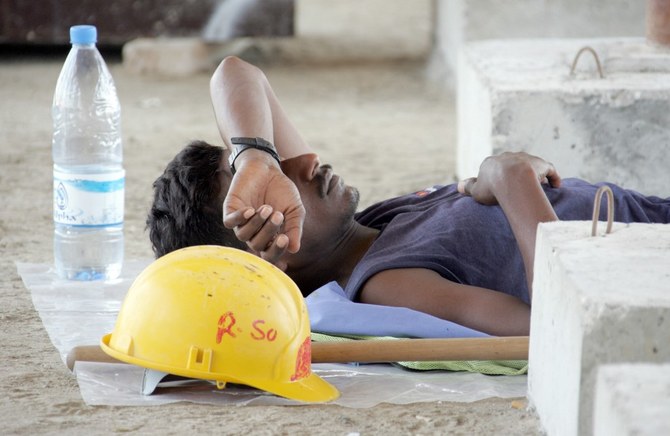
UAE companies are at risk of being penalized up to Dh50,000 if they break the afternoon outdoor work ban during summer. (AFP file photo)
Short Url
Updated 14 June 2020
Follow

UAE’s annual summer outdoor work ban to start Monday

DUBAI: The UAE’s annual ban on outdoor work during the hot summer months begins on Monday and would last for three months, the country’s human resource and Emiratisation ministry said.

A worker is not required not to stay in the outdoor workplace after 12:30 p.m. and is prohibited from resuming work before 3:00 p.m., state news agency WAM reported.

A WAM report said that summer season in the UAE will officially start on June 21 and will continue until September 23, with temperatures expected exceed more than 43° Celsius.

Employers are required to provide their workers with a shaded place to rest in during their breaks.

The ministry also said that daily working hours, for morning, evening or both shifts, are not to exceed eight hours.

If a worker exceeds such eight hours within 24 hours, the extra time will be deemed overtime, for which the worker is to be paid in accordance UAE labor rules, the ministry added.

But companies responsible for works which must continue for technical reasons are exempted from the ban.

“Workers can continue working during the banned hours if they are working on projects that cannot be postponed for technical reasons such as asphalting of roads and laying concrete as well as repairing damage in water pipes, petrol pipes, sewage pipes or the disconnection of electrical lines,” it said.

The exemption also includes those working on projects licensed from governmental departments which could affect the flow of traffic, or also that which could affect electrical, water supplies or communications.

The ministry likewise advised exempt companies to provide rehydration facilities for workers, at the risk of penalty being imposed equivalent to Dh5,000 per worker or a maximum of Dh50,000 for multiple workers.


UN rights chief Shocked by ‘unbearable’ Darfur atrocities

Updated 18 January 2026
Follow

UN rights chief Shocked by ‘unbearable’ Darfur atrocities

  • Mediation efforts have failed to produce a ceasefire, even after international outrage intensified last year with reports of mass killings, rape, and abductions during the RSF’s takeover of El-Fasher in Darfur

PORT SUDAN: Nearly three years of war have put the Sudanese people through “hell,” the UN’s rights chief said on Sunday, blasting the vast sums spent on advanced weaponry at the expense of humanitarian aid and the recruitment of child soldiers.
Since April 2023, Sudan has been gripped by a conflict between the army and the paramilitary Rapid Support Forces that has left tens of thousands of people dead and around 11 million displaced.
Speaking in Port Sudan during his first wartime visit, UN Human Rights commissioner Volker Turk said the population had endured “horror and hell,” calling it “despicable” that funds that “should be used to alleviate the suffering of the population” are instead spent on advanced weapons, particularly drones.
More than 21 million people are facing acute food insecurity, and two-thirds of Sudan’s population is in urgent need of humanitarian aid, according to the UN.
In addition to the world’s largest hunger and displacement crisis, Sudan is also facing “the increasing militarization of society by all parties to the conflict, including through the arming of civilians and recruitment and use of children,” Turk added.
He said he had heard testimony of “unbearable” atrocities from survivors of attacks in Darfur, and warned of similar crimes unfolding in the Kordofan region — the current epicenter of the fighting.
Testimony of these atrocities must be heard by “the commanders of this conflict and those who are arming, funding and profiting from this war,” he said.
Mediation efforts have failed to produce a ceasefire, even after international outrage intensified last year with reports of mass killings, rape, and abductions during the RSF’s takeover of El-Fasher in Darfur.
“We must ensure that the perpetrators of these horrific violations face justice regardless of the affiliation,” Turk said on Sunday, adding that repeated attacks on civilian infrastructure could constitute “war crimes.”
He called on both sides to “cease intolerable attacks against civilian objects that are indispensable to the civilian population, including markets, health facilities, schools and shelters.”
Turk again warned on Sunday that crimes similar to those seen in El-Fasher could recur in volatile Kordofan, where the RSF has advanced, besieging and attacking several key cities.
Hundreds of thousands face starvation across the region, where more than 65,000 people have been displaced since October, according to the latest UN figures.