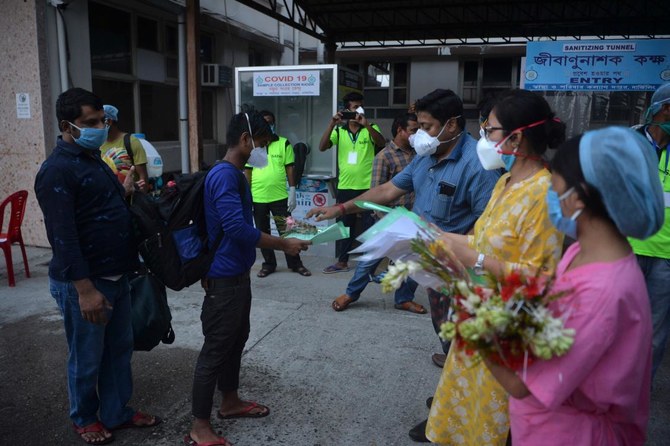
NEW DELHI: India’s coronavirus infections crossed 200,000, official figures showed on Wednesday, and a peak could still be weeks away in the world’s second-most populous country, where the economy has begun re-opening after a lockdown imposed in March.
Cases jumped by 8,909 over the previous day in one of the highest single-day spikes, taking the tally to 207,615, the health ministry said.
“We are very far away for the peak,” said Dr. Nivedita Gupta, of the government-run Indian Council of Medical Research. Government officials have previously said it could be later this month, or even July, before cases start to fall off.
The death toll from the disease stood at 5,815.
Six other nations, including the United States, Britain and Brazil, have higher caseloads, and in India’s favor, at least its mortality rate has been comparably low.
But India’s infections are rising as it ends a severe lockdown of its 1.3 billion people imposed in March.
The lockdown has crippled the economy and left tens of thousands without work.
As train and bus services open, migrant workers are traveling home from the coronavirus hot spots of Mumbai and Delhi to the hinterland where infections are starting to rise, health officials say.
These included states such as Bihar, Odisha and Uttarakhand which traditionally supply the bulk of migrant workers.
Still, Gupta said relative to its large population, India had done well in tackling the disease. “Our preventive measures have been very effective. We are in a much better position vis-a-vis other countries,” she said.
Officials say the lockdown helped limit the spread of the virus, giving space to hospitals to deal with those affected. India’s fatality rate of 2.82 percent against the global average of 6.13 percent was among the lowest in the world, Lav Agarwal, joint secretary in the health ministry, said.
“We have been able to achieve this due to timely identification of cases and proper clinical management,” he said.

India’s coronavirus cases cross 200,000, peak still weeks away
https://arab.news/zy3r4
India’s coronavirus cases cross 200,000, peak still weeks away
- Cases jumped by 8,909 over the previous day in one of the highest single-day spikes
- Infections are rising as it ends a severe lockdown of its 1.3 billion people imposed in March
Nigeria signals more strikes likely in ‘joint’ US operations
- Nigeria on Friday signalled more strikes against jihadist groups were expected after a Christmas Day bombardment by US forces against militants in the north of the country
LAGOS: Nigeria on Friday signalled more strikes against jihadist groups were expected after a Christmas Day bombardment by US forces against militants in the north of the country.
The west African country faces multiple interlinked security crises in its north, where jihadists have been waging an insurgency in the northeast since 2009 and armed “bandit” gangs raid villages and stage kidnappings in the northwest.
The US strikes come after Abuja and Washington were locked in a diplomatic dispute over what Trump characterised as the mass killing of Christians amid Nigeria’s myriad armed conflicts.
Washington’s framing of the violence as amounting to Christian “persecution” is rejected by the Nigerian government and independent analysts, but has nonetheless resulted in increased security coordination.
“It’s Nigeria that provided the intelligence,” the country’s foreign minister, Yusuf Tuggar, told broadcaster Channels TV, saying he was on the phone with US State Secretary Marco Rubio ahead of the bombardment.
Asked if there would be more strikes, Tuggar said: “It is an ongoing thing, and we are working with the US. We are working with other countries as well.”
Targets unclear
The Department of Defense’s US Africa Command, using an acronym for the Daesh group, said “multiple Daesh terrorists” were killed in an attack in the northwestern state of Sokoto.
US defense officials later posted video of what appeared to be the nighttime launch of a missile from the deck of a battleship flying the US flag.
Which of Nigeria’s myriad armed groups were targeted remains unclear.
Nigeria’s jihadist groups are mostly concentrated in the northeast of the country, but have made inroads into the northwest.
Researchers have recently linked some members from an armed group known as Lakurawa — the main jihadist group located in Sokoto State — to Islamic State Sahel Province (ISSP), which is mostly active in neighboring Niger and Mali.
Other analysts have disputed those links, though research on Lakurawa is complicated as the term has been used to describe various armed fighters in the northwest.
Those described as Lakurawa also reportedly have links to Al-Qaeda affiliated group for the Support of Islam and Muslims (JNIM), a rival group to ISSP.
While Abuja has welcomed the strikes, “I think Trump would not have accepted a ‘No’ from Nigeria,” said Malik Samuel, an Abuja-based researcher for Good Governance Africa, an NGO.
Amid the diplomatic pressure, Nigerian authorities are keen to be seen as cooperating with the US, Samuel told AFP, even though “both the perpetrators and the victims in the northwest are overwhelmingly Muslim.”
Tuggar said that Nigerian President Bola Tinubu “gave the go-ahead” for the strikes.
The foreign minister added: “It must be made clear that it is a joint operation, and it is not targeting any religion nor simply in the name of one religion or the other.”


