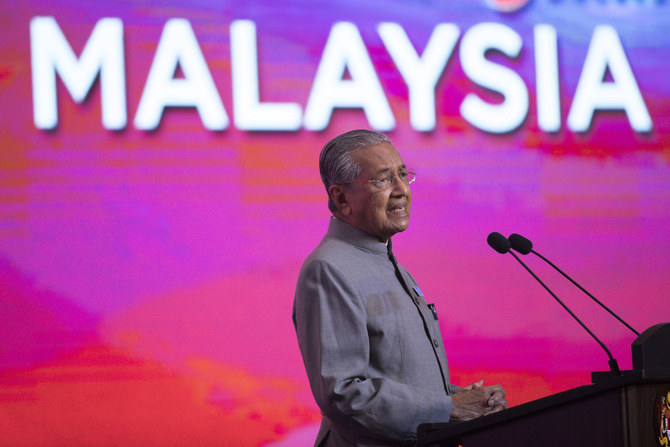
KUALA LUMPUR, Malaysia: Malaysia’s former prime minister, Mahathir Mohamad, has been ousted from his ethnic Malay political party in the latest twist of a power struggle with his successor, but he has vowed to challenge the move.
The 94-year-old Mahathir, along with his son and three other senior members, were expelled from the Bersatu party on Thursday.
The party has been split into two camps since intense political wrangling led Mahathir to resign as prime minister in February and the king to appoint fellow party member Muhyiddin Yassin as his replacement despite Mahathir’s objections.
Mahathir’s son, Mukhriz Mahathir, has since challenged Muhyiddin as party president in a vote that’s been postponed by the coronavirus pandemic.
“The unilateral action by Bersatu’s president to sack us without valid reason is due to his own fears in facing party elections as well as his unsafe position as the most unstable prime minister in the history of the country’s administration,” a joint statement by Mahathir and the four others said.
Mahathir co-founded Bersatu with Muhyiddin in 2016, and the party joined an alliance that won a stunning victory in 2018 polls, leading to the first change of government since independence.
The ruling alliance collapsed after Muhyiddin pulled Bersatu out to work with the former government, which has been accused of massive corruption. Mahathir, a two-time prime minister, resigned in protest.
Mahathir has said he still has the majority support of lawmakers and has called for a no-confidence vote against Muhyiddin. The vote has been delayed amid the pandemic but could be held at the next sitting of Parliament in July.
In their statement, Mahathir and the other expelled members said the move was illegal and they may take legal action to challenge their termination and ensure Bersatu isn’t used as a vehicle for those crazy for power.
Party letters sent to the five said their membership had ceased as they sat with the opposition bloc during a half-day Parliament sitting on May 18. But the letter was signed by a lower official who Mahathir’s group and others said had no power to remove them.
“All eyes are on Mahathir’s next move,” said Oh Ei Sun, a senior fellow at the Singapore Institute of International Affairs. “Muhyiddin would be gravely mistaken if he thinks this will slow down Mahathir’s relentless onslaught to not so much unseat him, but topple the present ruling coalition.”
Muhyiddin had earlier tried to reconcile with Mahathir, but failed.
The current government includes the party of ex-Prime Minister Najib Razak, who is on trial on charges related to a massive financial scandal.

Malaysia’s Mahathir ousted from party amid power struggle
Short Url
https://arab.news/46e9s
Malaysia’s Mahathir ousted from party amid power struggle
- Bersatu party has been split into two camps
- Mahathir Mohamad co-founded Bersatu with Muhyiddin Yassin in 2016
Indonesia’s president reaches a trade deal with US while in Washington for Trump’s Board of Peace
- The White House is calling it a “great deal” that will “help both countries to strengthen economic security”
- Indonesian and US companies also reached several business deals this week
WASHINGTON: The White House announced a reciprocal trade agreement with Indonesia on Thursday while President Prabowo Subianto was in Washington to attend the first meeting of President Donald Trump’s Board of Peace.
Under the agreement, Southeast Asia’s largest economy will eliminate tariffs for 99 percent of American goods while the US will maintain tariffs on most Indonesian goods at 19 percent, the White House said. That is the same rate the US has set for Cambodia and Malaysia. Indonesia also agreed to address non-tariff barriers to US goods and to remove restrictions on exports to the US for critical minerals and other industrial commodities, the White House said.
Indonesian and US companies also reached 11 deals this week worth $38.4 billion, including purchases of US soybeans, corn, cotton and wheat, cooperation in critical minerals and oil field recovery, and joint ventures in computer chips.
“We have negotiated very intensively over the last few months, and I think we have reached solid understandings on many issues,” Prabowo told business executives Wednesday at the US Chamber of Commerce.
A White House statement called it a “great deal” and said it “will help both countries to strengthen economic security, promote economic growth, and thereby continuously lead to global prosperity.”
The agreement was later signed by US Trade Representative Jamieson Greer and his Indonesian counterpart, Airlangga Hartarto.
Hartarto told a news conference from Washington that both governments cast the agreement as marking the start of a “new golden age” in bilateral economic ties and Indonesia will introduce measures designed to keep trade flows secure and prevent misuse of sensitive goods.
Indonesia’s pledge for Gaza stabilization force
The agreement was announced the same day that Prabowo, leader of the world’s most populous Muslim country, reiterated his pledge at the Board of Peace meeting to send 8,000 troops or “more if necessary” for an international stabilization force in Gaza.
Indonesia was among the first to make a firm commitment to a critical element of Trump’s postwar Gaza reconstruction plan.
“President Prabowo of Indonesia, thank you very much,” Trump said at the Board of Peace meeting. “It’s a big country you have, and you do a great job.”
Prabowo praised Trump in return. “We are very optimistic with the leadership of President Trump, this vision of real peace will be achieved,” Prabowo said. “There will be problems, but we will prevail.”
Cambodia and Vietnam are the two other Southeast Asian countries that joined the board, which was originally envisioned as overseeing the Gaza ceasefire but has taken shape with wider ambitions to broker other global conflicts.
Their leaders also came to Washington for the inaugural meeting. Cambodia has already inked a trade deal with the US, while Vietnam has reached a framework agreement.
Critical minerals play into Indonesia deal
Indonesian companies agreed this week to buy 1 million tons of soybeans, 1.6 million tons of corn and 93,000 tons of cotton from the US They also pledged to buy up to 5 million tons of US wheat by 2030.
The countries agreed to cooperate on critical minerals, though details were not immediately available.
Washington is seeking Indonesia’s agreement to lift restrictions on critical mineral exports, which the Trump administration argues could safeguard US manufacturers from supply‑chain disruptions. The administration has sought to defend against China’s stranglehold on the key elements needed for everything from fighter jets to smartphones.
At the Chamber of Commerce event, Prabowo said Indonesia can serve as a “bridge” and “honest broker” between great powers, apparently referring to the US-China competition.
Vietnam’s leader makes first visit to the US since being reelected
At the Board of Peace meeting, Trump called Vietnam “incredible as a country and as a force” and told leader To Lam that it was “a really great honor to have you.”
Lam’s visit to the US is his first since he was reelected as the head of Vietnam’s ruling Communist Party last month. Typically, China is an initial stop in a nod to the countries’ ideological ties and Beijing’s status as Vietnam’s largest trading partner. Lam did visit China in August 2024 before traveling to the US during his first term.
Analysts say Lam’s visit to the US before traveling to Beijing this time around is a notable shift in sequencing. Hanoi describes its foreign policy as independent and balanced among major powers.
Trade negotiations between Vietnam and the United States are ongoing following the Trump administration levying 20 percent tariffs on Vietnamese exports. The latest, sixth round of talks concluded in early February.
Under the agreement, Southeast Asia’s largest economy will eliminate tariffs for 99 percent of American goods while the US will maintain tariffs on most Indonesian goods at 19 percent, the White House said. That is the same rate the US has set for Cambodia and Malaysia. Indonesia also agreed to address non-tariff barriers to US goods and to remove restrictions on exports to the US for critical minerals and other industrial commodities, the White House said.
Indonesian and US companies also reached 11 deals this week worth $38.4 billion, including purchases of US soybeans, corn, cotton and wheat, cooperation in critical minerals and oil field recovery, and joint ventures in computer chips.
“We have negotiated very intensively over the last few months, and I think we have reached solid understandings on many issues,” Prabowo told business executives Wednesday at the US Chamber of Commerce.
A White House statement called it a “great deal” and said it “will help both countries to strengthen economic security, promote economic growth, and thereby continuously lead to global prosperity.”
The agreement was later signed by US Trade Representative Jamieson Greer and his Indonesian counterpart, Airlangga Hartarto.
Hartarto told a news conference from Washington that both governments cast the agreement as marking the start of a “new golden age” in bilateral economic ties and Indonesia will introduce measures designed to keep trade flows secure and prevent misuse of sensitive goods.
Indonesia’s pledge for Gaza stabilization force
The agreement was announced the same day that Prabowo, leader of the world’s most populous Muslim country, reiterated his pledge at the Board of Peace meeting to send 8,000 troops or “more if necessary” for an international stabilization force in Gaza.
Indonesia was among the first to make a firm commitment to a critical element of Trump’s postwar Gaza reconstruction plan.
“President Prabowo of Indonesia, thank you very much,” Trump said at the Board of Peace meeting. “It’s a big country you have, and you do a great job.”
Prabowo praised Trump in return. “We are very optimistic with the leadership of President Trump, this vision of real peace will be achieved,” Prabowo said. “There will be problems, but we will prevail.”
Cambodia and Vietnam are the two other Southeast Asian countries that joined the board, which was originally envisioned as overseeing the Gaza ceasefire but has taken shape with wider ambitions to broker other global conflicts.
Their leaders also came to Washington for the inaugural meeting. Cambodia has already inked a trade deal with the US, while Vietnam has reached a framework agreement.
Critical minerals play into Indonesia deal
Indonesian companies agreed this week to buy 1 million tons of soybeans, 1.6 million tons of corn and 93,000 tons of cotton from the US They also pledged to buy up to 5 million tons of US wheat by 2030.
The countries agreed to cooperate on critical minerals, though details were not immediately available.
Washington is seeking Indonesia’s agreement to lift restrictions on critical mineral exports, which the Trump administration argues could safeguard US manufacturers from supply‑chain disruptions. The administration has sought to defend against China’s stranglehold on the key elements needed for everything from fighter jets to smartphones.
At the Chamber of Commerce event, Prabowo said Indonesia can serve as a “bridge” and “honest broker” between great powers, apparently referring to the US-China competition.
Vietnam’s leader makes first visit to the US since being reelected
At the Board of Peace meeting, Trump called Vietnam “incredible as a country and as a force” and told leader To Lam that it was “a really great honor to have you.”
Lam’s visit to the US is his first since he was reelected as the head of Vietnam’s ruling Communist Party last month. Typically, China is an initial stop in a nod to the countries’ ideological ties and Beijing’s status as Vietnam’s largest trading partner. Lam did visit China in August 2024 before traveling to the US during his first term.
Analysts say Lam’s visit to the US before traveling to Beijing this time around is a notable shift in sequencing. Hanoi describes its foreign policy as independent and balanced among major powers.
Trade negotiations between Vietnam and the United States are ongoing following the Trump administration levying 20 percent tariffs on Vietnamese exports. The latest, sixth round of talks concluded in early February.
© 2026 SAUDI RESEARCH & PUBLISHING COMPANY, All Rights Reserved And subject to Terms of Use Agreement.