

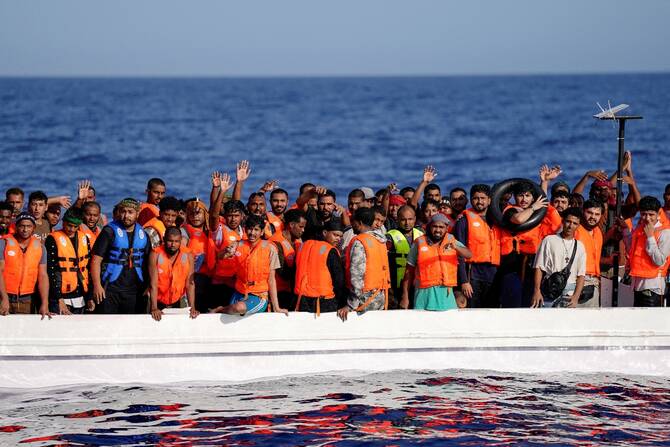
From the sky, NGO searches for west African migrant boats in distress

Migrants standing on a fiberglass boat wave at NGO Open Arms rescue boat "Astral" as they assist them in international waters south of Lampedusa, in the Mediterranean Sea. (Reuters)
Short Url
Updated 20 February 2026
Follow

From the sky, NGO searches for west African migrant boats in distress

  • More than 3,000 migrants died in 2025 while attempting to reach Spain clandestinely, according to the Spanish NGO Caminando Fronteras

OFF THE COAST OF THE CANARY ISLAND: Every hour is crucial when searching for distressed west African migrant boats in the Atlantic, where the long route and harsh weather easily spell disaster, a nonprofit that conducts aerial surveillance told AFP during a recent mission.
AFP rode along with the organization Humanitarian Pilots Initiative (HPI) as it raced to locate several missing pirogues — long, rickety canoes — that had left The Gambia but never showed up at their final destination.
The mission: search an area larger than Switzerland, from hundreds of meters (yards) in the air, with an aim of rendering aid before it is too late.
“People could be dead or dying from dehydration, heat stroke or any other conditions,” pilot Omar El Manfalouty told AFP.
Migrants departing from west Africa and traveling up the Atlantic are usually trying to reach Europe via the Canary Islands off northwest Africa.
The Spanish archipelago is the jumping off point for their continued journey onward to the European continent.
With many recent departures taking place from further south in The Gambia and Guinea, migrants are now spending longer at sea and facing more hardships.
More than 3,000 migrants died in 2025 while attempting to reach Spain clandestinely, according to the Spanish NGO Caminando Fronteras.
While HPI has operated since 2016 in the central Mediterranean, it is a relative newcomer to the Atlantic.
In the Mediterranean, it has already helped spot more than 1,000 boats, alerting international NGO rescue ships which then go and help.
AFP flew with HPI on its third mission in nine months in the Atlantic, riding for several days in the NGO’s Beechcraft Baron 58 nicknamed “Seabird.”

- ‘Vast area’ -

“The Atlantic Ocean is huge. It’s a vast area and it’s impossible to cover it in its entirety,” said El Manfalouty.
“We brought our longest-range aircraft here and we’re focusing on the area which other actors cannot reach, approximately between 300 and 500 nautical miles from the Canaries,” he said.
Once HPI spots a vessel, it sends an alert for emergency response to nearby merchant ships so that they can provide immediate support. From there, Spain’s maritime safety and rescue authority, Salvamento Maritimo, takes over.
“Having an aircraft in the area to support from the air with 10 times the speed (of boats) makes a lot of sense,” said Samira, the mission’s tactical coordinator who asked not to use her last name due to threats the NGO receives in several European countries.
One morning in January the crew received an alert from another NGO that a boat which had departed The Gambia carrying 103 people, including nine women and three children, was missing. HPI quickly mobilized.
The trip from The Gambia to the Canaries is 1,000 nautical miles, meaning there is a vast region where the boat might be, Samira said. On her tablet, she plotted out several routes.

- Eyes glued -

Once the plane reached the patrol zone, the aircraft descended below cloud cover and followed straight, parallel trajectories. Three crew members kept their eyes glued to the windows for the pirogue.
While in the air they received word of another vessel: a second boat, which left The Gambia seven days earlier with 137 people on board.
With the strong winds and swell, “the boats may have drifted,” Samira said.
Boats have previously drifted so far as to reach the Caribbean or South America without any survivors.
After three consecutive days of flying, the crew had covered nearly 3,800 nautical miles, but there was still no trace of the two boats.
Near a migrant reception center in Las Palmas, a major city in the Canary Islands, Ousmane Ly, a recently arrived 25-year-old Senegalese man, gazed at the beach. Other migrants, also from Senegal, were taking advantage of the sunny day to take photos.
The joy of having made it outweighed the difficulty some were having walking after days crammed into a pirogue.
Their hands, arms and legs bore wounds caused by the salt water.
He recounted how once they boarded the pirogue, he and the other passengers were covered with a tarpaulin: “I closed my eyes and thought of my mother,” he said.
The tarpaulin — used to protect them from the sun during the day and cold at night — was removed only 10 days later, when the boat was rescued by Salvamento Maritimo.
There were 108 people on board, two of whom were found dead during the rescue.


US and Mideast countries seek Kyiv’s drone expertise as Russia-Ukraine talks put on ice

Updated 06 March 2026
Follow

US and Mideast countries seek Kyiv’s drone expertise as Russia-Ukraine talks put on ice

KYIV, Ukraine: The United States and its allies in the Middle East are seeking Ukraine's expertise in countering Iran's Shahed drones, according to Ukrainian President Volodymyr Zelenskyy.

Various countries, including the United States, have approached Ukraine for help in defending against the Iranian drones, Zelenskyy said late Wednesday. He said he has spoken in recent days with the leaders of the United Arab Emirates, Qatar, Bahrain, Jordan and Kuwait about possible cooperation.

Russia has fired tens of thousands of Shaheds at Ukraine since it invaded its neighbor just over four years ago, launching a swarm of more than 800 drones and decoys in its biggest nighttime barrage. Iran has responded to joint U.S.-Israeli strikes by launching the same type of drones at countries in the Middle East.

Ukrainian assistance in countering Iranian drones will be provided only if it does not weaken Ukraine's own defenses, and if it adds leverage to Kyiv's diplomatic efforts to stop the Russian invasion, according to the Ukrainian leader.

"We help to defend from war those who help us, Ukraine, bring a just end to the war" with Russia, Zelenskyy said. Later Thursday, Zelenskyy said he had received a U.S. request for support to defend against the drones in the Middle East and had given the order for equipment to be provided along with Ukrainian experts without providing further details.

"Ukraine helps partners who help our security and the protection of our people's lives," he added in a social media post.

Trump, in an interview Thursday with Reuters, said, "Certainly I'll take, you know, any assistance from any country."

Ukraine has battle-tested drone defenses

Ukraine has pioneered the development of cut-price drone killers that cost as little as $1,000, rewriting the air defense rule book and making other countries take notice.

European countries got a wake-up call last September on the changed nature of air defense when Poland scrambled multimillion-dollar military assets, including F-35 and F-16 fighter jets and Black Hawk helicopters, in response to airspace violations by cheap drones.

Ukrainian manufacturers have developed low-cost interceptor drones specifically designed to hunt and destroy Shaheds, and its rapidly expanding drone industry is producing excess capacity.

Zelenskyy announced earlier this year that Ukraine would begin exporting the battle-tested systems.

The European Union's top diplomat, Kaja Kallas, said before chairing a meeting of EU and Gulf foreign ministers via video link Thursday that the talks would look at how Ukraine's experience can help countries counter Iranian drones.

Middle East war delays Russia-Ukraine talks

The Iran war, now in its sixth day, has drawn international attention away from Europe's biggest conflict since World War II, and forced the postponement of a new round of U. S-brokered talks between Russia and Ukraine planned for this week, Zelenskyy said.

Western governments and analysts say the Russia-Ukraine war has killed hundreds of thousands of people, while there is no sign that yearlong U.S.-led peace efforts will stop the fighting any time soon.

"Right now, because of the situation around Iran, there are not yet the necessary signals for a trilateral meeting," Zelenskyy said. "But as soon as the security situation and the overall political context allow us to resume that trilateral diplomatic work, it will be done."

Zelenskyy thanked the United States for the return from Russia on Thursday of 200 Ukrainian prisoners of war. Russia's Defense Ministry also said it received the same number of prisoners from Ukraine and thanked the U.S. and United Arab Emirates for mediating.

Prisoner swaps have been one of the few tangible results of the talks. Vladimir Medinsky, a Russian negotiator, said on social media that a total of 500 prisoners from each side would be exchanged between Thursday and Friday.

Oleksandr Merezhko, the head of Ukraine's parliamentary foreign affairs committee, said Russian President Vladimir Putin is trying to drag out the negotiations so that he can press on with Russia's invasion while escaping further U.S. sanctions.

He urged the U.S. administration to look at the Russia-Ukraine war and the war in the Middle East as linked.

"In reality, Russia and Iran are close allies that act in concert — Iran supplies weapons and Russia helps Iran develop its defense industry. These are interconnected conflicts," Merezhko told The Associated Press.

Ukraine's army has recently pushed back Russian forces at some points along the roughly 1,250-kilometer (750-mile) front line, according to the Institute for the Study of War.

Localized Ukrainian counterattacks liberated more territory than Ukrainian forces lost in the last two weeks of February, the Washington-based think tank said this week, estimating the recovered land at about 257 square kilometers (100 square miles) since Jan. 1.