

Security forces kill four militants in Pakistani province bordering Afghanistan

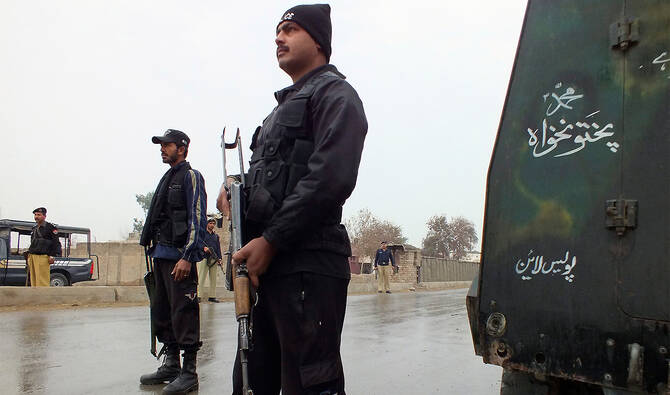
Policemen stand guard as they cordon the road leading to an isolated army checkpoint after it was attacked by militants at Lakki Marwat in the outskirts of Dera Ismail Khan on February 2, 2013. (REUTERS/File)
Short Url
Updated 20 February 2026
Follow

Security forces kill four militants in Pakistani province bordering Afghanistan

  • The operation was conducted in Lakki Marwat district of Khyber Pakhtunkhwa on reports about militant presence
  • It comes days after militants rammed an explosive-laden car into a Pakistani checkpost, killing 11 security personnel

ISLAMABAD: Pakistani security forces have killed four Tehreek-e-Taliban Pakistan (TTP) militants in an operation in the northwestern Khyber Pakhtunkhwa (KP) province that border Afghanistan, the Pakistani military said late Thursday.

The operation was conducted in KP’s Lakki Marwat district on reports about militant presence, according to the Inter-Services Public Relations (ISPR), the military’s media wing.

Weapons and ammunition were seized from the deceased militants who remained actively involved in numerous militant activities in the area.

“Sanitization operation is being conducted to eliminate any other Indian-sponsored kharja (militant) found in the area,” the ISPR said in a statement.

New Delhi did not immediately respond to the statement.

Pakistan has struggled to contain a surge in militancy in KP, where militant groups, particularly the TTP, have frequently targeted security forces, law enforcers and government officials in recent years.

Earlier this week, Pakistani Taliban militants rammed an explosive-laden vehicle into the wall of a checkpost manned jointly by security forces and law enforcement agencies in KP’s Bajaur district, killing 11 security personnel among 12 people, the Pakistani military’s media wing said.

It added that 12 militants were also gunned down in an exchange of fire with security forces.

Islamabad accuses Afghanistan of allowing the use of its soil and India of backing militant groups for cross-border attacks against Pakistan. Kabul and New Delhi deny this.

Earlier on Thursday, Islamabad also issued a demarche to the Afghan deputy head of mission for the “terrorist” attack that killed 12 people, including 11 security personnel, Pakistan’s foreign office said.


Pakistan advances $1.1 billion Thar coal-to-urea project to cut fertilizer imports

Updated 6 sec ago
Follow

Pakistan advances $1.1 billion Thar coal-to-urea project to cut fertilizer imports

  • Thar lignite to be converted into urea under Pakistan’s flagship Coal-to-Fertilizer plan
  • Sindh administration says the initiative will create thousands of jobs, generate exports

ISLAMABAD: Pakistan has moved forward with a $1.12 billion coal-to-fertilizer project in the desert region of Thar, an official statement said on Friday, as it aims to use domestic coal to produce urea and reduce reliance on imported fertilizer and costly natural gas.

The initiative is part of Pakistan’s broader push to tap the vast coal reserves in Tharparkar district in southern Sindh province. Thar is home to one of the world’s largest untapped lignite coal deposits, discovered in the 1990s, and has in recent years become central to the country’s coal-based power generation expansion.

“This project is of immense importance not only for Sindh but for the entire country,” Shah said, according to the statement. “It will reduce reliance on imported fertilizer, create jobs, generate exports and add value to our indigenous coal resources.”

Pakistan traditionally produces urea using natural gas as feedstock. However, declining domestic gas reserves and rising liquefied natural gas (LNG) imports have increased production costs and placed pressure on foreign exchange reserves.

Under the Coal-to-Fertilizer (C2F) initiative, Thar coal will be converted into synthesis gas through a process known as coal gasification. The hydrogen extracted from that gas will then be used to produce ammonia, which is combined with carbon dioxide to manufacture urea.

The project is designed to produce around 717,000 tons of urea annually, with roughly half intended for domestic use and the remainder for export. Officials estimate annual export revenues of up to $260 million.

Once operational, the statement said, the project could create more than 3,500 direct jobs and about 7,000 indirect jobs, while generating royalties for the provincial government through coal extraction.