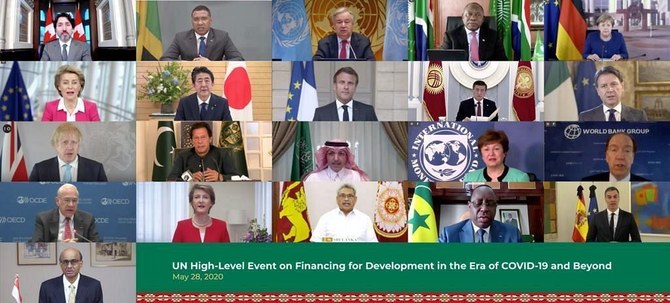
DUBAI: Saudi G20 presidency, represented by the Kingdom’s minister of finance, joined the UN meeting titled “Financing for Development in the Era of COVID-19 and Beyond,” state news agency SPA reported.
Heads of states and international organizations, representatives from NGOs and the private sector discussed six topics mainly, global liquidity and financial stability, debt vulnerability, private sector creditors engagement, external finance and remittances for inclusive growth, illicit financial flows and recovering better for sustainability and growth.
“The Kingdom of Saudi Arabia, including in its capacity as the G20 President, remains committed to work with others to address what is, first and foremost, a human tragedy, and its global health, economic and social impacts, including on the most vulnerable,” Mohammed Al-Jadaan said during the meeting.
The minister highlighted the G20’s response to the challenges in the health, economic and social sectors created by the coronavirus pandemic.
“As the president of the G20 in 2020, the Kingdom of Saudi Arabia immediately took concrete steps to drive and coordinate international response, with the aim of developing collective actions to address the global challenges presented by the COVID-19 pandemic,” he added.
The meeting was co-chaired by UN head Secretary-General António Guterres, Jamaican Prime Minister Andrew Holness and Canadian Prime Minister Justin Trudeau.
It launched a collective effort to create proposals which will help overcome challenges in the six areas mentioned earlier, which will be presented during a political forum in July and at the General Assembly in September, SPA added.
Meanwhile, the G20 International Financial Architecture (IFA) working group held an extraordinary meeting to assess the Debt Service Suspension Initiative (DSSI).
The initiative, which could provide around $14 billion in immediate and critical liquidity relief through official bilateral creditors for the poorest nations, received 36 applications during the first month.
The DSSI “would help vulnerable countries strengthen their fight against the pandemic. This amount could increase significantly if additional creditors, including multilateral development banks and private sector creditors, join the initiative” Saudi G20 Presidency Policy Lead of the IFA Bandr Alhomaly said.
Experts from the International Monetary Fund, World Bank, Institute of International Finance, Paris Club Secretariat and various regional development banks joined the meeting.
The group will host another extraordinary meeting on June 23 to further examine the DSSI implementation efforts, ahead of the Finance Ministers and Central Bank Governors meeting in July.


![]()

Saudi G20 presidency joins UN meeting on development financing amid COVID-19 pandemic
Short Url
https://arab.news/gebhh
Saudi G20 presidency joins UN meeting on development financing amid COVID-19 pandemic
- Heads of states and international organizations, representatives from NGOs and the private sector joined the UN meeting
- The G20 International Financial Architecture (IFA) working group also held a meeting


Latest updates


© 2026 SAUDI RESEARCH & PUBLISHING COMPANY, All Rights Reserved And subject to Terms of Use Agreement.