


ISLAMABAD: For an hour and a half every fortnight, a group of Pakistanis log on to Zoom, a video-conferencing platform, to enter the digital space of the “Halqa-e-Aldardsha Al-Arabia” or the Arabic Speaking Circle.
The group of 20 are joined by 50 other linguaphiles from Saudi Arabia, Kuwait, Egypt, Yemen, Sudan and even India — Pakistan’s nuclear-armed neighbor, and its archrival since the 1947 partition.
However, due to the apolitical nature of the group, the conversations are exclusive to and revolve around their experiences and mutual love of Arabic — a language that transcends their digital boundaries.
“Currently, there are 70 members in the group, 20 Pakistanis and 50 from other countries. The Pakistanis and two Indians aren’t native Arabic speakers, they’ve learnt it in the 1970s (as overseas workers), while members from Middle Eastern countries are native speakers, so it’s a good mix,” Dr. Inamul Haq Ghazi, founder of the group and chairman of the Arabic translation department at the International Islamic University in Islamabad, told Arab News on Tuesday.
The group held its first meeting on May 15 with an aim “to promote the language and exchange cultural experiences.”
The idea, Dr. Ghazi said, originated from the fact that a lot of overseas workers and expatriates were well-versed in spoken Arabic but “didn’t have a platform to connect to a larger audience.”
“Our governments (Pakistan and Saudi Arabia) have strong historical relationships, but we want to promote people-to-people contact through our platform. Millions of our nationals are employed in different fields in several Middle Eastern countries, especially Saudi Arabia and the United Arab Emirates (UAE),” he said.
Prime among those is Ambassador Javed Hafeez, another founding member, who said that it began as an informal “group of friends” who were fluent in classical Arabic and “wanted to share their social and cultural experiences.”
“Being fluent in the language, I appear on numerous Arabic news channels as an analyst where I promote a positive image of Pakistan,” Hafeez, who has served in many Middle Eastern countries including Saudi Arabia as an ambassador, told Arab News.
He added that Arabic was a rich language, before urging Pakistani youth to learn it “to expand their careers in the Middle East and know more about their social and cultural values.

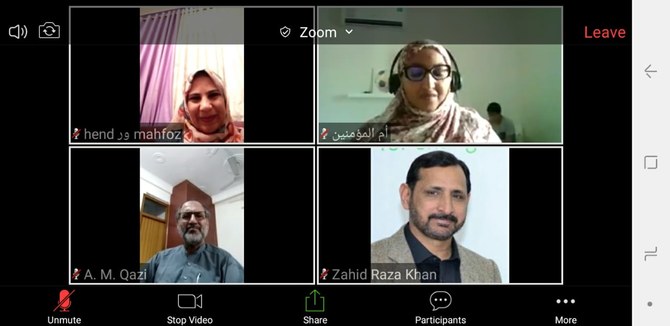
A screen grab shows participants of the Arabic Speaking Circle meeting via Zoom held on May 15. (Supplied by Ambassador Javed Hafeez)
All are welcome, Dr. Ghazi added, since there are “no restrictions on nationality.”
“We are, in fact, including people of different nationalities in our group to make it a multinational platform,” he said.
The topics vary from talking about personal experiences to curated subjects.
“In our next meeting, we are planning to discuss ‘Arab travelers to the sub-continent, and how they have portrayed the area in their travelogues.’ We’ve already circulated this topic among the participants, and each member will come prepared to talk about it and ask different questions,” Hafeez said, adding that in the previous session he’d shared his experience of learning the language and how it helped him “climb the ladder of success as a diplomat.”
Next, the group has plans to set up a “Regional Arabic Center” in Pakistan, with the help of Saudi Arabia, to promote the Arabic language and cultural exchange between the two countries.
“The platform could also be used to dub classical dramas and films in both Urdu and Arabic to promote them in Pakistan and Middle Eastern countries. This is an apolitical platform, and its only purpose is to promote Arabic language and strengthen our relationship with Middle Eastern countries,” Dr. Ghazi said.


