



KARACHI: It’s got a ring to it.
Or so say fans and followers of 26-year-old Pakistani musician brothers, Leo Twins, after the duo created a cover version of Turkish drama Diriliş: Ertuğrul’s original soundtrack.
“We were actually asked by our fans to create a cover version of the original soundtrack in the comments section of our channel. So, it’s an amazing feeling to know that it’s being loved so much,” Sharoon Leo, one of the twins, said during an exclusive interview with Arab News.
It’s the cover track which accompanies the roll credits for Ertugrul Ghazi, the Urdu-dubbed version of the drama series which is based on the history of the Muslim Oghuz Turks from the 13th century, and was released on state-run PTV on April 25 after Prime Minister Imran Khan said it would “help the youth learn about Islamic values and history.”
Since being released on video-sharing platform Youtube three weeks ago, the soundtrack has already garnered 5.1 million views.
Sharoon told Arab News that while recreating the cover was a challenge – owing to the popularity of the OST conceptualized by Jenerik Müziği – they’ve tried to retain its “Middle-Eastern feel” as much as possible.
“We always try to do our covers differently from the originals,” Sharoon said talking about their cover versions of HBO’s popular series, Game of Thrones, and Pakistani drama Mere Pass Tum Ho.
“There was an instrument in the original track which we thought could best be replaced with the rubab. We also enhanced the violin, which was not very obvious initially,” he explained.
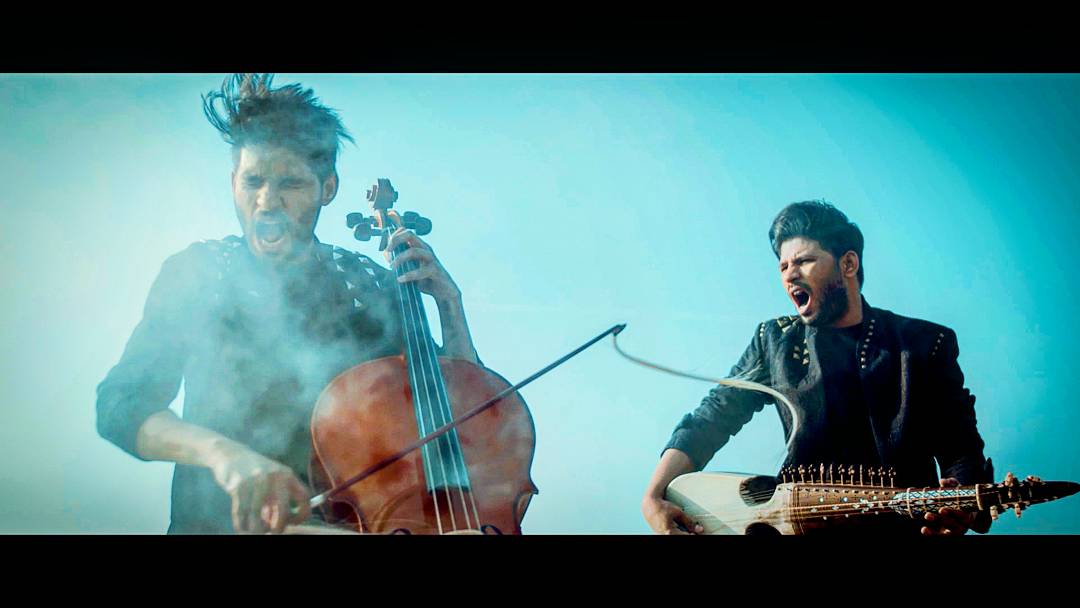
A screengrab from the music video of the track 'Hum Zalmi' featuring Leo Twins.
While Sharoon plays the violin and cello, his twin, Haroon works with other instruments such as the guitar, rubab, tabla, piano, cajon, ukulele, mandolin, darbuka, and more.
Together, they set up Leo Twins, a namesake of their zodiac sign, in their birthplace of Rawalpindi in 2012.
Sharoon credits their success to their “real teacher in music,” Ustad Idrees Ahmed Khan, explaining how a simple gesture of kindness on his part set the tone for their triumphant rise.
“One day, we saw a guitar and violin at a shop, but did not have enough money to buy them. So, we sold our new mobiles and paid for the instruments. Ustaad Idrees Ahmed Khan, who used to give music lessons at the shop, was observing us the whole time, and asked if we would like to learn music from him for free. He said it was because he saw a passion in us for music, which was rare those days, especially in our generation,” Sharoon said.
That was eight years ago, and while they’ve had several hits and misses through the years, they got their first big break in 2015, after featuring alongside music giants, Rahat Fateh Ali Khan and Atif Aslam, as part of their team on Nescafe Basement’s Season 3.
However, nothing compares to the accolades they’ve received for the Ertugrul cover, Sharoon said, with the soundtrack being retweeted by Turkish Deputy Minister Ali Shaheen and several other bloggers in Turkey.
“It has attracted a very different audience. We have been doing covers to pay tribute to our legendary artists for several years now and could only gather 45,000 subscribers. Still, after we uploaded the Ertugrul Ghazi soundtrack, the number of subscribers has crossed 243K. This soundtrack has given us a new breakthrough,” he said.


